


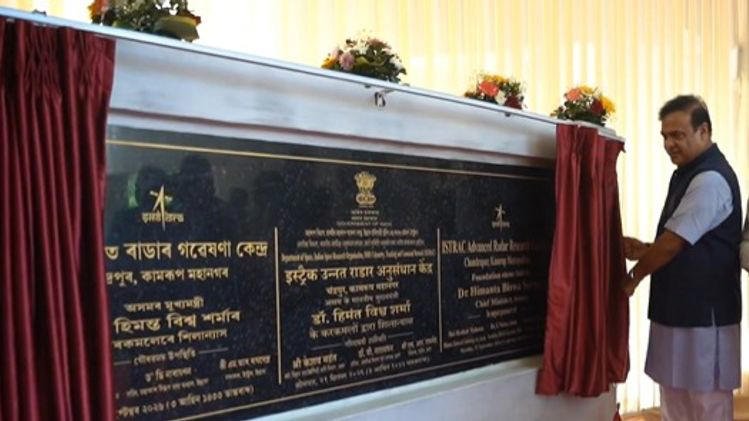
Assam has taken a significant step towards expanding its role in India’s space and scientific research sector. Chief Minister Himanta Biswa Sarma performed the Bhumi Pujan and laid the foundation stone for ISRO’s ISTRAC Advanced Radar Research Facility at Chandrapur in Kamrup Metropolitan district on September 21, 2026.
The Indian Space Research Organisation (ISRO) will develop the facility under its Telemetry, Tracking and Command Network (ISTRAC). The project forms part of the Network for Space Object Tracking and Analysis (NETRA) initiative. The facility will strengthen India’s ability to observe and track objects in space. It will also support the protection of important Indian space assets.
Chandrapur Set to Join India’s Space Research Network
The foundation ceremony marks an important development for Assam’s scientific infrastructure. The new facility will use advanced radar systems and optical telescopes to monitor satellites and other objects in space.
Space Situational Awareness has become increasingly important as more satellites enter orbit. Space agencies need accurate information about the location and movement of satellites, debris and other objects. Such information can help identify possible risks to spacecraft and support safer space operations.
ISRO’s NETRA programme aims to build a wider network of radars and optical telescopes across India. These facilities will collect observations from different locations and help scientists study objects across various orbital regions.
CM Highlights Assam’s Growing Scientific Role
Chief Minister Himanta Biswa Sarma described the project as a new chapter in Assam’s association with India’s space programme. He said the facility would strengthen space science and research in Assam and the Northeast.
The Chief Minister also highlighted the opportunities that the project could create for research, innovation and skill development. He said Assam could benefit from greater interaction between national scientific institutions and educational institutions in the state.
The project could also give students and young researchers greater exposure to advanced technologies. Fields such as astronomy, atmospheric science, radar technology and space science could gain more attention among students in the region.
ISRO Chairman and Secretary of the Department of Space V. Narayanan attended the foundation ceremony along with other officials.
Assam Allocates Land for the ISRO Facility
The Assam government has allocated land at the former Chandrapur Thermal Power Station site for the project. Sarma said the state had allotted around 200 bighas of land to ISRO.
ISRO’s annual report for 2025-26 provides further details about the site. The report says the organisation identified a 67-acre site at Chandrapur for the NETRA radar. It also records that the final registration of the land took place on November 7, 2025.
The use of the former power station site gives the project a new purpose. The location will now support advanced scientific infrastructure instead of its earlier industrial function.
Advanced Radar Will Track Space Objects
The Chandrapur facility will form part of India’s growing space surveillance network. Its radar systems will help ISRO observe objects that orbit Earth.
Radar-based observations can provide important information about the position and movement of space objects. Optical telescopes can add further observations to the tracking network.
Together, these systems can improve the quality of data available to scientists and mission planners. The information can help researchers understand the changing space environment and assess possible risks to satellites.
ISRO has already identified the expansion of radar and optical telescope facilities as an important part of its Space Situational Awareness programme. The organisation uses such systems to monitor space objects and support safe and sustainable use of outer space.
Cloud Research Radar to Support Weather Studies
The Chandrapur project will also have an important atmospheric research component. Sarma said the first cloud research radar at the facility could become operational by February 2027.
The radar will help researchers study clouds and atmospheric conditions. Scientists can use such observations to better understand weather processes and atmospheric phenomena in Assam and the wider Northeast.
The region experiences heavy rainfall and other weather events. Better scientific data could therefore support research into local atmospheric conditions.
The project will not limit its activities to space surveillance. Its research infrastructure can also contribute to a better understanding of the atmosphere and weather systems.
Opportunities for Students and Researchers
The development of the facility could also create new opportunities for Assam’s academic community. The state has several major educational and research institutions, including IIT Guwahati and other universities and colleges.
Sarma has stressed the importance of connecting these institutions with emerging areas of science and technology. Collaboration with ISRO could give students greater access to scientific knowledge and research opportunities.
The facility could also encourage young people to explore careers in space science, engineering, astronomy and related fields. Greater exposure to advanced research may help students understand the practical applications of subjects they study in classrooms.
Such links could also support innovation and encourage young researchers to work on projects connected with India’s expanding space sector.
ISRO and Assam to Strengthen Scientific Collaboration
The Assam government has also sought greater cooperation between ISRO and the state’s upcoming scientific infrastructure. During the event, Sarma invited ISRO to provide technical and scientific support to the Science City at Sonapur.
The proposed collaboration could connect schools, colleges, universities and research institutions with the state’s emerging science facilities. It could also create more opportunities for students to interact with scientists and learn about space technology.
The Chief Minister said such cooperation could help Assam develop a stronger scientific ecosystem. The state government expects the Chandrapur facility to play a role in that process.
Chandrapur’s Strategic Importance
The location of the facility gives Chandrapur an important place in India’s space surveillance plans. ISRO needs observation facilities across different geographical locations to build a broad tracking network.
ISRO has noted that a geographically diverse network of radars and optical telescopes helps provide wider coverage of objects in different orbital regimes. Chandrapur will therefore add another location to this expanding network.
The project also reflects the growing importance of space-based infrastructure in modern society. Satellites support communication, navigation, weather monitoring, disaster management and several other services. Protecting these assets requires accurate information about the space environment.
A New Chapter for Assam’s Science Sector
The foundation stone ceremony at Chandrapur marks the beginning of a major scientific project in Assam. The ISRO Advanced Radar Research Facility will support space object tracking through Project NETRA. Its planned cloud research radar will also expand atmospheric studies in the region.
For Assam, the project offers opportunities beyond the construction of a new research facility. It can strengthen links between ISRO, educational institutions and young researchers. It can also increase exposure to advanced space and radar technologies.
As work progresses, Chandrapur is set to become an important location within India’s growing space research and surveillance infrastructure. The project could further connect Assam with the country’s expanding scientific and technological ecosystem.