


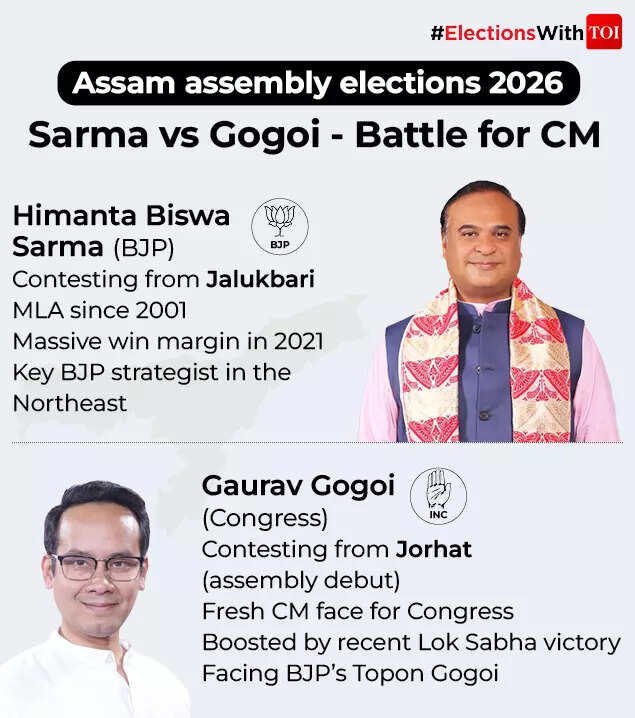
The upcoming Assam Assembly elections 2026 has set the stage for a high-stakes political battle, with Chief Minister Himanta Biswa Sarma seeking to retain power while Congress leader Gaurav Gogoi prepares to play a more prominent role. As the contest intensifies, a SWOT analysis offers deeper insight into the strengths, weaknesses, opportunities, and threats shaping the electoral landscape in Assam.
Read More: Tripura Food Minister Assures Adequate Fuel Supply Across State
Strengths of Himanta Biswa Sarma and BJP
Himanta Biswa Sarma enters the election with strong political capital. Over the past few years, his government has focused on infrastructure development, improved connectivity, and investment promotion. Consequently, many voters associate his leadership with visible progress.
Another major strength lies in organizational efficiency. The Bharatiya Janata Party maintains a well-structured grassroots network across Assam. This network allows the party to mobilize voters effectively during elections.
Moreover, Sarma’s image as a decisive leader has helped him build credibility. His ability to manage law and order and push administrative reforms strengthens his appeal among a wide section of voters.
Additionally, the BJP benefits from support at the central level. Coordination with the Union government has enabled faster execution of projects and policy alignment.
Weaknesses Facing the Incumbent Government
Despite its strengths, the BJP faces certain challenges. Issues such as unemployment and rising prices have drawn criticism from opposition parties. These concerns may influence voter sentiment, especially among youth.
Internal dissent also poses a risk. In several constituencies, rebel candidates and factionalism could split votes. As seen in some regions, ticket distribution has not satisfied all party members.
Furthermore, anti-incumbency remains a natural factor after years in power. Some voters may seek change, particularly in areas where development has not met expectations.
The government must also address concerns related to social harmony. While peace efforts have made progress, sporadic tensions continue to challenge stability.
Opportunities for BJP in 2026 Elections
The BJP has significant opportunities to consolidate its position. First, its development narrative continues to resonate with voters. Projects related to roads, healthcare, and education provide tangible evidence of governance.
Second, the party can leverage welfare schemes to strengthen its voter base. Direct benefit programs and targeted initiatives have improved outreach among economically weaker sections.
Additionally, a fragmented opposition could work in BJP’s favor. If opposition parties fail to present a united front, the ruling party may benefit from divided votes.
The BJP can also capitalize on its strong campaign machinery. With experienced leadership and effective communication strategies, it can shape the electoral narrative.
Threats to BJP’s Electoral Prospects
However, the BJP faces growing competition from the Indian National Congress and regional players. A united opposition could pose a serious challenge.
Gaurav Gogoi’s increasing visibility adds another layer of complexity. As a relatively young and dynamic leader, he has the potential to attract new voters, especially among youth and urban populations.
Moreover, local issues such as land rights, identity politics, and economic disparities could influence voting patterns. Opposition parties may use these issues to challenge the BJP’s governance record.
The presence of rebel candidates and independent contenders could further complicate electoral dynamics by splitting traditional vote banks.
Strengths of Gaurav Gogoi and Congress
Gaurav Gogoi represents a new generation of leadership within the Congress. His clean image and articulate communication style have helped him connect with diverse audiences.
The Congress aims to position him as a credible alternative to the incumbent leadership. By focusing on issues such as unemployment and economic challenges, the party seeks to gain traction among dissatisfied voters.
Additionally, the Congress has been working to rebuild its organizational structure in Assam. Efforts to strengthen grassroots presence could improve its performance in key constituencies.
Gogoi’s appeal among younger voters may also play a crucial role in shaping the election outcome.
Weaknesses of Congress in Assam
Despite these strengths, the Congress faces several hurdles. Organizational weaknesses and lack of consistent leadership in the past have affected its performance.
The party also struggles with internal divisions in some regions. Without a unified strategy, it may find it difficult to counter the BJP’s well-organized campaign.
Moreover, the Congress must overcome the perception of being less effective in governance compared to the incumbent. Convincing voters to shift allegiance will require a strong and clear narrative.
Opportunities for Congress and Opposition
The 2026 elections present an opportunity for the Congress to stage a comeback. Anti-incumbency sentiment, if it grows stronger, could work in its favor.
Building alliances with regional parties could significantly improve its chances. A united opposition front would increase competitiveness in multiple constituencies.
Furthermore, focusing on local issues and grassroots engagement can help the Congress connect with voters more effectively.
Gaurav Gogoi’s leadership provides a fresh opportunity to rebrand the party and attract new support.
Threats Facing the Opposition
The biggest threat to the opposition remains fragmentation. Multiple parties competing against each other could divide votes and weaken their overall impact.
Additionally, the BJP’s strong organizational network and resources pose a significant challenge. Matching the scale and intensity of the BJP’s campaign will not be easy.
The opposition must also address internal conflicts and present a cohesive vision. Without unity, their chances of success may diminish.
Conclusion
The Assam Assembly elections 2026 promises to be a closely contested battle between Himanta Biswa Sarma’s leadership and the emerging challenge led by Gaurav Gogoi. While the BJP relies on its development record and organizational strength, the Congress seeks to capitalize on anti-incumbency and present a fresh alternative.
The outcome will depend on several factors, including voter sentiment, alliance strategies, and campaign effectiveness. As the political landscape evolves, the SWOT analysis highlights both opportunities and risks for all players.
Ultimately, the election will determine whether Sarma retains power or Gogoi’s rise marks a turning point in Assam’s political trajectory.
Read More: Tipra Motha rules out alliances ahead of ADC elections