


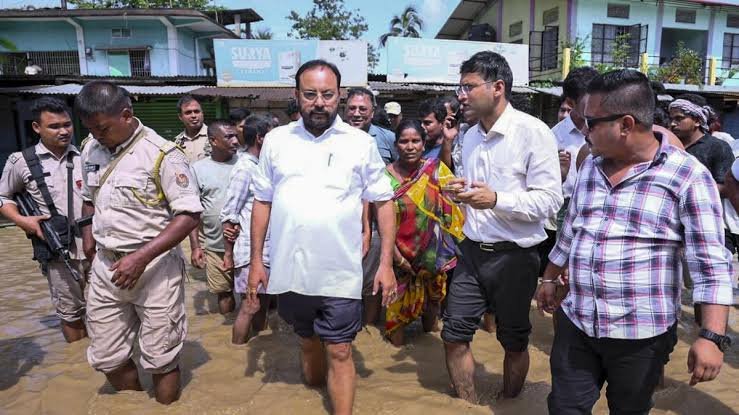
Assam’s flood crisis has triggered a fresh political storm after the official casualty figure reached 95, intensifying debate over disaster preparedness, relief operations, infrastructure, and government accountability. Floodwaters have disrupted communities across the state, while authorities continue rescue and relief efforts.
The rising casualty figure has increased pressure on the Assam government to explain its response and strengthen assistance for affected families. Moreover, opposition leaders have used the crisis to question flood-control measures and the administration’s preparedness for recurring emergencies.
However, the humanitarian situation remains the immediate priority. Authorities must continue rescue operations, maintain relief camps, provide essential supplies, and support families affected by deaths, displacement, and property losses.
Sivasagar Relief Camps Scrutinised After Assam Flood Toll Touches 95
Assam Flood Crisis Intensifies Political Pressure
The reported toll of 95 has made the flood crisis a major political issue in Assam.
Government agencies face the difficult task of coordinating rescue operations across affected districts. Furthermore, officials must manage relief camps, food distribution, healthcare, drinking water, sanitation, and transportation at the same time.
The scale of the emergency has consequently increased scrutiny of administrative preparedness.
However, flood conditions can change rapidly, and casualty figures may undergo further verification as authorities assess affected areas.
Opposition Questions Government Response
Opposition leaders have raised questions about the government’s handling of the floods.
Their concerns can include relief distribution, infrastructure maintenance, flood-control measures, and compensation for affected families. Moreover, opposition parties can use visits to affected areas to highlight problems reported by residents.
Such political scrutiny can increase pressure on the administration.
However, individual complaints do not necessarily reflect conditions across all affected districts.
Relief Camps Become Key Focus
Relief camps have become crucial for families forced to leave flooded homes.
Authorities need to provide adequate shelter, food, clean drinking water, medicines, sanitation facilities, and other essential supplies. Additionally, officials must monitor camp populations and identify residents who need specialised assistance.
Effective camp management can reduce hardship during prolonged displacement.
However, camp conditions can vary depending on location, population, and access to supplies.
Sivasagar Faces Relief Challenges
Sivasagar has received particular attention as flood-affected residents seek temporary shelter and assistance.
Local authorities and relief agencies need to coordinate food distribution, healthcare, sanitation, and transportation. Furthermore, changing flood conditions can force officials to adjust evacuation and shelter arrangements.
The district’s response therefore forms part of the wider state-level flood management effort.
However, local assessments remain necessary to understand the needs of individual communities.
Infrastructure Comes Under Scrutiny
The floods have renewed questions about Assam’s infrastructure resilience.
Roads, bridges, drainage networks, and embankments can influence how quickly communities become isolated during severe flooding. Moreover, damage to transport links can delay rescue teams and prevent essential supplies from reaching affected areas.
The crisis could therefore intensify demands for stronger infrastructure.
However, exceptionally severe rainfall can overwhelm infrastructure even when authorities maintain existing systems.
Agriculture Suffers Major Disruption
Flooding has also placed pressure on Assam’s agricultural communities.
Farmers can lose crops, livestock, stored produce, and access to farmland. Additionally, prolonged waterlogging can delay agricultural activity and increase recovery costs for rural households.
These losses can create long-term economic consequences.
However, authorities usually need detailed assessments before determining the full scale of agricultural damage and eligible compensation.
Death Toll Raises Public Concern
A casualty figure of 95 has intensified concern among residents across the state.
Every additional death increases pressure on authorities to improve evacuation, early-warning systems, and emergency response. Furthermore, families affected by fatalities may require financial and administrative support.
The human cost has consequently become central to the public debate.
However, officials must continue verifying casualty information to maintain accurate records.
Flood Preparedness Faces Questions
Assam experiences recurring floods, making preparedness a long-standing political issue.
Governments face demands to strengthen embankments, drainage systems, early-warning networks, evacuation plans, and community preparedness. Moreover, long-term flood management requires coordination between state agencies, district administrations, and local communities.
The current crisis could renew calls for comprehensive planning.
However, durable improvements require sustained investment rather than short-term emergency measures alone.
Healthcare and Sanitation Need Attention
Flood conditions can create additional health risks.
Authorities must maintain access to medicines, healthcare workers, clean water, and sanitation facilities in affected communities and relief camps. Furthermore, stagnant water and overcrowded shelters can increase pressure on public-health systems.
Early intervention can reduce preventable health problems.
However, healthcare requirements differ across affected locations and can change as flooding continues.
Displaced Families Need Long-Term Support
Emergency shelter represents only the first stage of recovery.
Families may need assistance repairing or rebuilding homes, replacing damaged belongings, and restoring livelihoods. Moreover, farmers may require support after losing crops and livestock.
Rehabilitation can therefore remain a political issue long after floodwaters recede.
However, the scope of assistance depends on official damage assessments and applicable government relief rules.
Political Allegations Add Tension
The flood crisis has also produced sharper political exchanges.
Opposition leaders have accused the government of failing to address underlying flood-management problems, while government representatives can point to rescue and relief measures. Additionally, individual political leaders have made allegations concerning governance and public spending.
These disputes have intensified the political atmosphere.
However, allegations of wrongdoing require evidence and appropriate investigation before authorities can establish responsibility.
Civil Society Supports Relief Efforts
Community organisations and volunteers continue to play an important role during emergencies.
They can distribute supplies, assist vulnerable residents, and communicate local needs to authorities. Furthermore, local organisations often possess detailed knowledge of affected communities and difficult-to-reach areas.
Their support can strengthen emergency operations.
However, relief efforts work best when community groups coordinate with official disaster-response systems.
Weather Remains a Critical Factor
Further rainfall could complicate Assam’s recovery.
Additional precipitation can raise water levels, prolong displacement, and damage already weakened infrastructure. Moreover, changing weather conditions can force authorities to revise evacuation and relief plans.
Weather monitoring therefore remains essential.
However, residents should rely on verified government warnings rather than unconfirmed information circulating online.
Compensation Could Shape Public Sentiment
Affected families are likely to seek compensation and rehabilitation assistance.
Government support may cover eligible losses involving homes, agriculture, livestock, or other assets. Additionally, authorities may face pressure to process applications quickly and communicate eligibility requirements clearly.
Efficient compensation can help affected communities begin recovery.
However, compensation decisions generally depend on official assessments and established relief guidelines.
Flood Management Returns to Political Agenda
The crisis has once again placed long-term flood management at the centre of Assam’s political debate.
Discussions may focus on embankment maintenance, river management, drainage, wetland protection, flood forecasting, and resilient infrastructure. Furthermore, policymakers may face demands to connect emergency response with long-term disaster planning.
The issue could remain politically important beyond the current emergency.
However, meaningful flood-risk reduction requires sustained implementation across multiple years.
Election Impact Remains Uncertain
The political consequences of the floods will depend partly on how affected communities assess the government’s response.
Timely relief, effective rehabilitation, and visible infrastructure improvements could strengthen public confidence. Conversely, prolonged shortages, delayed assistance, or unresolved grievances could provide opposition parties with stronger criticism.
Public opinion may therefore evolve throughout the recovery process.
However, the current crisis alone cannot determine future electoral outcomes.
Conclusion
The Assam flood crisis, with the official casualty figure reaching 95, has intensified both humanitarian concerns and political debate across the state. Relief operations, infrastructure resilience, agricultural losses, compensation, and disaster preparedness have all come under greater scrutiny.
Moreover, the political storm will depend heavily on how authorities manage the recovery phase. Effective relief and transparent rehabilitation could help rebuild public confidence, while unresolved concerns could deepen opposition criticism.
Overall, Assam’s latest flood emergency has once again demonstrated the political importance of disaster management. The government’s ability to protect affected communities, deliver timely assistance, and address long-term flood risks will remain central to the state’s public debate.
FAQs
1. What is the current official Assam flood casualty figure?
The official casualty figure referenced in this report has reached 95.
2. Why have the floods become a political issue?
The crisis has raised questions about disaster preparedness, relief distribution, infrastructure, compensation, and government accountability.
3. What support do relief camps provide?
Relief camps can provide temporary shelter, food, drinking water, healthcare, sanitation, and assistance for displaced families.
4. What long-term flood issues face Assam?
Key issues include embankment maintenance, drainage, river management, early-warning systems, infrastructure resilience, and agricultural recovery.
5. Could the floods affect Assam’s politics?
The crisis could influence public opinion depending on the government’s relief and rehabilitation performance. However, its eventual electoral impact remains uncertain.