


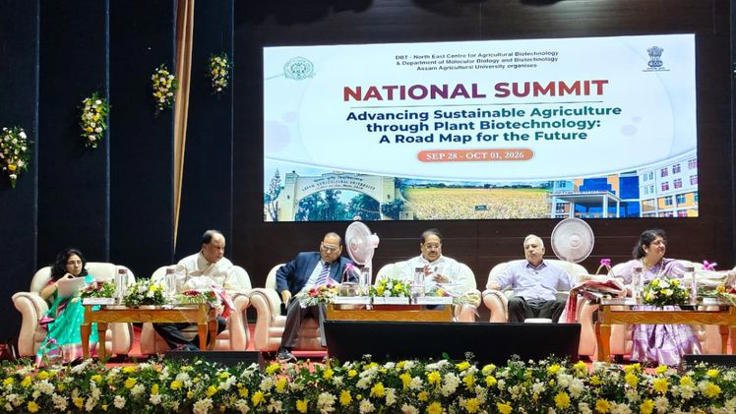
Assam has hosted a national summit focused on the role of plant biotechnology in sustainable agriculture. The event brought together scientists, researchers, policymakers and industry representatives to discuss new approaches to crop improvement and food security.
The summit focused on how biotechnology can support farmers while addressing climate change, resource shortages and rising food demand. Participants discussed scientific developments that could help create more resilient and productive agricultural systems.
The event also highlighted the need to connect scientific research with practical solutions for farmers.
Plant biotechnology takes centre stage
Plant biotechnology uses scientific techniques to improve crops and develop useful agricultural traits. Researchers can use these technologies to study plant characteristics and support the development of varieties with improved productivity or resistance.
During the summit, experts discussed the potential of biotechnology to address several challenges facing modern agriculture.
These challenges include changing weather patterns, soil degradation, water shortages and the emergence of pests and diseases. Therefore, researchers are exploring technologies that can help crops adapt to changing environmental conditions.
Focus on climate-resilient crops
Climate change has created additional challenges for farmers across India. Changes in rainfall patterns, rising temperatures and extreme weather events can affect crop productivity.
The summit placed emphasis on developing climate-resilient agricultural systems. Scientists discussed crop varieties that can perform better under environmental stress.
Such research could support farmers in regions that regularly face floods, droughts or other weather-related challenges.
Assam has particular relevance in this discussion. The state faces recurring floods that can significantly affect agricultural production and rural livelihoods.
Assam’s agricultural challenges
Agriculture remains an important part of Assam’s rural economy. However, farmers face several challenges related to flooding, land conditions, pests and access to modern technology.
Plant biotechnology could provide additional tools for addressing some of these challenges. Researchers can focus on crop varieties that tolerate specific environmental stresses.
At the same time, experts emphasised that biotechnology must work alongside conventional farming knowledge and sustainable agricultural practices.
The combination of scientific research and local agricultural experience can help develop solutions suited to regional conditions.
Scientists discuss crop improvement
Crop improvement remained one of the key themes at the summit. Scientists are exploring different technologies to improve crop characteristics and strengthen agricultural productivity.
Plant biotechnology can support research into traits such as disease resistance, nutritional quality and tolerance to environmental stress.
However, researchers also need to evaluate the safety, effectiveness and suitability of new technologies before farmers adopt them on a wider scale.
The summit provided a platform for experts to discuss these scientific and practical considerations.
Technology and food security
India’s growing population has increased the importance of food security. Agricultural production must meet rising demand while natural resources remain under pressure.
Participants discussed how biotechnology could contribute to this challenge. Improved crops could potentially help farmers produce more from available land and resources.
At the same time, sustainable agriculture requires efficient use of water, soil and other natural resources.
Therefore, experts highlighted the importance of developing technologies that improve productivity without placing additional pressure on the environment.
Connecting research with farmers
One of the key challenges in agricultural biotechnology is taking scientific research from laboratories to farms.
Researchers may develop promising technologies, but farmers need affordable and practical solutions. Extension services and training can help farmers understand new agricultural practices.
The summit therefore stressed the importance of cooperation between scientists, government agencies, agricultural institutions and farmers.
Such collaboration can help ensure that research addresses real agricultural problems.
Opportunities for Northeast India
The summit also highlighted the potential of agricultural biotechnology in the Northeast.
The region has diverse climatic conditions and a wide range of crops. However, farmers often face challenges related to infrastructure, transportation and access to modern agricultural technologies.
New crop technologies could support agricultural development if researchers adapt them to local conditions.
Improved crop varieties could also create opportunities for higher productivity and better resilience against climate-related risks.
Sustainable agriculture remains a priority
Plant biotechnology represents only one part of the broader transition towards sustainable agriculture.
Experts also emphasised the importance of soil health, water conservation, biodiversity and responsible farming practices. Technology can complement these approaches rather than replace them.
A sustainable agricultural system needs to balance productivity with environmental protection.
The summit’s discussions therefore focused on using biotechnology responsibly and integrating scientific advances with sustainable farming methods.
Assam emerges as a platform for agricultural innovation
By hosting the national summit, Assam provided a platform for discussion on the future of agricultural biotechnology in India.
The event brought attention to the role of science in addressing challenges such as climate change, food security and crop productivity.
For Assam and the wider Northeast, the discussions could encourage greater cooperation between agricultural researchers and local farming communities.
The focus on sustainable agriculture through plant biotechnology also reflects a broader effort to develop farming systems that can respond to changing environmental and economic conditions.
As India looks towards the next generation of agriculture, continued research, responsible technology adoption and stronger connections between scientists and farmers will remain important for building a resilient food system.