


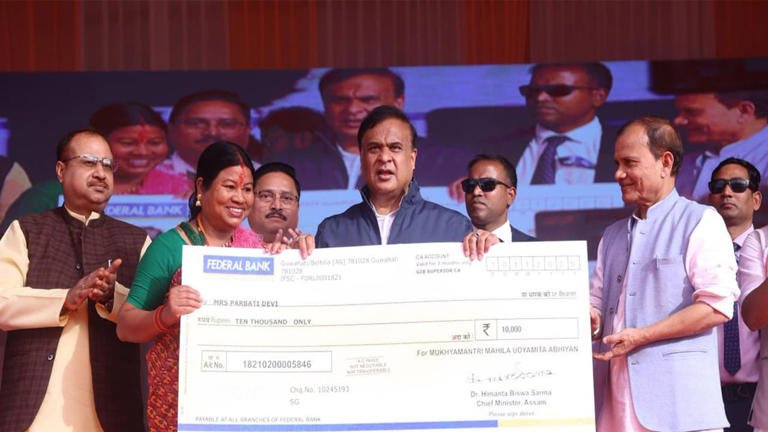
The Government of Assam has achieved a significant milestone in women’s empowerment. Recently, official reports confirmed that over 70,000 women get seed capital under MMUA scheme (Mukhya Mantri Mahila Udyamita Abhiyan). This ambitious project aims to transform members of Self-Help Groups (SHGs) into independent business owners. By providing direct financial support, the state is paving the way for a new era of economic stability in rural households.
Chief Minister Himanta Biswa Sarma has often highlighted that the goal is to create “Lakhpati Baideus” (millionaire sisters). This vision is becoming a reality as more women get seed capital under MMUA scheme to launch their own micro-enterprises. Consequently, these women are no longer just homemakers; they are becoming the primary breadwinners for their families.
Read More: Tripura CM: Practical Education Through Modern Technology is Key
The Vision Behind the MMUA Initiative
The Mukhya Mantri Mahila Udyamita Abhiyan was designed to bridge the gap between traditional labor and modern entrepreneurship. For a long time, rural women lacked the initial funds required to start a trade. However, when these 70,000 women get seed capital under MMUA scheme, they receive the essential “push” needed to buy equipment or raw materials. Therefore, the scheme acts as a catalyst for local economic growth.
Moreover, the program is structured in phases to ensure long-term success. In the first phase, eligible women receive a grant of Rs 10,000. If they utilize this amount properly and meet specific criteria, they become eligible for further loans and subsidies. This tiered approach ensures that those who get seed capital under MMUA scheme remain motivated to scale their businesses sustainably.
Criteria for Success and Social Reform
Interestingly, the MMUA scheme is not just about finance; it also promotes social responsibility. To get seed capital under MMUA scheme, beneficiaries must comply with certain conditions. For instance, they must ensure their daughters are enrolled in school and that they do not violate the state’s policies regarding the age of marriage. Thus, the government is using economic incentives to drive positive social change across the state.
Additionally, the scheme requires participants to have a business plan. Whether it is poultry farming, tailoring, or food processing, the focus is on viability. Because the women get seed capital under MMUA scheme, they are also provided with basic training in bookkeeping and marketing. This holistic support system reduces the risk of business failure and builds confidence among rural entrepreneurs.
Strengthening the Rural Economy
The impact of this scheme is already visible in the local markets of Assam. As thousands of women get seed capital under MMUA scheme, the production of indigenous goods has seen a sharp rise. From handloom products to organic pickles, the “Vocal for Local” movement is gaining massive momentum. Furthermore, this surge in local production reduces the state’s dependency on imported goods from other regions.
Small-scale industries are the backbone of any developing economy. By ensuring that 70,000 women get seed capital under MMUA scheme, the government is effectively creating thousands of mini-factories in every village. This decentralization of wealth is crucial for the balanced development of Upper and Lower Assam alike. As a result, the rural-urban economic divide is slowly beginning to narrow.
Administrative Efficiency and Digital Transparency
One of the highlights of this mission is the transparent manner in which the funds are distributed. To ensure that every deserving woman can get seed capital under MMUA scheme, the government utilized a digital application process. This minimized the influence of middlemen and ensured that the money reached the beneficiaries’ bank accounts directly via Direct Benefit Transfer (DBT).
Furthermore, the state’s administrative machinery worked tirelessly to verify applications and provide technical assistance. The Chief Secretary has noted that the success of the MMUA is a testament to the synergy between various departments. Because the process is monitored closely, the likelihood of funds being misused is very low. This transparency encourages more women to step forward and apply for future phases of the project.
Conclusion: A Brighter Future for Assam’s Women
The news that over 70,000 women get seed capital under MMUA scheme is just the beginning of a larger movement. As these businesses grow, they will create more jobs within the villages, leading to a self-reliant Assam. The Chief Minister’s commitment to creating 40 lakh “Lakhpati Baideus” is a bold step toward making Assam one of the top five states in India.
Ultimately, financial independence is the most powerful tool for gender equality. When women get seed capital under MMUA scheme, they gain the power to make decisions for their families and communities. This initiative is a shining example of how targeted welfare schemes can produce lasting economic and social benefits. With continued support, the women of Assam are set to lead the state’s journey toward Viksit Bharat.
Read More: Jindal Seeks Satellite Station for Kurukshetra