


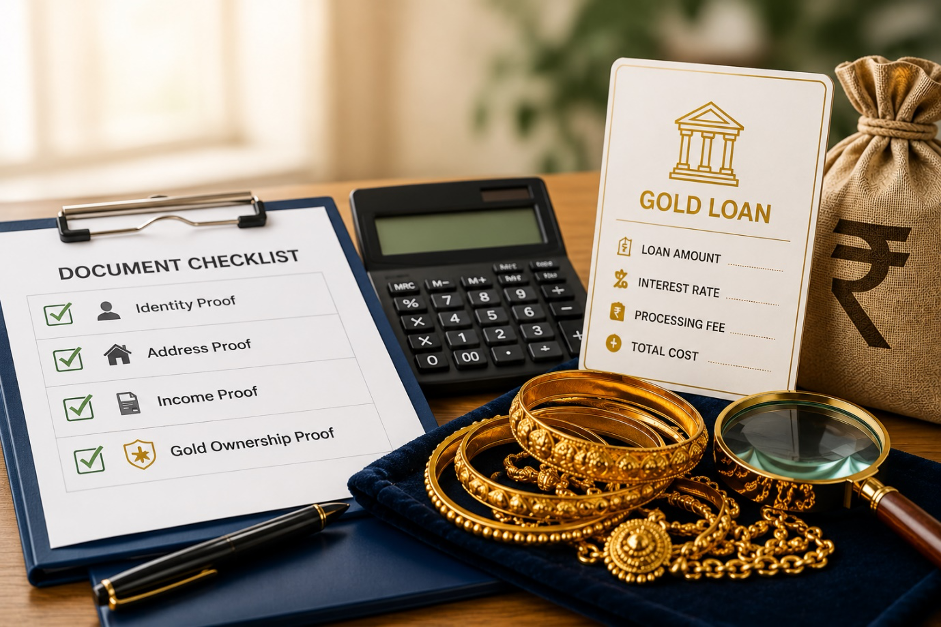
Most people walk into a gold loan thinking it’s the simplest borrowing option available. You bring your gold, the lender appraises it, and you walk out with cash. That’s the broad idea, and it’s not wrong. But the moment you try to estimate what this loan will actually cost you, a surprising bottleneck appears: your documents. Getting your paperwork sorted before you start calculating loan costs isn’t just good practice. It changes the numbers you’re working with.
Why Documents Come Before Calculations
There’s a tempting urge to jump straight into figuring out interest rates and repayment amounts. I get it. You want to know the bottom line. But the cost of a gold loan depends on several factors that are directly tied to the information in your documents. Your identity proof determines your eligibility with a particular lender. Your address proof can influence which branch processes your loan and what rate tier you fall into. Your income documentation, when applicable, affects the loan-to-value ratio some lenders are willing to offer.
If you start estimating costs without confirming what documents you have and whether they’re current, you’re building on guesswork. And guesswork with money tends to be expensive.
The Baseline Set of Gold Loan Documents
Every lender in India requires a standard set of identity and address proofs. Your Aadhaar card, PAN card, voter ID, or passport will usually cover the identity requirement. For address verification, a utility bill, ration card, or the Aadhaar itself typically works. Some lenders also ask for a recent passport-sized photograph.
What catches people off guard is the validity and consistency requirement. If your Aadhaar shows one address and your utility bill shows another, you’ll face delays or even a different rate structure because the lender’s risk assessment changes. Keeping your gold loan documents updated and mutually consistent before you approach any lender saves real time and prevents unpleasant cost surprises at the disbursement stage.
Banks and non-banking financial companies sometimes have slightly different documentation expectations. A nationalized bank might require income proof even for a gold loan below a certain threshold, while an NBFC might skip that requirement entirely. These differences affect your total cost because they influence processing fees, interest rates, and turnaround times.
How Document Status Directly Affects Loan Cost
Here’s where it gets practical. Lenders price risk. A borrower who presents clean, consistent, and complete documentation is a lower-risk customer. Lower risk often translates to a better interest rate, even if the difference is only a quarter of a percentage point. On a loan of two or three lakhs repaid over twelve months, that fraction adds up.
Processing fees are another area where document readiness matters. When your paperwork is incomplete, some lenders charge higher processing fees to account for the additional verification work. Others simply reject the application, pushing you to a lender with higher base rates. Either way, the cost goes up because your documents weren’t ready.
There’s also the time factor. A delayed gold loan means you might miss the financial window you were trying to hit, whether that’s a medical expense, a business opportunity, or an education payment. The indirect cost of document delays is harder to quantify but very real.
Getting Accurate Cost Estimates
Once your documents are in order, you’re in a position to get reliable cost projections. This is the right time to use a gold loan interest calculator, not before. These tools ask you to input a loan amount, tenure, and interest rate. The output is only as good as the inputs you provide. If you don’t know your actual eligible interest rate because your documents haven’t been verified, the calculator gives you a number that may be significantly off.
The gold purity, weight, and current market rate determine how much you can borrow. But the interest rate, processing fee, and any applicable charges are shaped partly by your borrower profile, which is established through your documents. So the sequence matters: documents first, then calculator, then decision.
Common Mistakes That Inflate Costs
One frequent error is assuming that gold loan documentation is identical across lenders. It isn’t. Banks regulated by the Reserve Bank of India follow one set of norms, while NBFCs operate under slightly different guidelines. Applying to multiple lenders with the same incomplete document set wastes time and can result in multiple hard inquiries on your credit report if the lender checks it.
Another mistake is photocopying old documents without checking expiry dates. A passport that expired six months ago won’t be accepted as valid identity proof by most lenders, even though the information on it is still accurate.
People also overlook the fact that joint applications require documentation for all applicants. If you’re applying with a family member, both sets of documents need to be current and consistent.
The Practical Takeaway
Treat your documents like the foundation of your loan cost estimate. Gather them, verify their validity, and confirm they match each other before you sit down to calculate anything. The fifteen minutes you spend organizing paperwork can save you from paying a higher rate, dealing with processing delays, or getting locked into a lender who wasn’t your best option. Gold loans are fast and flexible, but only when you arrive prepared. The gold sits in the vault either way. Your job is to make sure everything around it is already sorted.