


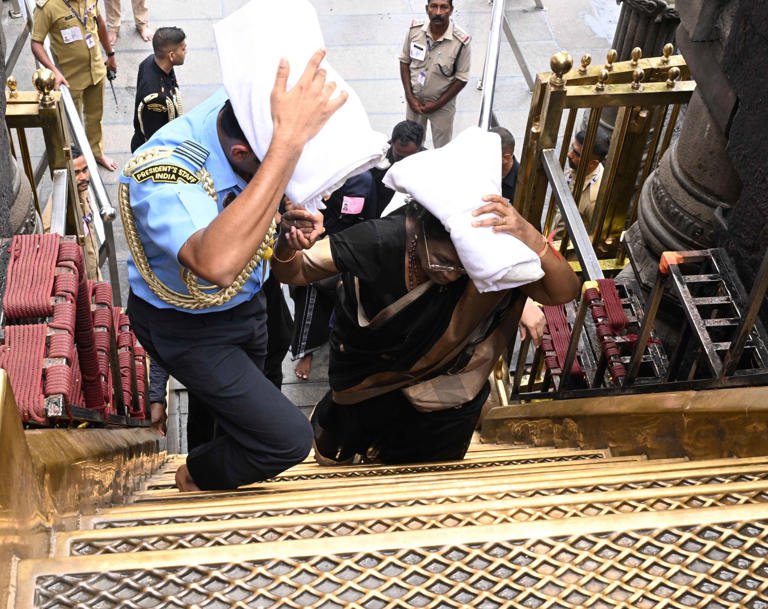
President Droupadi Murmu visited the renowned Sabarimala Temple in Kerala, becoming the first woman President of India to offer prayers at the hill shrine. Her visit marked a significant moment not only for the temple’s long and complex history but also for the broader conversation about faith, gender, and inclusion in India’s religious landscape.
Read More: Tripura Civil Society Calls Bandh Over Tiprasa Accord, Infiltration
A Historic Visit to Sabarimala
The Droupadi Murmu prays at Sabarimala visit took place under tight security and careful coordination between the Kerala government and the Travancore Devaswom Board. The President, who arrived in Kerala for a three-day official tour, made her way to the temple early in the morning, following the traditional path and rituals associated with the pilgrimage.
Wearing a simple traditional Kerala saree, President Murmu climbed the sacred hill to reach the Sannidhanam (main temple complex). She was accompanied by officials from the President’s office, the Kerala Governor Arif Mohammed Khan, and state representatives. Upon arrival, she performed the customary rituals, offering prayers to Lord Ayyappa — the presiding deity of Sabarimala.
Her visit has been described by officials as a personal act of devotion. However, it carries a strong message of equality and faith in the face of historical restrictions and debates surrounding women’s entry into the shrine.
The Significance of Droupadi Murmu’s Visit
The Droupadi Murmu prays at Sabarimala moment has drawn national attention for its social and cultural implications. Sabarimala has long been a site of religious debate due to restrictions placed on women of menstruating age. While President Murmu’s visit followed temple customs, it also underscored how India’s highest constitutional office embodies inclusivity and spiritual freedom.
As the first tribal and second woman President of India, Murmu’s journey to Sabarimala symbolizes both reverence and progress. Her respectful adherence to tradition while representing modern leadership reflects a balanced vision of India’s evolving spiritual identity.
Political analysts and cultural observers have noted that the President’s visit has opened a broader conversation about women’s participation in religious spaces. “Her act is not political—it’s historical,” said sociologist Dr. Mini Menon. “It shows that devotion can coexist with dignity and constitutional equality.”
Smooth Coordination and Devotee Reactions
The Travancore Devaswom Board made elaborate arrangements to facilitate the visit. The temple remained closed to regular devotees for a brief period during the President’s prayers, ensuring smooth proceedings without disrupting traditional activities.
Many pilgrims expressed joy at witnessing the event, calling it a proud moment for both Kerala and the nation. “To see the President of India walking the same sacred path as us was emotional,” said Ramesh Nair, a devotee from Kottayam. “It shows that faith unites everyone, regardless of position.”
Local authorities ensured that all rituals were conducted according to temple guidelines. Sources confirmed that the President also donated to the temple trust, supporting ongoing conservation and pilgrim welfare projects.
Sabarimala: A Temple of Faith and Controversy
The Droupadi Murmu prays at Sabarimala visit comes years after the 2018 Supreme Court verdict that allowed women of all ages to enter the temple, sparking nationwide debates and protests. Although the verdict remains in effect, its implementation has been met with challenges and continued discussions over tradition versus equality.
President Murmu’s visit, therefore, holds a unique position in history—it demonstrates respect for faith while promoting a message of unity. It shows that reverence for divine traditions can go hand in hand with modern democratic values.
Religious scholars observed that her visit was conducted with utmost adherence to temple customs, ensuring that spiritual sentiments were honored. “Her approach was humble and deeply spiritual,” said a temple priest. “She showed that faith transcends gender or position.”
A Message of Equality and Harmony
The President’s visit also reflects India’s growing narrative of inclusivity in cultural and religious spheres. As a tribal woman who rose to the nation’s highest office, Murmu’s journey represents perseverance, devotion, and empowerment.
Her prayer at Sabarimala highlights the harmony between individual belief and institutional tradition. It demonstrates that India’s strength lies in its ability to honor faith while embracing diversity.
Political leaders across party lines praised the President for the dignified and respectful manner of her visit. Kerala Chief Minister Pinarayi Vijayan welcomed her gesture, calling it “a moment of pride for the people of Kerala.”
Renewed Interest in Pilgrimage Tourism
The Droupadi Murmu prays at Sabarimala event has renewed interest in Kerala’s pilgrimage tourism sector. Officials from the state tourism department said that the President’s visit would encourage devotees across India to explore Sabarimala with greater respect and curiosity.
The state government plans to improve infrastructure along the pilgrimage route, ensuring better facilities for visitors. Tourism experts believe that Murmu’s visit could help project Kerala as a global example of inclusive spirituality.
Local businesses and community members near Sabarimala welcomed the development, saying it brought renewed attention to the area’s cultural significance. Many believe it will inspire more women pilgrims to participate respectfully in traditional practices.
A Moment That Redefines Faith
President Droupadi Murmu’s act of devotion has set a new precedent in India’s cultural and religious history. The Droupadi Murmu prays at Sabarimala visit will be remembered not just as a spiritual milestone but also as a gesture that bridged faith, leadership, and equality.
Her serene composure and quiet devotion reflected a deep message—spirituality in India belongs to everyone. As she left the temple, temple bells rang and devotees chanted “Swamiye Saranam Ayyappa,” echoing through the hills of Sabarimala, marking a morning that will remain etched in history.
With this visit, Droupadi Murmu has shown that faith, when guided by respect and humility, can transcend every barrier. Her prayer at Sabarimala stands as a reminder that India’s soul lies in unity, where tradition and transformation walk hand in hand.
Read More: Eco-Tourism In Guwahati: The Future Of Sustainable Travel