


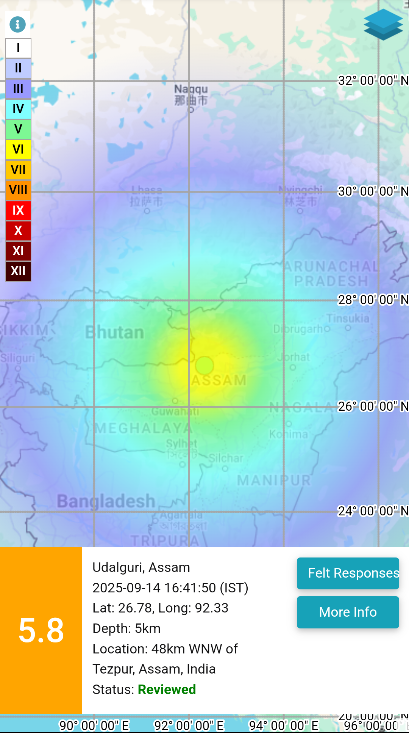
An earthquake measuring 5.8 on the Richter scale jolted Assam on Sunday afternoon, sending tremors across several northeastern states, including Meghalaya, Nagaland, and Tripura.
According to the National Center for Seismology (NCS), the quake was recorded at 4:41 pm with its epicentre in Assam’s Udalguri district. The seismic activity was located at latitude 26.78°N and longitude 92.33°E, at a shallow depth of just 5 km, which amplified the impact of the tremors across the region.
Soon after the initial quake, two aftershocks were reported in quick succession. The first aftershock, recorded at 4:58 pm in Udalguri district, measured 3.1 magnitude. It occurred at latitude 26.80°N and longitude 92.33°E, with a depth of 5 km. The second aftershock, with a magnitude of 2.9, was registered at 5:21 pm in Sonitpur district at latitude 26.81°N and longitude 92.33°E, also at a depth of 5 km.
Residents across Assam and neighboring states reported strong vibrations that caused panic in many areas. Although no immediate reports of casualties or major damage have surfaced, authorities have urged people to remain alert due to the possibility of further seismic activity.
Union Minister and former Assam Chief Minister Sarbananda Sonowal expressed concern through a social media post. He wrote, “Major earthquake in Assam. My prayers for everyone’s safety and well-being. Urge all to stay alert!” His message echoed the sentiments of thousands who experienced the tremors.
The northeastern region of India falls under a high seismic zone, making it prone to frequent earthquakes. Experts highlight that shallow quakes, like the one recorded in Udalguri, tend to be felt more intensely across wider areas despite their moderate magnitude.
Officials have confirmed that monitoring will continue closely in the coming hours. Disaster response teams remain on standby, while residents are being advised to follow safety protocols and avoid unnecessary panic.
This earthquake once again highlights the vulnerability of the northeastern states to seismic disturbances. The National Center for Seismology has assured continuous updates for public awareness and preparedness in the region.