


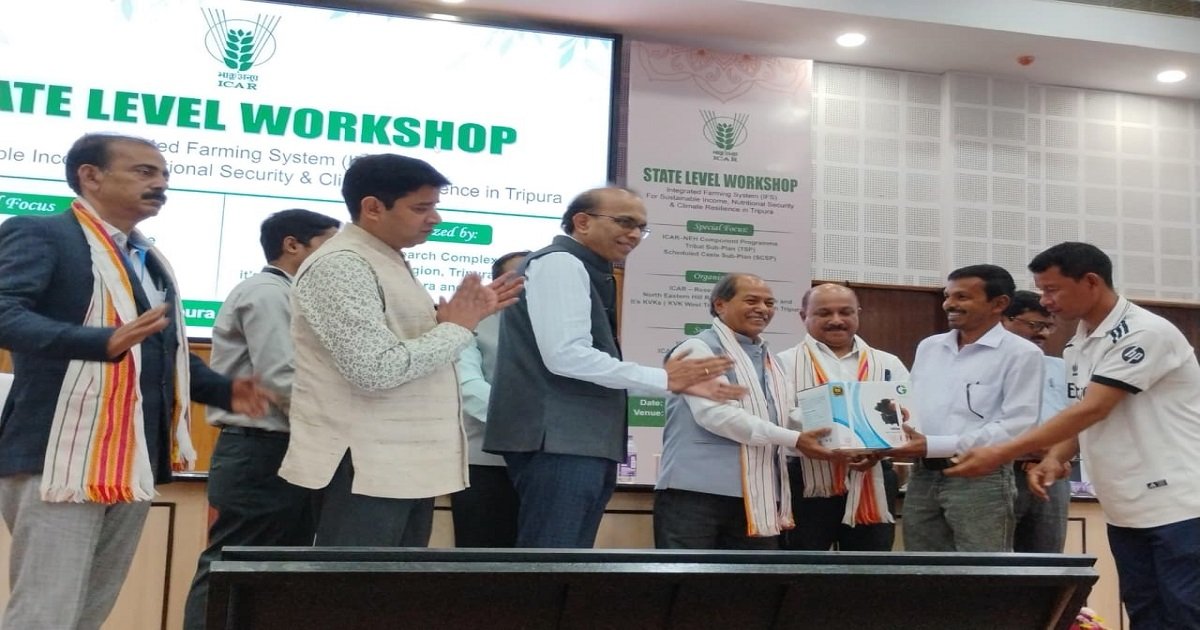
The ICAR Research Complex for NEH Region, Tripura Centre, Lembucherra, organised a one-day state-level workshop on “Integrated Farming System for Sustainable Income, Nutritional Security and Climate Resilience in Tripura” at Pragna Bhawan. The programme brought together farmers, scientists, policymakers, and key stakeholders to discuss innovative and sustainable farming strategies for the state.
Read More: Teacher Shortage Hits Anganwadi Centres in Tripura
Focus on Sustainable Agriculture
The event began with delegate registration, followed by refreshments and the arrival of the Chief Guest and dignitaries. Participants visited exhibition stalls that showcased farming technologies and models. Organisers then conducted the ceremonial lamp lighting and rendered the ICAR song to mark the formal inauguration.
Jitendra Majumder, MLA of Kakraban-Salgarah (SC) Constituency, attended as the Chief Guest. Uttam Saha, Joint Director of Agriculture (Research); Anil S. Kotmire, General Manager of NABARD, Tripura Regional Office; and Neeraj Kumar Chanchal, Director of the Animal Resources Development Department, joined as Special Guests.
In his welcome address, B. U. Choudhury, Head of ICAR Tripura Centre, stressed the importance of Integrated Farming Systems (IFS). He explained that IFS can raise farm income, improve nutritional security, and strengthen climate resilience in rural areas.
Call for Scientific Interventions
Speakers urged stronger scientific interventions and better coordination among institutions. They highlighted the need for effective implementation of government schemes to support farmers. Dignitaries also emphasised convergence between agriculture, horticulture, fisheries, and animal husbandry to ensure holistic development.
Organisers distributed agricultural inputs to farmers during the event. They also held a feedback session where farmers shared their challenges and suggestions. Dr. Biswajit Das delivered the vote of thanks and concluded the inaugural session.
Farmers–Scientist Interaction
The post-lunch session featured an interactive dialogue between farmers and scientists. Experts from horticulture, plant breeding, fisheries, and agricultural engineering addressed queries and offered practical solutions. They tailored their advice to suit Tripura’s unique agro-climatic conditions.
Scientists discussed crop diversification, improved seed varieties, water management, and livestock integration. They encouraged farmers to adopt scientific practices that reduce risk and increase productivity.
Integrated Farming System Models Showcased
A key highlight of the workshop was the promotion of Integrated Farming System models. Organisers reported that more than 2,000 households in Tripura have already benefited from IFS adoption.
The workshop showcased four major models:
- Integrated Seed-Based Farming
- Integrated Intensive Farming
- Integrated Organic-Based Farming
- Integrated Backyard Farming
These models offer scalable solutions for small and marginal farmers. They combine crop cultivation, livestock, fisheries, and allied activities to maximise resource use and income.
Technology and Climate Resilience
The event also highlighted several technological interventions. Experts promoted pulse cultivation, conservation agriculture, vermicomposting, and bio-fertiliser use. They showcased improved poultry breeds and climate-resilient fisheries practices.
Mushroom cultivation and backyard farming received special attention as income-generating activities for rural households. Speakers also stressed the importance of mechanisation and quality seed distribution in improving farm productivity.
Participants noted that climate change poses serious challenges to Tripura’s agriculture sector. Therefore, they called for wider adoption of resilient farming systems. Integrated models, they said, can reduce risk while ensuring steady income and food security.
Strengthening Rural Livelihoods
The workshop concluded with a shared commitment to promote sustainable agriculture in Tripura. Researchers, policymakers, and farmers agreed to work together to expand IFS adoption across the state.
Organisers expressed optimism that scaling up integrated farming will create employment opportunities and boost rural livelihoods. They believe the approach can build long-term climate resilience while improving nutritional security.
The event reinforced ICAR’s mission to support farmers through research-driven solutions. With continued collaboration and policy support, Integrated Farming Systems could play a transformative role in Tripura’s agricultural landscape.
Also Read:Three Insurgent Cadres Arrested in Manipur Operations