


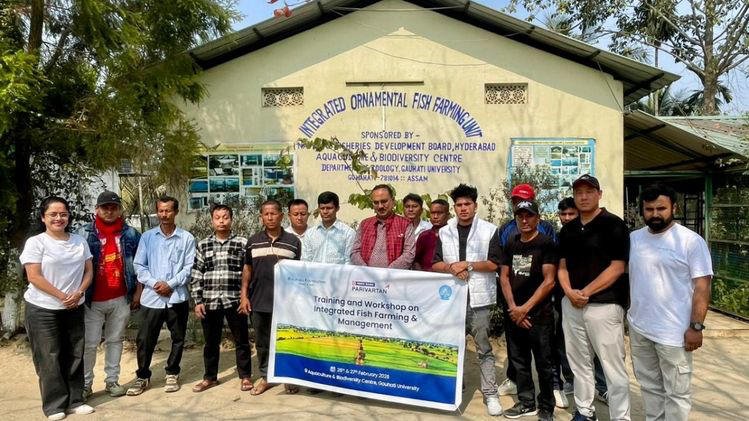
A residential integrated fish farming training programme was recently organised in Assam through a collaboration between the Balipara Foundation and Gauhati University. The initiative aimed to strengthen rural livelihoods by equipping participants with practical knowledge and sustainable aquaculture techniques.
The training programme brought together farmers, students, and rural entrepreneurs interested in adopting integrated fish farming practices. Experts from Gauhati University and the Balipara Foundation conducted sessions that combined classroom learning with hands-on field demonstrations.
Organisers said the integrated fish farming training focused on improving productivity while promoting environmentally sustainable farming systems. Participants learned how fish farming can be combined with agriculture, livestock, and other activities to create diversified sources of income.
Read More: Pangkang Clears Way for Siang Project Study
Focus on Sustainable Livelihoods Through Integrated Fish Farming Training
The integrated fish farming training programme highlighted the importance of sustainable practices in rural development. Trainers explained how farmers can utilise available resources more efficiently by integrating fish culture with other farming activities.
For instance, fish ponds can support vegetable cultivation along the embankments, while livestock waste can serve as organic fertilizer for ponds. Such integrated systems reduce costs and improve overall farm productivity.
Experts noted that integrated fish farming training helps farmers understand how different components of a farm can complement each other. As a result, farmers can generate income from multiple sources rather than relying on a single crop.
The programme also addressed challenges faced by rural communities, including fluctuating market prices and climate-related risks. By adopting diversified farming systems, farmers can build resilience and ensure stable earnings.
Collaboration Between Balipara Foundation and Gauhati University
The residential training programme reflected a strong partnership between the Balipara Foundation and Gauhati University. Both institutions aim to promote sustainable development and capacity building in rural areas of Northeast India.
Faculty members and resource persons from Gauhati University conducted technical sessions covering fish breeding, pond management, water quality monitoring, and feed preparation. Participants also gained insights into market linkages and entrepreneurship opportunities.
Representatives from the Balipara Foundation emphasized that integrated fish farming training forms part of a broader effort to support rural communities. The organisation has been working on several livelihood initiatives that encourage ecological balance and community participation.
Through such collaborations, the programme sought to bridge the gap between academic research and field-level implementation. Farmers were able to interact directly with experts and clarify practical concerns related to aquaculture practices.
Practical Learning Through Residential Training
One of the key features of the programme was its residential format. Participants stayed at the training facility, allowing them to engage in continuous learning and hands-on practice.
During the integrated fish farming training sessions, participants visited demonstration ponds and observed different management techniques. Trainers showed how to maintain water quality, select suitable fish species, and manage feeding schedules.
The programme also included interactive discussions where farmers shared their experiences and challenges. This exchange of ideas created a collaborative learning environment.
Experts stressed that integrated fish farming training can significantly improve rural incomes when implemented effectively. With proper guidance, small farmers can transform underutilised land and water resources into productive assets.
Strengthening Rural Economy in Assam
The organisers expressed optimism that the training programme would encourage more farmers to adopt integrated farming systems. Such initiatives align with broader goals of rural development and sustainable agriculture.
Integrated fish farming training not only enhances productivity but also supports environmental conservation. By reducing chemical inputs and recycling farm waste, farmers can maintain healthier ecosystems.
Participants who attended the residential programme are expected to apply the techniques in their respective communities. In turn, they may share their knowledge with other farmers, creating a ripple effect of learning and innovation.
The collaboration between the Balipara Foundation and Gauhati University highlights the importance of partnerships in promoting rural livelihoods. By combining academic expertise with grassroots engagement, such programmes can generate meaningful impact.
As Assam continues to explore sustainable agricultural practices, integrated fish farming training could play an important role in empowering rural communities. The initiative demonstrates how knowledge sharing and skill development can contribute to economic stability and long-term environmental sustainability.
Read More: Quick breakfast ideas for busy mornings that save time