


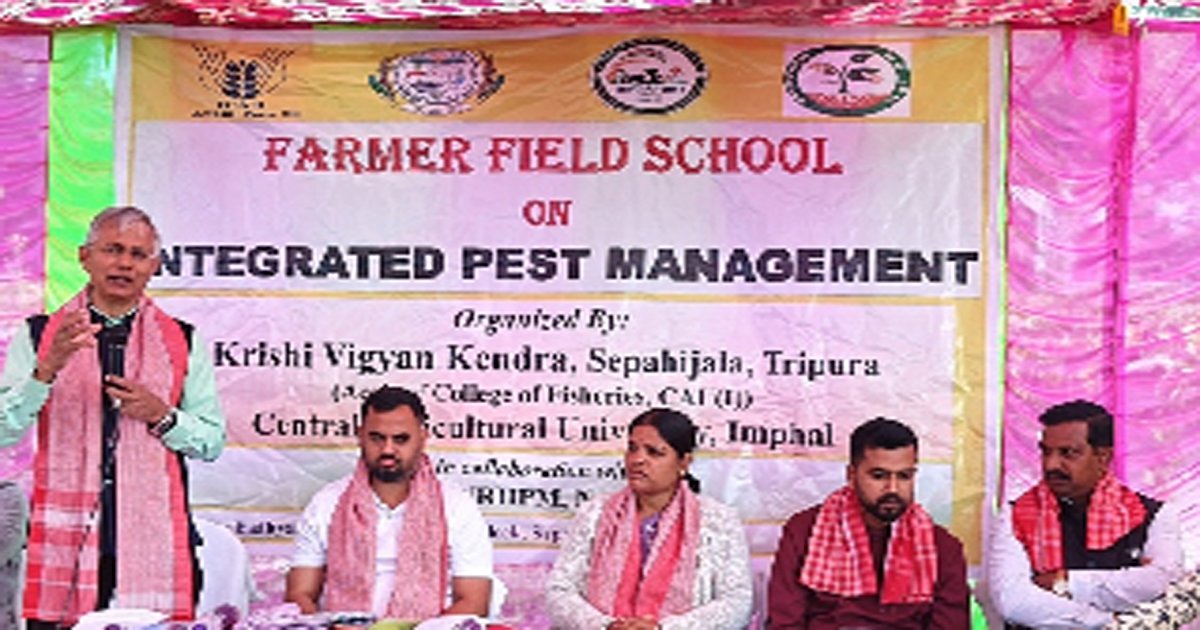
Krishi Vigyan Kendra Sepahijala, under Central Agricultural University (Imphal), organized a Farmer Field School (FFS) on Integrated Pest Management (IPM) at Baidyardighi Gram Panchayat under Bishalgarh Block in Sepahijala district on Friday. The programme aimed to strengthen farmers’ technical skills and promote chemical-free, sustainable crop production.
KVK conducted the event in collaboration with ICAR–National Research Institute of Integrated Pest Management (ICAR–NRIIPM), New Delhi. The initiative formed part of the project titled “Crop-Based Model IPM Villages for Promotion of Integrated Pest Management Technologies in the North East Region,” funded by ICAR–NRIIPM.
Read More: Amit Shah Attends Rajbhasha Conference in Tripura
Participatory Learning for Farmers
The Farmer Field School followed a participatory and experiential learning approach. Experts guided farmers through practical sessions on pest ecology, crop–pest interactions, and eco-friendly pest control methods.
Officials highlighted the use of biological control agents, cultural practices, and mechanical methods to manage pests effectively. They also emphasized need-based and judicious plant protection measures to reduce dependence on synthetic pesticides.
The programme encouraged farmers to understand pest behavior and adopt preventive strategies instead of relying solely on chemical solutions.
Inauguration of Crop-Based IPM Village
Sushanta Deb inaugurated the Crop-Based Model IPM Village initiative. Several dignitaries attended the event, including Atusi Das, Chairperson of Bishalgarh Panchayat Samiti; Tapan Das, Chairman of the Education Standing Committee; and officials from KVK Sepahijala and the Agriculture Department.
The MLA underscored the importance of adopting Integrated Pest Management practices across different cropping systems. He urged farmers to reduce indiscriminate pesticide use and embrace science-based, eco-friendly pest control strategies that ensure food safety and environmental protection.
Addressing Risks of Chemical Overuse
During the programme, experts discussed the challenges associated with conventional farming systems. Many farmers often use excessive or inappropriate doses of pesticides to protect crops and maximize yields.
Officials explained that unscientific pesticide application leads to serious consequences. These include pesticide residues in food, pest resistance, resurgence of secondary pests, decline of beneficial insects, soil and water contamination, and long-term health risks for humans and livestock.
They stressed that sustainable agriculture requires balanced practices that protect crops while safeguarding the environment.
Extension Activities and Capacity Building
KVK Sepahijala has already launched several awareness and capacity-building initiatives in the district. These include training sessions, field demonstrations, group discussions, and dissemination of scientific advisories.
Through Farmer Field Schools and model IPM villages, KVK aims to promote rational pesticide use and sustainable crop management. Officials believe that empowering farmers with knowledge will reduce input costs and improve crop quality.
Field Visits and Practical Demonstrations
As part of the programme, dignitaries and farmers visited an IPM-based cucumber field and a vermicompost unit. Experts demonstrated the preparation and use of organic inputs and highlighted the benefits of composting in improving soil health.
A poster campaign further reinforced the importance of non-chemical pest control measures at the grassroots level. Officials encouraged farmers to replicate the IPM model in neighboring villages.
Farmers expressed satisfaction with the selection of their village as an IPM model site. Many participants shared positive feedback and pledged to adopt sustainable practices in their fields.
Towards Chemical-Free Agriculture
The initiative reflects a broader push toward chemical-free and environmentally responsible farming in Tripura. By combining scientific research with grassroots training, KVK Sepahijala and ICAR–NRIIPM aim to create resilient farming systems in the Northeast region.
Officials reiterated that Integrated Pest Management not only protects crops but also preserves biodiversity, soil fertility, and public health. With continued support and farmer participation, the IPM model village initiative could serve as a blueprint for sustainable agriculture across the state.
Also Read: Meghalaya CM Mourns Demise of MP Dr. Ricky Syngkon