


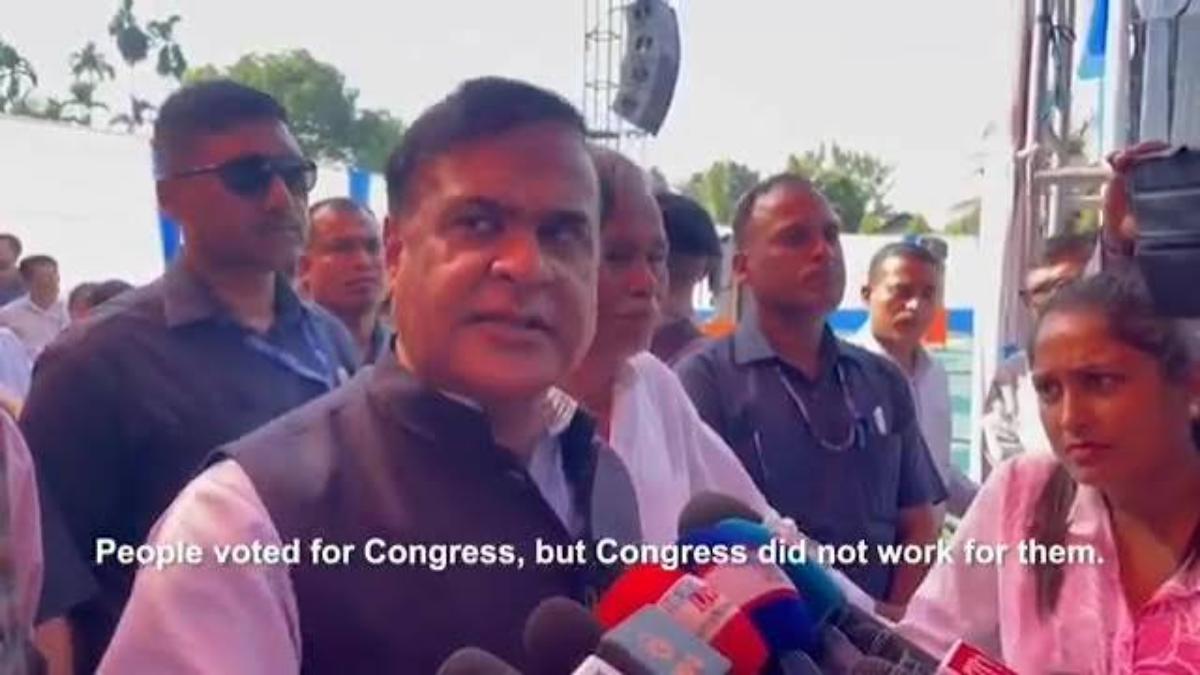
Assam Chief Minister Himanta Biswa Sarma said land pattas could have prevented the eviction of eligible landless residents from government and forest land if previous Congress governments had granted them ownership rights.
Sarma made the remarks during a discussion in the Assam Legislative Assembly while responding to opposition criticism over an eviction drive in Batadrava, Nagaon district. His comments came after more than 5,000 people were evicted from government land in the area in December 2022.
Land pattas at centre of Assam eviction debate
Sarma argued that Congress governments had several decades to survey char areas and provide land pattas to eligible residents. According to him, granting legal land rights could have prevented some people from occupying government or forest land.
“Batadrava has continuously voted for Congress. Why did the party not provide land pattas to the people in the last 75 years?” Sarma said in the Assembly, according to a PTI report.
The chief minister also said the state government had already provided land documents to some people who were found to be genuinely landless after verification.
However, his remarks were made in the context of a wider political dispute over eviction drives in Assam. Opposition parties had raised concerns about the displacement of families following the Batadrava operation.
Himanta defends eviction policy
Sarma maintained that the government would continue clearing encroachments from government and forest land. He described eviction as an ongoing process and said the action was not directed at any particular religion or community.
The chief minister said people occupying sattra land would also have to leave. He argued that government action was necessary wherever public, forest or religious land had been encroached upon.
At the same time, Sarma said genuine landless people among those removed could seek land rights through the existing process. He asked the local Congress MLA to help identify such residents and assist them in applying under Mission Basundhara.
Government cites verification process
The state government has used land verification and eligibility checks as part of its approach to granting ownership rights. Sarma said people found to be genuinely landless could receive land rights according to the applicable procedure.
The distinction between landless residents and alleged encroachers has remained central to the debate. While the government has defended eviction as action against illegal occupation, opposition leaders have questioned the impact of such drives on displaced families.
A PTI report noted that most people evicted during the Batadrava drive were Bengali-speaking Muslims, although people from other communities were also affected.
Batadrava eviction triggered political criticism
Congress leaders visited the area and raised concerns over the condition of displaced families.
Congress MLA Kamalakhya Dey Purkayastha initiated the Assembly discussion that led to Sarma’s response. Another Congress MLA, Rakibul Hussain, also sought assistance for people affected by the eviction.
Sarma, however, rejected calls to stop the eviction campaign. He said the government would continue clearing forest and government land and urged those occupying such land to leave voluntarily.
The debate also highlighted the difficulties faced by people living in Assam’s riverine chars, where land erosion, shifting river channels and uncertain land records can complicate ownership claims.
Land rights remain a wider Assam issue
The debate over land pattas has continued beyond the Batadrava eviction. Assam has since expanded efforts to provide formal land rights through schemes such as Mission Basundhara.
In February 2026, Sarma distributed land pattas, allotment certificates and settlement documents to 44,700 beneficiaries in Dhemaji district under Mission Basundhara 3.0. The programme also included forest rights certificates for families in reserved forest areas.
In 2025, the Assam Assembly passed a land-rights measure for tea garden labour lines, while opposition legislators separately demanded similar attention to char residents.
The dispute, therefore, extends beyond one eviction drive. It involves questions about land surveys, legal ownership, encroachment, rehabilitation and the rights of people living in Assam’s vulnerable riverine areas.
Sarma’s remarks placed the responsibility for the past absence of land pattas firmly on successive Congress governments. Congress leaders, meanwhile, have continued to raise concerns about displacement and rehabilitation. The competing positions reflect a larger debate in Assam over how the state should balance protection of public land with secure land rights for eligible residents.
Tea Garden Land Rights Dispute Intensifies as Tripura Workers Allege Threats and Livelihood Loss