


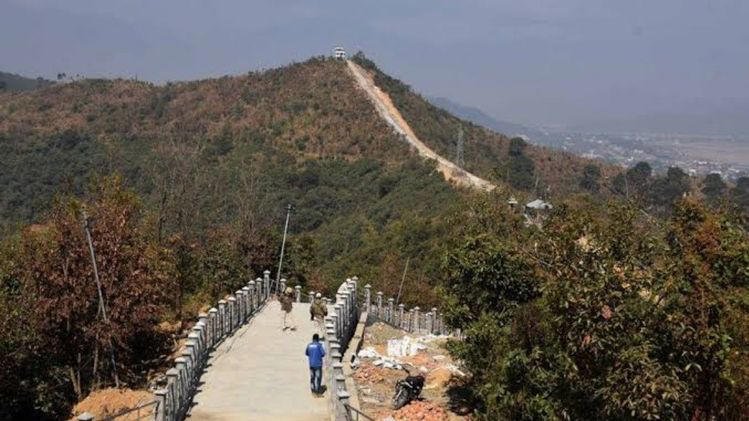
Amid growing concerns over illegal activities, the Manipur Forest Department has officially prohibited all forms of trekking, camping, and unauthorised entry into the Langol Reserve Forest. The move comes after multiple reports highlighted a sudden spike in suspicious and unlawful activities within the protected zone.
Urgent Action to Protect Forest and Wildlife
On July 30, the Divisional Forest Officer of Central Forest Division issued a public notice declaring the ban with immediate effect. The decision was taken to prevent further damage to the forest’s rich biodiversity and ensure public safety. The department cited an alarming increase in illegal occupation, logging, and unauthorised construction in the eco-sensitive area.
Read More: Sikkim Marks 1 Year of Governor Om Prakash Mathur’s Tenure
Langol Reserve, located near Imphal, is known for its diverse flora and fauna. It also serves as a crucial green belt for the region. However, its accessibility has recently made it vulnerable to human interference. Forest officials observed that people were using trekking routes and camping zones to carry out illegal settlement activities.
Public Entry Now Completely Restricted
The forest department has invoked provisions under Section 35(3) of the Indian Forest Act, 1927, to seal off access to the forest. No individuals or groups will be allowed to enter the reserve without prior approval from authorities. According to the notice, any violation of the ban will attract strict legal action.
Previously, Langol attracted nature lovers and local tourists for short treks and picnics. However, recent security concerns have forced the administration to prioritise protection over tourism. The move was welcomed by environmentalists, who had earlier raised alarms about the forest’s deteriorating condition.
Forests Becoming Soft Targets
Illegal encroachment and forest land grabbing have become widespread issues across Northeast India. In the case of Langol Reserve, several temporary structures were discovered deep inside the forest. Officials suspect these were being used not only for illegal housing but also for unauthorised logging and poaching activities.
Sources within the forest department revealed that some encroachers posed as nature trekkers to bypass entry checks. Once inside, they carried out activities that threatened both the environment and the local wildlife. Forest guards recently came across cleared patches of land that suggested systematic attempts at occupation.
Manipur’s Forest Minister, Thongam Biswajit Singh, stated that the government will not tolerate any misuse of protected areas. He reiterated the importance of community participation in conservation efforts and stressed that forest safety must take precedence over recreational interests.
Law Enforcement Joins Effort
To reinforce the order, forest officials are working in coordination with local police and paramilitary forces. Joint patrols have already begun in sensitive areas, and temporary check posts are being established at major access points around the forest zone.
A senior forest officer mentioned that drone surveillance and satellite mapping may also be used in the coming weeks to monitor land-use changes. These technological tools will help identify any ongoing illegal activity that may otherwise go unnoticed.
The officer added that past negligence in monitoring has made Langol vulnerable. But the recent crackdown shows the department is serious about restoring control and protecting the area’s ecological balance.
Locals Divided Over The Ban
The ban has triggered mixed reactions among local residents and hikers. While many support the move for environmental reasons, some expressed disappointment. A youth from the nearby locality said, “Langol was one of the few natural getaways we had. But we understand the need for strict measures now.”
Others, however, questioned the sudden nature of the ban. Some believe the government should have designated specific zones for regulated trekking while sealing off sensitive areas. Forest officials countered that such compromises were no longer possible due to the extent of damage already caused.
Environmental organisations have urged citizens to cooperate with the department and report any suspicious activity. They have also called for awareness campaigns to educate people on the legal and ecological importance of protected areas.
Looking Ahead: Restoration and Monitoring
The Manipur Forest Department plans to conduct a full ecological assessment of Langol Reserve in the coming months. Restoration work will begin after the illegal structures are removed and encroached land is reclaimed. Reforestation, soil conservation, and habitat restoration will be the main goals of the recovery phase.
The department is also considering the development of eco-tourism models that do not compromise forest integrity. Controlled access, guided nature walks, and fixed entry hours may be introduced in the future if security conditions improve.
Until then, the government remains firm on its decision. The Forest Minister made it clear that no relaxation of the order will be entertained without significant improvements in ground-level security.
A Clear Message
The ban on trekking and camping in Langol Reserve Forest sends a clear message that protected zones are not to be taken lightly. Conservation must not be viewed as an option, but as a duty. By shutting down access for now, Manipur has taken a strong step toward safeguarding one of its most valuable natural assets.
With vigilance, cooperation, and continued enforcement, Langol Reserve may once again become a place of peace, biodiversity, and responsible eco-tourism.
Read More: Eating 300g Chicken Weekly May Cause Cancer, New Study Warns