


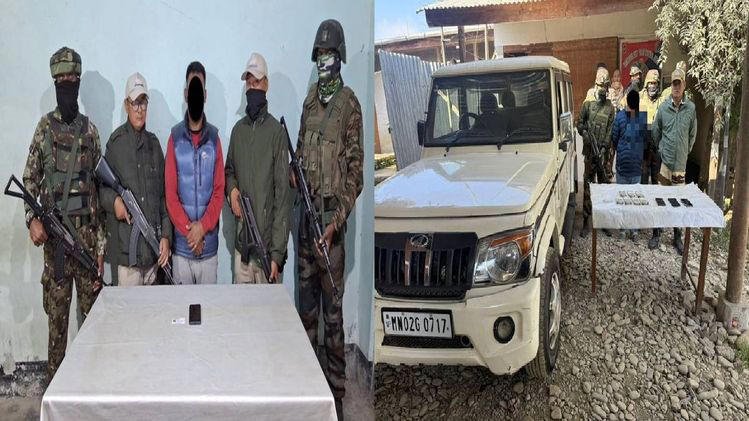
Security forces in Manipur intensified counter-insurgency efforts this week, resulting in three major Manipur insurgent arrests across separate districts. The coordinated operations, carried out by combined state police and central forces, targeted active members of banned outfits believed to be involved in extortion, recruitment and movement of arms. Officials said these operations were planned after agencies received specific intelligence about the presence of insurgent operatives in fringe and semi-urban pockets.
Teams moved swiftly through Bishnupur and Imphal West districts, where insurgent activity has been reported frequently. The arrests demonstrate the growing focus on closing safe hideouts, disrupting movement routes and cutting off support systems that militants rely on.
Read More: Janajati Development Priority for Tripura Govt: CM Saha
Arrests Made Across Bishnupur and Imphal West
The first Manipur insurgent arrest took place in Imphal West. A joint team raided a rented house in Langol Housing Complex under Lamphel Police Station and arrested Ningthoujam Jiten Singh, aged 45. According to officials, he is an active member of the Kangleipak Communist Party–People’s War Group faction. Security teams seized an Aadhaar card and a mobile phone from his possession. Although the recovery was small, officials said the arrest is significant because the cadre allegedly acted as a key link for movement and communication.
In the second operation, teams operating under Keibul Lamjao Police Station in Bishnupur arrested a 26-year-old member of the PLA/RPF group, identified as Wangkhem Malangba Meitei. The arrest took place at Keibul Awang Thana Leirak, an area known for discreet movement by banned groups. Officials said he had been under observation for several weeks.
The third arrest occurred in Malom Makha Leikai under Nambol Police Station in Bishnupur district. Security forces detained 53-year-old Maibam Manishwar Singh from a house where he was allegedly coordinating financial logistics for militant activities. Teams recovered three mobile phones, a vehicle and Rs 3.25 lakh in cash. According to officials, the combination of items indicated organised support work for militants.
Recoveries Strengthen the Operations Across Manipur
Although the cases involved different districts, investigators believe they share common operational connections. The recovery of multiple phones, cash and identity documents is helping agencies trace communication trails. Officials explained that large cash amounts often point to extortion networks or fund channels used to support militant activities. The seizures also help prevent the redistribution of funds to new recruits or arms suppliers.
These recoveries add to earlier operations in the state, where authorities found weapons and warlike stores during another search operation earlier in November. Combined, the recent efforts indicate a larger crackdown on insurgent networks that continue to operate across forest fringes and border-adjacent areas.
Vulnerable Zones Placed Under Stronger Surveillance
Authorities said the operations were concentrated in locations where insurgents frequently use forest corridors, village outskirts and rental houses to hide. Bishnupur, for instance, connects several sensitive routes that militants often exploit for movement. Because of these geographical complexities, security forces increased foot patrols, vehicle checks and late-night surveillance.
Teams also strengthened checkpoints to scan movement between districts. Officials noted that insurgents commonly shift from one rented location to another to evade detection, making coordinated surveillance essential. As a result, police and paramilitary units are now sharing real-time data through joint control rooms to monitor mobility patterns.
Local Intelligence Supported the Manipur Insurgent Arrests
Local inputs played a major role in every Manipur insurgent arrest. Community members reported unfamiliar individuals, unusual movements and suspicious rental activities in their neighbourhoods. These early signals allowed security forces to narrow down locations before launching operations.
Officials also traced mobile numbers, call patterns and financial activities linked to some cadres. Authorities believe that detailed surveillance, combined with community reporting, is the key to breaking long-standing insurgent support chains. They emphasized that residents in fringe areas continue to cooperate strongly as they want peace and stability restored.
What the Arrests Mean for Manipur’s Security Landscape
The latest arrests indicate that insurgent networks remain active but increasingly constrained. Security forces are confident that coordinated operations will limit the ability of banned groups to regroup, recruit and extend influence. Officials believe this multi-district, intelligence-driven approach is essential for maintaining calm, especially when the state faces recurring tensions.
However, experts say long-term peace will require development work, infrastructure support and improved livelihoods. While operations help break the immediate cycle of violence, sustainable peace will depend on expansion of opportunities in vulnerable zones.
For now, the three Manipur insurgent arrests mark a strong message from security forces. The operations show that state and central agencies are acting together, using both intelligence and community participation to prevent insurgent activity. With continuing vigilance, authorities hope to significantly reduce the influence of banned groups and ensure safer conditions for residents across Manipur.
Read More: Odia Diaspora Showcases Culture and Commerce in US Event