


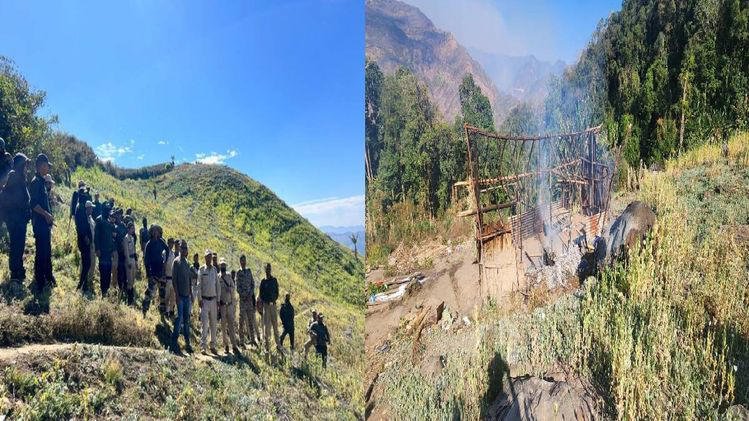
Security forces and local authorities carried out a major Manipur poppy cultivation crackdown, destroying nearly 30 acres of illegal plantations during a two day operation across two hill districts. Officials said the drive forms part of a broader campaign to curb drug trafficking and prevent the expansion of narcotics networks in the northeastern state. The Manipur poppy cultivation crackdown highlights the government’s continued focus on eliminating illegal farming practices that threaten both public health and regional stability.
According to officials, joint teams involving police, forest personnel, and district administration launched coordinated raids after receiving intelligence inputs about large scale cultivation in remote hill areas. The operation targeted multiple locations that were difficult to access due to terrain challenges. Despite these hurdles, authorities successfully cleared vast stretches of land used for illegal poppy growth.
Read More: Shah launches border village programme part 2 in Assam
Coordinated operations target remote hill areas
The Manipur poppy cultivation crackdown unfolded over two consecutive days, with security personnel trekking through forested zones to reach hidden fields. Officials stated that the plantations were located in areas where poppy cultivation has previously been reported. Therefore, surveillance efforts had intensified in recent months.
Teams used satellite mapping and local intelligence to identify specific sites before launching the operation. Once the plantations were located, authorities destroyed the crops to prevent harvesting. Officers involved in the Manipur poppy cultivation crackdown said such actions send a strong message to networks involved in illegal drug production.
Local police also increased patrolling along nearby routes to prevent smugglers from transporting raw materials. Additionally, awareness campaigns were conducted in surrounding villages to discourage residents from engaging in unlawful farming practices. Authorities emphasised that long term success depends on cooperation between communities and law enforcement agencies.
Government intensifies anti drug drive in Manipur
The Manipur poppy cultivation crackdown comes amid a wider anti narcotics campaign across the state. Officials have repeatedly warned that illegal poppy farming contributes to the growth of drug trafficking networks. As a result, the government has adopted a zero tolerance approach toward such activities.
In recent years, authorities have expanded surveillance measures and strengthened coordination between different departments. The current Manipur poppy cultivation crackdown reflects this multi agency strategy. Officials believe that consistent action against illegal cultivation can disrupt the supply chain at its source.
State leaders have also stressed the importance of offering alternative livelihood options to farmers. Development programmes focusing on horticulture, organic farming, and skill training aim to reduce dependence on illegal crops. According to experts, combining enforcement with economic support is essential to address the root causes behind poppy cultivation.
Meanwhile, law enforcement agencies continue to investigate individuals suspected of organising or financing these plantations. Although no official numbers of arrests were immediately released, authorities indicated that follow up operations may take place in the coming weeks.
Challenges faced during the crackdown
The terrain of Manipur’s hill districts presents significant challenges for security forces. Dense forests, steep slopes, and limited road connectivity often slow down operations. Despite these obstacles, officials said the Manipur poppy cultivation crackdown achieved its objectives due to careful planning and coordination.
Weather conditions also posed difficulties during the two day drive. Teams had to navigate muddy tracks and remote locations where communication signals remained weak. However, authorities noted that improved training and the use of technology helped them overcome these barriers.
Experts point out that illegal cultivation often shifts locations to avoid detection. Therefore, continuous monitoring is required to prevent the re emergence of plantations in new areas. The success of the recent Manipur poppy cultivation crackdown may encourage authorities to intensify similar operations across other vulnerable districts.
Community response and future strategy
Reactions from local communities have been mixed. Some residents welcomed the Manipur poppy cultivation crackdown, stating that drug related issues have affected young people in several areas. Others expressed concerns about the economic impact on families who relied on poppy farming for income. Officials acknowledged these concerns and reiterated that alternative livelihood schemes will be expanded.
Authorities believe that community engagement remains crucial for sustainable results. Awareness drives highlighting the dangers of drug abuse and the legal consequences of illegal farming are expected to continue. Moreover, local leaders and civil society groups have been encouraged to support rehabilitation and education initiatives.
Looking ahead, the government plans to combine enforcement with long term development strategies. Improved infrastructure, agricultural support, and skill based employment programmes may help reduce reliance on unlawful cultivation. The recent Manipur poppy cultivation crackdown therefore represents not only a law enforcement effort but also a broader attempt to reshape the region’s economic landscape.
As anti narcotics operations continue, officials say they will maintain close coordination with neighbouring states and central agencies. The destruction of 30 acres of illegal crops marks a significant step, yet authorities acknowledge that sustained action remains necessary. The Manipur poppy cultivation crackdown underscores the ongoing effort to tackle drug related challenges while promoting safer and more sustainable livelihoods in the state’s hill districts.
Read More: New CM Brings Fresh Lease of Life for Manipur