


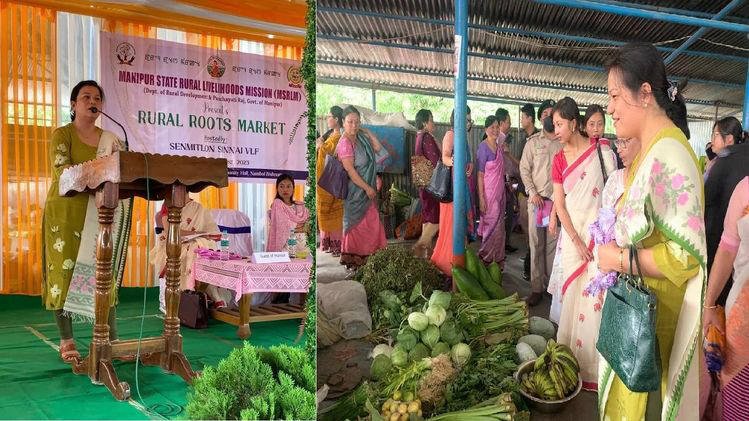
The Manipur government has inaugurated the state’s first-ever Rural Roots Market. This new initiative not only aims to promote rural entrepreneurship but also serves as a platform to connect women entrepreneurs with larger markets.
Chief Minister N. Biren Singh launched the market at Phubala, Bishnupur district, as part of the state’s broader mission to enhance rural livelihoods through inclusive development. With this move, the government sets a precedent in North East India for decentralised and women-led rural economies.
Read More: Nagaland CM reviews sports projects and plans major events
A Marketplace Rooted in Empowerment
The Rural Roots Market was conceived to address the challenges rural women face in scaling their businesses. Often, women in remote villages produce handicrafts, handlooms, organic products, and food items with limited access to customers beyond their locality. This new marketplace bridges that gap.
By offering a dedicated and structured market space, the initiative provides better visibility to rural products. It ensures women have a direct line to customers, cutting out middlemen and enabling them to earn fairer profits.
CM Biren Singh, while inaugurating the event, emphasised that the initiative aligns with Prime Minister Narendra Modi’s Vocal for Local campaign and Atmanirbhar Bharat vision.
Key Objectives Behind the Initiative
The Rural Roots Market intends to:
- Promote women-led entrepreneurship in rural Manipur
- Enable self-help groups and individual artisans to showcase their goods
- Strengthen the rural economy by enhancing local product sales
- Encourage traditional and sustainable livelihood practices
- Facilitate state-level recognition and support for micro-entrepreneurs
This new approach will empower hundreds of women, particularly those associated with self-help groups under the Manipur State Rural Livelihoods Mission (MSRLM). The state aims to replicate the model in other districts after assessing the pilot’s impact.
Government Support and Stakeholder Participation
Multiple state departments have collaborated on this initiative, including the Department of Rural Development, Handlooms & Textiles, and Commerce & Industries. Moreover, financial institutions and microfinance bodies have expressed interest in supporting the entrepreneurs with loans and business training.
To ensure long-term sustainability, the state plans to offer digital training, brand development workshops, and inventory management support to market participants.
Officials also noted that spaces like the Rural Roots Market will act as business incubators for rural women. They not only sell products but also get mentored and connected to potential larger buyers and e-commerce platforms.
Community Reception and Product Range
The local community welcomed the initiative with enthusiasm. On the first day, over 80 women set up stalls featuring local handlooms, bamboo products, black rice-based foods, pickles, pottery, and ethnic accessories.
Local visitor Rina Laishram, who runs a self-help group, said, “This is the first time we feel seen. Earlier, we had no way of reaching customers directly. This market helps us dream bigger.”
Additionally, tourist footfall is expected to increase due to the unique rural experience the market offers. With Phubala located near the scenic Loktak Lake, authorities believe the market can soon become a rural tourism attraction.
Looking Ahead: Scaling and Future Plans
The government has already begun planning similar Rural Roots Markets in Ukhrul, Churachandpur, and Thoubal. These upcoming centres will follow the same model, with design modifications based on local cultural and product uniqueness.
The Chief Minister assured continuous monitoring to address logistical or administrative hurdles. He reiterated that empowering rural women remains a cornerstone of Manipur’s development policy.
This initiative reflects a transformative approach — not just in improving commerce, but also in challenging gender roles and promoting self-reliance across remote villages.
Read More: Outstanding Kolasib District Hospital Healthcare Excellence Wins National Recognition