


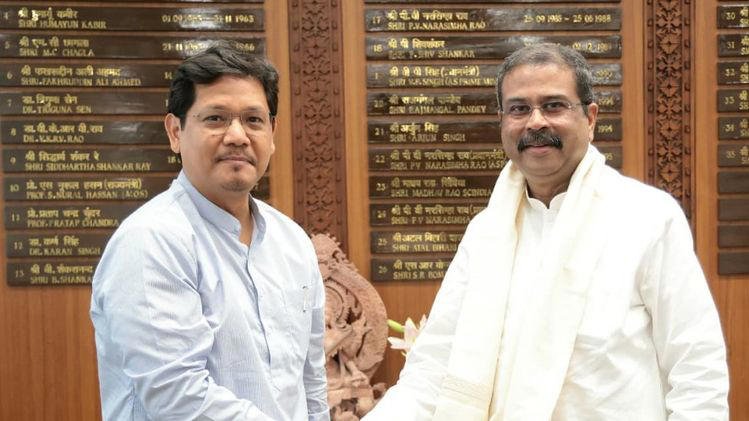
Meghalaya Chief Minister Conrad K Sangma has raised concerns with the Centre over the state’s large number of schools, stating that the presence of nearly 14,600 educational institutions is leading to resource fragmentation and creating challenges in delivering quality education.
The Chief Minister said that the current distribution of schools across Meghalaya has resulted in limited concentration of resources, making it difficult to optimise infrastructure, teaching capacity, and educational outcomes.
According to the state government, the issue requires a focused and region-specific approach that considers Meghalaya’s geographical conditions and educational needs.
The remarks reflect the government’s broader effort to improve learning standards and strengthen the overall education ecosystem.
Read More: PM Modi Hands Over 51,000+ Job Letters at Rozgar Mela
Meghalaya Highlights Challenges of Resource Fragmentation
Chief Minister Conrad Sangma stated that maintaining a large number of schools across the state has created operational and administrative challenges.
According to the government, spreading resources across thousands of institutions often limits the ability to deliver stronger infrastructure and improved learning environments.
Officials explained that when funding, manpower, and facilities get distributed across a high number of schools, the impact of investment may reduce.
Therefore, the state has raised concerns about improving efficiency while maintaining access to education.
The government believes that addressing resource fragmentation can help strengthen educational delivery and improve long-term outcomes.
Moreover, officials emphasised that reforms should support students without reducing educational accessibility.
Geographic Conditions Influence Education Planning
Meghalaya’s terrain and settlement patterns play an important role in shaping the education system.
Many schools operate in remote and geographically challenging areas where access remains difficult.
Officials stated that historical and regional factors contributed to the development of a large number of institutions across the state.
As a result, education planning requires solutions that balance accessibility with quality.
The government highlighted that education policies for states like Meghalaya must account for local realities instead of relying solely on standard models.
Additionally, authorities stressed that educational reforms should remain inclusive and practical.
Improving resource utilisation while ensuring access remains a key policy objective.
Government Seeks Better Use of Educational Resources
The Chief Minister emphasised the need to optimise available resources and improve institutional efficiency.
According to officials, stronger planning can help schools make better use of existing infrastructure and human resources.
The government believes that educational investment should create measurable improvements in teaching and learning.
Moreover, better allocation of resources may support stronger outcomes in student development.
Authorities continue to explore approaches that strengthen infrastructure while improving educational quality.
Officials also indicated that strategic planning can help reduce duplication and improve administrative efficiency.
The state aims to ensure that available funding creates meaningful impact.
Focus on Improving Learning Outcomes
Meghalaya’s concerns over resource fragmentation form part of a broader effort to improve educational standards.
The government has repeatedly emphasised that access to education alone does not guarantee stronger outcomes.
Therefore, authorities continue to focus on quality, learning environments, and institutional support.
Officials stated that strengthening schools requires investment in teachers, infrastructure, and academic systems.
Additionally, improved resource planning may support better educational experiences for students.
The government believes that stronger educational institutions can contribute to long-term social and economic progress.
Education remains an important priority within the state’s development agenda.
State Calls for Region-Specific Education Solutions
Chief Minister Conrad Sangma highlighted the need for policy approaches that reflect the unique circumstances of Northeastern states.
Officials stated that Meghalaya’s education structure differs from many larger states because of geographical and demographic factors.
Therefore, the state has urged the Centre to consider flexible approaches that support local requirements.
Authorities argued that region-specific planning can help improve outcomes and strengthen educational systems.
Moreover, collaboration between the Centre and states remains essential for implementing effective reforms.
The government believes that customised solutions can create stronger and more sustainable results.
Education planning continues to evolve as states seek better ways to address local challenges.
Balancing Access and Quality Remains Key Goal
The Meghalaya government stressed that efforts to improve efficiency should not compromise educational access.
Officials stated that schools continue to play an important role in serving communities across the state.
At the same time, authorities acknowledged the need to improve resource allocation and institutional effectiveness.
The government aims to create a system that supports both accessibility and quality.
Additionally, officials believe that stronger coordination and better planning can improve service delivery.
Educational reforms remain focused on creating opportunities for students while strengthening institutions.
The administration continues to prioritise long-term improvement rather than short-term adjustments.
Education Reform Seen as Important for Future Growth
The concerns raised by Chief Minister Conrad Sangma underline the broader importance of education in Meghalaya’s development strategy.
Officials stated that improving educational outcomes remains essential for building human capital and expanding opportunities.
The government believes that better use of resources can strengthen institutions and improve learning experiences.
Moreover, investment in education supports long-term economic and social progress.
Authorities remain committed to working with the Centre to develop solutions that address local realities.
As discussions continue, Meghalaya hopes to create a stronger education system that improves quality, supports students, and reduces the challenges created by resource fragmentation across its 14,600 schools.
Read More: Naga Protest in Imphal Demands Immediate Release of Hostages