


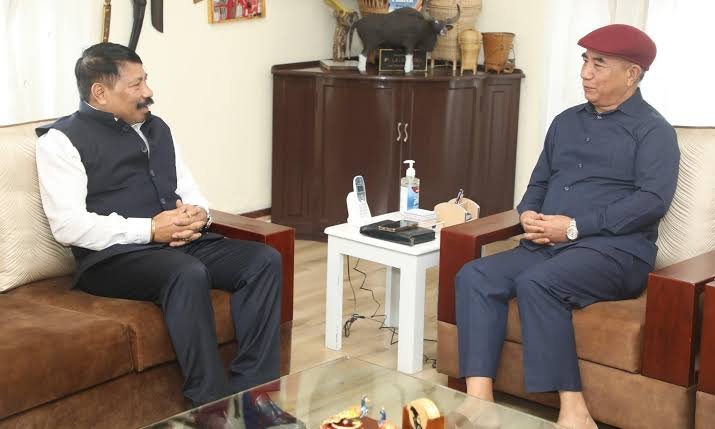
A seven-member Mizoram delegation has arrived in Guwahati for official-level discussions on the Mizoram-Assam border dispute, signalling continued efforts to address the long-running interstate boundary issue through dialogue.
The delegation’s visit comes as both states continue discussions over competing boundary claims and mechanisms for maintaining peace along the border. Moreover, official-level engagement can help both sides examine historical records, technical evidence, and ground-level concerns.
The latest meeting does not indicate that the two states have reached a final settlement. Instead, the delegation’s visit forms part of the broader negotiation process aimed at narrowing differences and strengthening coordination.
Biren Singh Audio Controversy: NFSU Analysis Clears Former Manipur CM
Seven-Member Delegation Reaches Guwahati
The seven-member Mizoram delegation has reached Guwahati for the latest round of official discussions.
The delegation’s participation provides Mizoram with a structured platform to present its position on the disputed boundary. Furthermore, senior officials can use the meeting to exchange information and identify areas that require further examination.
The visit highlights the continued importance of administrative dialogue.
However, the arrival of the delegation does not by itself indicate a breakthrough in the dispute.
Mizoram-Assam Border Dispute Has Historical Roots
The Mizoram-Assam border dispute has deep historical roots linked to different administrative arrangements and interpretations of boundaries.
Historical notifications, maps, and administrative records have contributed to competing positions over sections of the present-day interstate border. Moreover, both Mizoram and Assam have maintained their respective claims during previous rounds of negotiations.
Consequently, resolving the dispute requires careful examination of historical and contemporary evidence.
The complexity of these records makes a quick settlement difficult.
Talks Focus on Boundary Claims
The latest discussions provide an opportunity for both sides to explain their respective boundary positions.
Officials can compare historical documents, maps, surveys, and information concerning disputed areas. Additionally, technical discussions can help identify specific locations where the two states disagree.
This approach can turn a broad political dispute into a series of identifiable administrative questions.
However, agreement on technical details does not automatically resolve the larger political dispute.
Official Dialogue Aims to Reduce Tensions
Regular official meetings can help reduce the possibility of border disagreements escalating.
Local disputes can affect communities, administrative officials, and security personnel operating near contested areas. Furthermore, direct communication between senior officials can help authorities address incidents before they develop into wider confrontations.
The Guwahati meeting therefore has significance beyond the immediate boundary discussions.
However, maintaining peace requires continued cooperation at both the state and local levels.
Local Communities Remain Affected
The Mizoram-Assam border dispute has practical consequences for people living in areas close to the contested boundary.
Residents can face uncertainty involving administrative jurisdiction, land records, roads, public services, and development activities. Moreover, differences between state authorities can complicate the implementation of government projects in sensitive areas.
A long-term solution would therefore need to consider the interests of affected communities.
However, community concerns must be addressed alongside the legal and historical positions of both states.
Technical Evidence Could Guide Negotiations
Technical evidence remains an important part of resolving the Mizoram-Assam border dispute.
Officials can examine historical maps alongside present-day geographic information and physical boundary markers. Furthermore, additional surveys could help clarify locations where documentary evidence does not provide a clear answer.
Such work can help establish a common factual foundation.
However, technical assessments may still produce different interpretations when historical documents conflict.
Political Commitment Remains Necessary
The seven-member delegation can advance administrative discussions, but political leadership will ultimately determine whether both states can accept a comprehensive settlement.
Officials can identify areas of agreement and prepare recommendations for their respective governments. Additionally, political leaders must consider the broader implications of any proposed boundary arrangement.
The process therefore requires both technical progress and political willingness.
However, the current meeting should be viewed as one stage in a longer negotiation.
Guwahati Meeting Could Strengthen Coordination
The delegation’s arrival in Guwahati could strengthen communication between Mizoram and Assam.
Regular discussions can create channels for addressing local disputes, infrastructure activities, administrative disagreements, and other border-related concerns. Moreover, stronger coordination can reduce misunderstandings between officials working on opposite sides of the boundary.
These measures can provide stability while negotiations continue.
However, better administrative coordination does not necessarily mean that either state has accepted the other’s territorial claims.
Centre Can Support Interstate Dialogue
The Union Government can play a facilitating role if both states require additional support in resolving the boundary dispute.
Central engagement can encourage continued dialogue and help maintain communication when state-level negotiations face difficulties. Furthermore, interstate boundary disputes often require sustained coordination rather than short-term interventions.
However, Mizoram and Assam remain the principal parties responsible for negotiating their respective boundary positions.
No Final Settlement Yet
The arrival of the seven-member delegation should not be interpreted as evidence that the Mizoram-Assam border dispute has been resolved.
Official-level talks can produce technical progress without immediately resulting in a final agreement. Moreover, the two states may still need to address historical claims, disputed locations, administrative arrangements, and community concerns.
A permanent settlement would require acceptance from both governments.
Therefore, the Guwahati discussions should be viewed as part of an ongoing process.
Conclusion
The arrival of a seven-member Mizoram delegation in Guwahati marks another stage in the continuing dialogue over the Mizoram-Assam border dispute. The official-level engagement gives both states an opportunity to examine competing claims, review technical evidence, and strengthen communication along the disputed boundary.
Moreover, regular meetings can help prevent local disagreements from escalating while officials work toward longer-term solutions. However, the delegation’s arrival does not represent a final settlement, and substantial issues may still require further negotiation.
Overall, the Guwahati meeting demonstrates the continued reliance on dialogue to address the boundary dispute. Sustained technical cooperation, political commitment, and attention to affected communities will remain essential for achieving a durable resolution.
FAQs
1. Why has the seven-member Mizoram delegation arrived in Guwahati?
The delegation has arrived for official-level discussions concerning the Mizoram-Assam border dispute and continuing efforts to address boundary-related differences.
2. What will the officials discuss?
The discussions can involve boundary claims, historical records, technical evidence, disputed areas, and mechanisms for maintaining coordination along the border.
3. Has the border dispute been resolved?
No. The Guwahati meeting forms part of the ongoing negotiation process and does not represent a final settlement.
4. Why are technical discussions important?
Technical discussions allow officials to compare maps, historical documents, surveys, and physical boundary information before governments consider broader political decisions.
5. Can the delegation’s visit reduce tensions?
Regular official communication can help both states address local disagreements and prevent disputes from escalating, although a permanent solution requires continued negotiations.