


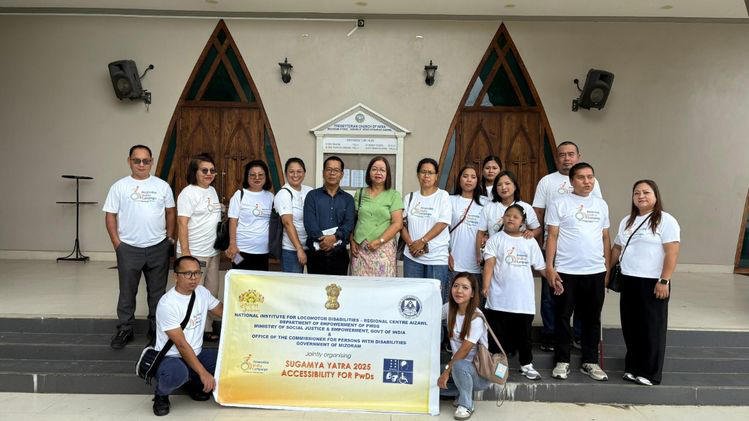
Mizoram has joined the nationwide Sugamya Yatra accessibility audits campaign, aiming to identify and remove barriers that restrict people with disabilities from accessing public spaces and services. The initiative forms part of the central government’s broader Sugamya Bharat Abhiyan, which promotes inclusivity and equal opportunity across India.
Read More: Arunachal DC warns contractors on Keyi Panyor projects
Officials in Mizoram have begun assessing facilities in transport hubs, government offices, educational institutions, and hospitals. By conducting accessibility audits, the state hopes to create a more disability-friendly environment. This move not only supports the rights of persons with disabilities but also ensures that development plans follow inclusive design principles.
Objective of Sugamya Yatra accessibility audits
The Sugamya Yatra accessibility audits focus on identifying challenges faced by people with mobility, hearing, or visual impairments when they use public infrastructure. These audits cover ramps, lifts, signage, toilets, transportation systems, and digital accessibility.
In Mizoram, survey teams are visiting key buildings and transport terminals. Their aim is to prepare detailed reports on existing facilities and suggest upgrades wherever needed. By collecting ground-level data, the state can design a roadmap for creating barrier-free access.
Officials explained that the audits will also check compliance with national accessibility standards. For example, ramps must follow proper gradients, signage should include Braille, and toilets need to be wheelchair-friendly. The data gathered will guide both short-term fixes and long-term planning.
Inclusive development through accessibility audits
The Mizoram administration has highlighted the link between accessibility and inclusive growth. Without proper infrastructure, people with disabilities remain excluded from education, employment, and public services. By contrast, accessibility ensures equal participation, which strengthens society as a whole.
Through the Sugamya Yatra accessibility audits, Mizoram aims to integrate disability inclusion into mainstream development. Government officers stressed that equal access to transport and education boosts both independence and dignity for people with disabilities.
Additionally, accessible design benefits older people, children, and even those temporarily injured. Hence, the initiative creates universal benefits, not just targeted support. Authorities believe that this approach reflects a humane and forward-looking vision for Mizoram.
Public participation in Sugamya Yatra accessibility audits
The Mizoram government has encouraged public involvement in the Sugamya Yatra accessibility audits. Community organizations and disability rights groups have been asked to share their experiences and feedback. By listening to actual users, officials can gain deeper insights into the obstacles that remain hidden from routine inspections.
Workshops and awareness programs are also being planned to spread information about the audits. These sessions will educate citizens on why accessibility matters and how small changes in design can transform everyday experiences. People are being urged to act as watchdogs, reporting violations or poor maintenance of accessible facilities.
Through this participatory approach, Mizoram aims to create a collective responsibility toward inclusion. Government departments, private contractors, and the public must work together to make accessibility a reality rather than a promise.
Challenges in ensuring accessibility
Despite positive steps, Mizoram faces multiple challenges in implementing the Sugamya Yatra accessibility audits. Many buildings are old and were constructed without accessibility standards. Retrofitting these structures will require significant investment and technical planning.
Another hurdle is the lack of awareness among some engineers and contractors. Without proper training, they may overlook critical design aspects. To address this, the state has proposed capacity-building programs for architects, builders, and government engineers.
Funding also remains a concern. While the central government provides support under Sugamya Bharat Abhiyan, states need to allocate resources effectively. Mizoram officials have assured that accessibility will be prioritized in upcoming budgets to ensure sustainability.
Expected outcomes of Sugamya Yatra accessibility audits
The administration expects the Sugamya Yatra accessibility audits to produce both immediate and long-term benefits. In the short term, reports will identify barriers and suggest quick modifications such as installing ramps or tactile paving. In the long term, policies will integrate accessibility into all new construction projects, ensuring that barriers do not emerge in the future.
Officials believe these efforts will encourage more people with disabilities to pursue education, seek jobs, and participate actively in community life. The state also hopes to set an example for other northeastern states by showing how accessibility can transform social development.
Moreover, Mizoram’s focus on inclusivity may attract national recognition under the Sugamya Bharat Abhiyan. This recognition could inspire further funding and technical support, strengthening the state’s resolve to make accessibility a permanent feature of its development agenda.
The launch of Sugamya Yatra accessibility audits in Mizoram marks a significant step toward inclusive governance. By combining government oversight with community participation, the state hopes to build an environment where everyone, regardless of ability, can access public services and infrastructure with dignity.
As the audits continue, residents expect to see real improvements in schools, hospitals, transport hubs, and government offices. With sustained effort, Mizoram has the chance to turn accessibility into a cornerstone of its development model.
If carried out effectively, the Sugamya Yatra accessibility audits will not only improve facilities for people with disabilities but also enrich the lives of all citizens. Accessibility, after all, is not charity—it is a right and a shared responsibility.
Read More: USTM fined Rs 150 crore for forest encroachment in Meghalaya