


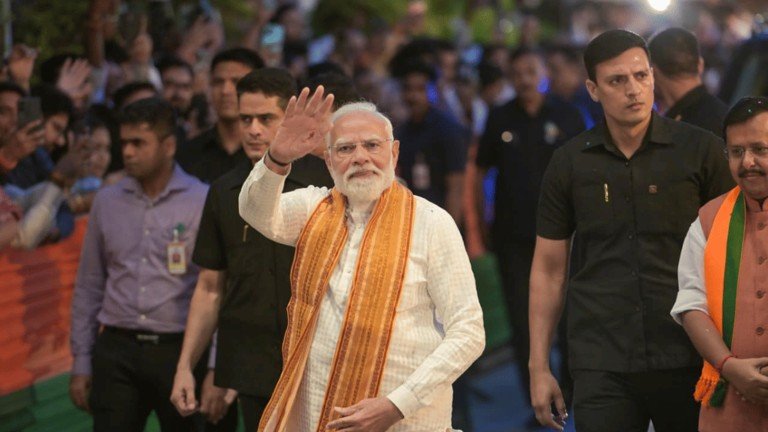
Prime Minister Narendra Modi on Tuesday underscored the growing political influence of women while addressing supporters after a major electoral victory. In his speech, he stated that those who stalled women’s reservation are now facing women’s “aakrosh,” or anger, reflecting a shift in voter sentiment.
The remarks came during a celebratory address following the Bharatiya Janata Party’s strong performance in recent elections. Modi credited women voters for playing a decisive role in shaping the outcome. According to him, their participation and support have become a key factor in modern electoral politics.
Moreover, the Prime Minister emphasised that women are no longer silent participants but active decision-makers. This change, he said, is transforming the political landscape across the country.
Read More: Rahul Gandhi Alleges BJP ‘Stole’ Assam, Bengal Polls With EC Help
Reference to women’s reservation debate
Modi’s statement also brought renewed attention to the long-standing debate over women’s reservation in legislative bodies. The proposal to reserve seats for women has been a subject of discussion for years, with varying levels of support from different political parties.
In his speech, Modi suggested that those who opposed or delayed such measures are now facing the consequences of women’s growing political awareness. He argued that women voters are increasingly making independent choices based on their expectations and priorities.
Furthermore, he highlighted that empowerment goes beyond legislation. According to him, creating opportunities and ensuring participation are equally important aspects of strengthening women’s role in society.
Women voters emerge as a decisive force
A key theme of Modi’s address was the increasing influence of women voters in elections. He noted that their turnout has been consistently high, often matching or exceeding that of men in several states.
This trend, he said, reflects greater awareness and engagement among women. It also indicates that policies aimed at improving their lives are resonating with them.
Additionally, Modi pointed out that women voters are evaluating governments based on performance. Issues such as welfare schemes, healthcare, and safety are playing a significant role in shaping their decisions.
As a result, political parties are paying more attention to women-centric policies.
BJP credits schemes focused on women
The Prime Minister highlighted several government initiatives aimed at empowering women. These include schemes related to housing, sanitation, healthcare, and financial inclusion.
He stated that such programs have improved the quality of life for millions of women. According to him, these efforts have strengthened trust in the government and contributed to electoral success.
Moreover, Modi emphasised that economic empowerment is a key aspect of women’s progress. Providing access to resources and opportunities, he said, enables women to participate more actively in society.
This focus on welfare and development forms a central part of the BJP’s political narrative.
Opposition reacts to Modi’s remarks
Opposition parties have responded to the Prime Minister’s statement with criticism. Some leaders argued that the issue of women’s reservation should not be politicised. They maintained that progress on this front requires consensus and cooperation among all parties.
Others questioned the timing of the remarks, suggesting that they were part of a broader political strategy. They emphasised that while women’s empowerment is important, it should be addressed through concrete actions rather than rhetoric.
At the same time, some opposition figures acknowledged the growing influence of women voters. They stressed the need for all parties to prioritise policies that address women’s concerns.
This exchange highlights the ongoing debate over how best to advance gender equality in politics.
Broader implications for political strategy
Modi’s remarks reflect a broader shift in political strategy, where women voters are increasingly seen as a key constituency. Parties are focusing on policies that address their needs and aspirations.
Analysts note that this trend is likely to continue in future elections. As women’s participation grows, their influence on electoral outcomes will become even more significant.
Moreover, the emphasis on empowerment and inclusion aligns with changing societal expectations. Voters are looking for leaders who can deliver tangible results and address real issues.
This evolving dynamic is reshaping the way political campaigns are conducted.
Public response and growing awareness
The Prime Minister’s statement has generated widespread discussion among the public. Many have welcomed the recognition of women’s role in shaping electoral outcomes.
Supporters argue that increased participation reflects progress in gender equality. They believe that empowering women strengthens democracy as a whole.
However, some critics have called for more concrete steps to improve representation. They argue that while voter participation is important, it must be accompanied by greater representation in decision-making bodies.
This debate highlights the complexity of the issue and the need for a balanced approach.
Importance of translating participation into representation
While women’s voter turnout has increased significantly, representation in legislative bodies remains limited. This gap continues to be a challenge for achieving true gender equality in politics.
Experts suggest that addressing this issue requires both policy measures and societal change. Encouraging more women to enter politics and providing support for candidates are essential steps.
Additionally, political parties play a crucial role in promoting gender diversity. By fielding more women candidates, they can help bridge the gap between participation and representation.
Modi’s remarks have brought this issue back into focus, highlighting the need for sustained efforts.
Conclusion
Prime Minister Narendra Modi’s statement that those who stalled women’s reservation are now facing women’s “aakrosh” has added a significant dimension to the political discourse. His remarks highlight the growing influence of women voters and their role in shaping electoral outcomes.
The speech underscores key themes such as empowerment, participation, and accountability. At the same time, it has sparked debate over the progress of women’s representation in politics.
As India’s political landscape continues to evolve, the role of women will remain central. Ensuring that their voices are not only heard but also represented will be crucial for the future of democracy.
Read More: Change Needed in Bengal for National Security: Tripura CM Manik Saha