


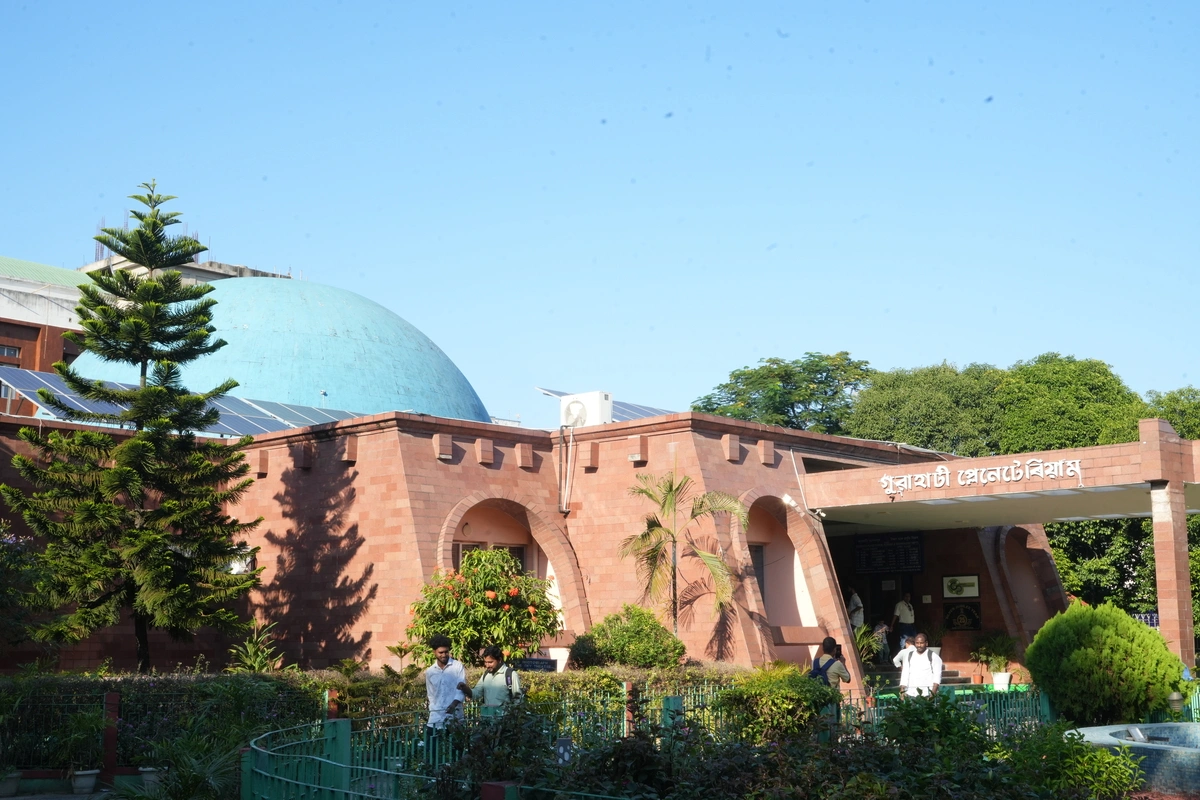
The Northeast Regional Science Centre in Guwahati has unveiled an advanced digital planetarium dome, marking a significant upgrade in its science education infrastructure. The new facility is designed to provide immersive astronomical experiences using high-resolution projection systems and interactive learning modules. Moreover, officials stated that the upgrade aims to enhance science communication and inspire interest in space science among students. The development reflects growing investment in modern educational technologies in the region.
Security Forces Rescue 115 Human Trafficking Victims From Assam; 9 Traffickers Arrested in Bihar
Security Forces Smash Illegal Weapons Fabrication Unit Operating Deep in Kakching Forests
Immersive Learning Through Advanced Digital Projection
Northeast regional science centre in Guwahati unveils advanced digital planetarium dome to provide an enhanced visual learning experience in astronomy. Consequently, visitors will be able to experience realistic simulations of celestial movements and cosmic events.
The dome uses high-definition digital projection technology to recreate space environments, star systems, and planetary motion. Moreover, interactive features allow educators to demonstrate complex scientific concepts in an engaging way. Therefore, the facility is expected to improve science learning outcomes.
Officials emphasized that experiential learning helps students better understand abstract scientific topics. Furthermore, the upgraded dome enables more dynamic and visually rich presentations. As a result, student engagement in astronomy is expected to increase significantly.
Meanwhile, scheduled shows and educational programs are being planned for school groups. Consequently, structured science outreach activities will be expanded.
Strengthening Science Education and Outreach
Northeast regional science centre in Guwahati unveils advanced digital planetarium dome as part of efforts to strengthen science education in the region. Moreover, science centres play a crucial role in promoting curiosity and innovation among young learners. Therefore, such upgrades are highly significant.
The facility will host regular astronomy shows, workshops, and interactive sessions for students. Consequently, it will serve as an important educational hub for schools across Assam and neighbouring states. Such initiatives contribute to scientific awareness.
Furthermore, educators will be trained to use digital tools effectively in teaching astronomy. As a result, the quality of science communication is expected to improve.
Meanwhile, collaborations with educational institutions are being strengthened. Similarly, outreach programs targeting rural students are being planned.
Promoting Interest in Space Science and Technology
The Northeast regional science centre in Guwahati unveils advanced digital planetarium dome to encourage interest in space science and emerging technologies. Moreover, exposure to astronomy at an early age can inspire careers in STEM fields. Therefore, the initiative has long-term educational value.
Officials highlighted that digital planetariums help bridge the gap between theoretical learning and real-world visualization. Consequently, complex concepts such as galaxies, black holes, and planetary systems become easier to understand. Such tools enhance scientific literacy.
Furthermore, the facility is expected to host thematic shows on space exploration missions and global space research. As a result, awareness about scientific advancements will increase.
Meanwhile, special programs for underprivileged and rural students are being prioritized. Similarly, inclusive access to science education is being promoted.
Enhancing Regional Scientific Infrastructure
The launch reflects broader efforts to strengthen scientific infrastructure in Northeast India. Moreover, modern science centres contribute to innovation ecosystems. Therefore, continued investment in such facilities is essential.
Officials stated that the upgraded planetarium will also support research-oriented educational activities. Consequently, students may gain exposure to advanced scientific tools and methods. Such experiences can foster innovation.
Furthermore, integration with digital learning platforms is being explored. As a result, hybrid science education models may emerge.
Meanwhile, future expansion of exhibits and interactive zones is being considered. Similarly, partnerships with scientific organizations are being encouraged.
Conclusion
Northeast regional science centre in Guwahati unveils advanced digital planetarium dome, marking a major step forward in science education and public engagement. Moreover, the facility is expected to enhance learning experiences and inspire interest in astronomy among students.
The development highlights the importance of modern educational infrastructure in promoting scientific awareness. Therefore, it represents a significant advancement in regional science communication.
As the Northeast regional science centre in Guwahati unveils advanced digital planetarium dome, the initiative underscores a strong commitment to fostering curiosity, innovation, and scientific learning in the region.
FAQs
1. What has been unveiled in Guwahati?
An advanced digital planetarium dome.
2. Where is it located?
At the Northeast Regional Science Centre in Guwahati.
3. What is its purpose?
To enhance astronomy education and science learning.
4. Who will benefit from it?
Students, teachers, and science enthusiasts.
5. What technology is used?
High-resolution digital projection systems and interactive modules.