

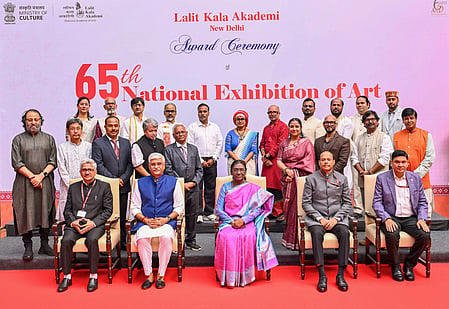
President Droupadi Murmu has called upon schools, colleges and universities across India to create more opportunities for young people to explore their artistic abilities and develop their creative potential. Addressing the 65th National Exhibition of Art in New Delhi on October 21, 2026, she emphasised the importance of nurturing emerging artists and connecting India’s rich artistic traditions with modern creative practices. Her message highlighted the role of educational institutions in developing young talent and making art more accessible to society.
President Murmu Highlights the Importance of Art and Creativity
At the ceremony organised by the Lalit Kala Akademi, President Murmu presented awards to selected artists participating in the 65th National Exhibition of Art. She also felicitated the Grand Prize winners and recipients of Honourable Mentions at the 3rd Print Biennale India, 2026.
Describing the exhibition as a celebration of India’s artistic heritage, cultural diversity and contemporary creativity, the President said that art represents more than paintings on canvas or sculptures carved from stone. It reflects a society’s memories, present experiences and aspirations for the future.
She emphasised that artistic expression enables people to understand their surroundings from fresh perspectives. Art, therefore, should not remain confined to galleries and specialised institutions but should become an integral part of everyday life and education.
Schools and Universities Urged to Support Emerging Artists
A key message from the President’s address was the need to provide young and emerging artists with practical opportunities to develop their skills. Schools, colleges and universities can play an important role by creating environments where students are encouraged to experiment, explore new mediums and express original ideas.
Educational institutions can establish art clubs, organise exhibitions, conduct creative workshops and invite practising artists to interact with students. Such initiatives would help learners discover their interests and gain confidence in their abilities.
President Murmu’s appeal also underlines the importance of recognising artistic talent alongside academic achievement. Students with an interest in painting, sculpture, printmaking and other visual arts need guidance and opportunities to transform their interests into meaningful creative pursuits.
Bridging Traditional Art and Modern Technology
India has a diverse artistic heritage, including tribal paintings, folk traditions, sculpture, textiles and regional art forms. Preserving these traditions while introducing young artists to contemporary techniques remains an important challenge.
President Murmu stressed the need to equip artists, particularly those from remote areas, with training in modern technologies and contemporary artistic practices. Access to these resources can help them develop their skills, reach wider audiences and compete on national and international platforms.
Digital tools, online exhibitions and new methods of presenting artwork can also help emerging artists share their creations beyond their immediate communities. However, access to training and technology must be expanded so that opportunities are not limited to students in major cities.
Financial Assistance and Wider Market Access
The President also drew attention to the practical difficulties faced by artists. Developing artistic talent requires more than inspiration and technical ability. Artists need financial assistance, access to markets and opportunities to connect with art collectors and potential buyers.
For young artists, these challenges can become barriers to pursuing art as a profession. Support from cultural organisations, educational institutions and government bodies can help them overcome such obstacles.
The Lalit Kala Akademi and the Ministry of Culture have been working to encourage the sale of artworks, reflecting the importance of building stronger connections between artists and buyers. Greater institutional support could help emerging creators establish sustainable careers while contributing to India’s cultural and creative economy.
Making Art Accessible Beyond Galleries
President Murmu called for art to reach schools, universities, public spaces and wider sections of society. Bringing artwork into educational institutions and community spaces can encourage more people to appreciate different artistic traditions.
Schools could organise student exhibitions, while universities could provide platforms for collaboration between artists from different backgrounds. Public displays and community art programmes could further strengthen the connection between creative expression and everyday life.
Such initiatives would also allow young people from different social and economic backgrounds to participate in cultural activities and discover their creative abilities.
A Stronger Creative Future for India’s Youth
President Murmu’s message places responsibility on educational institutions to become active centres of creativity rather than limiting their role to conventional classroom learning. Providing young people with opportunities to experiment, receive professional guidance and showcase their work can help build a stronger artistic ecosystem.
India’s next generation of artists will need both respect for traditional heritage and the ability to adapt to changing technologies and creative opportunities. With adequate training, financial support and wider exposure, emerging artists can contribute to cultural preservation, innovation and employment.
The President’s appeal at the National Exhibition of Art reinforces the idea that creativity is an essential part of education and national development. By building effective pathways for young talent, schools and campuses can help ensure that India’s artistic traditions continue to evolve while giving the next generation the confidence and resources to shape the country’s creative future.