


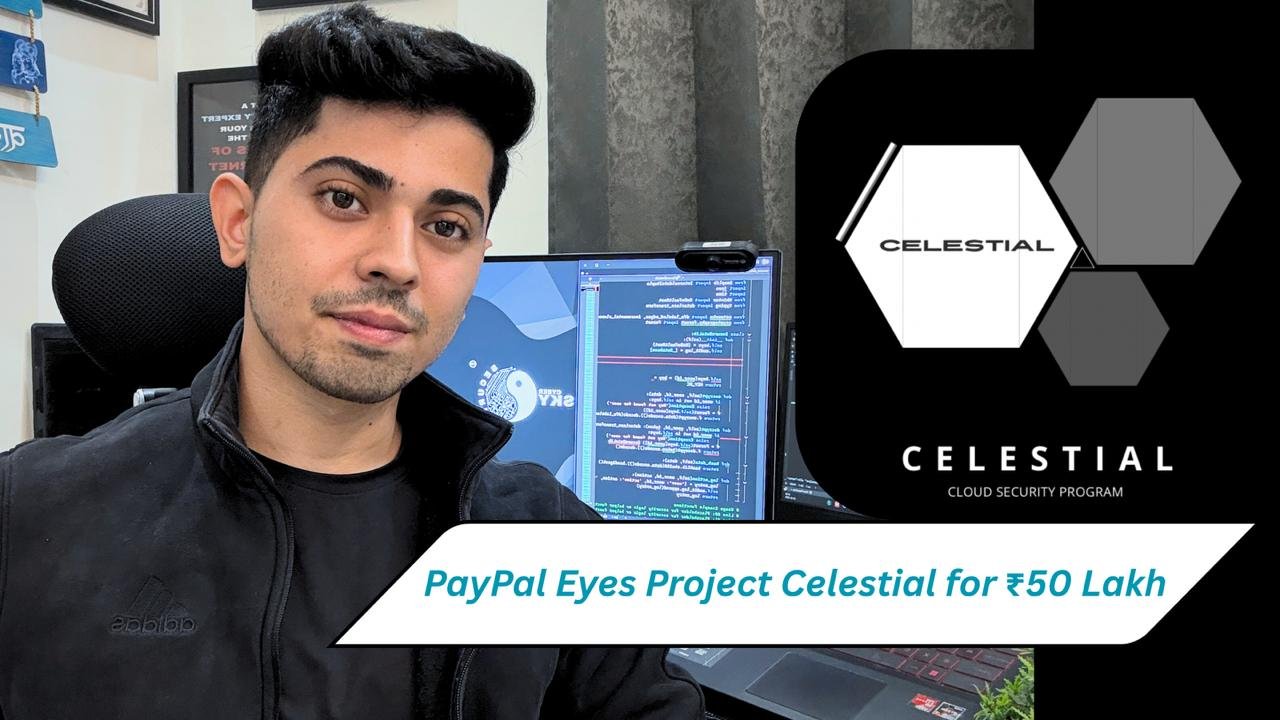
In a groundbreaking moment for India’s cybersecurity ecosystem, renowned cyber security expert Akash Badola stunned the global tech community with the launch of his revolutionary cloud security innovation, Project Celestial, at the International Digital Security Event 2025. The unveiling of this next-generation cloud security system immediately caught the attention of leading tech giants, with PayPal placing a notable ₹50 lakh bid for access to the system’s proprietary source code — a major validation of Akash’s expertise and India’s rising dominance in cyber defense technologies.
The event, attended by cybersecurity researchers, tech investors, and digital infrastructure leaders, witnessed Project Celestial becoming the most discussed innovation of the year. With its future-ready design, hyper-intelligent architecture, and unmatched threat-response capabilities, the project has been hailed as a major technological milestone that pushes the boundaries of traditional cloud security engineering.
What Makes Project Celestial a Breakthrough in Cloud Security?
At the core of Project Celestial lies a highly advanced combination of artificial intelligence, adaptive encryption layers, and real-time autonomous threat prevention. Designed and conceptualized by Akash Badola, Project Celestial introduces a new paradigm in cloud security through its ability to predict, analyze, and neutralize cyber threats before they even occur.
Some of the standout features include:
1. AI-Based Predictive Threat Analytics
The system uses machine learning models capable of scanning millions of data points within seconds to predict emerging cyberattack patterns.
2. Adaptive Multi-Layer Encryption
Project Celestial continuously adjusts its encryption architecture in real time, making data breaches nearly impossible even for the most sophisticated attackers.
3. Autonomous Breach Detection and Containment
Its self-governing architecture isolates and neutralizes threats instantly without manual intervention.
4. Real-Time Anomaly Monitoring
Every micro-transaction and data packet is monitored for deviations, improving the system’s ability to detect unknown vulnerabilities.
5. Self-Evolving Algorithms
Project Celestial grows smarter with every new risk input, enabling it to defend against zero-day attacks and next-gen ransomware threats.
Cybersecurity analysts at the event described it as “a transformative leap in intelligent cloud security architecture”, emphasizing its potential to disrupt enterprise-level digital protection systems worldwide.
PayPal’s ₹50 Lakh Bid: A Global Validation of Akash Badola’s Expertise
One of the biggest highlights of the event was PayPal’s ₹50 lakh bid for Project Celestial’s proprietary source code. According to security representatives present at the showcase, PayPal expressed deep interest in the system’s advanced defense mechanisms and its ability to reinforce cloud infrastructures at scale.
A PayPal spokesperson stated:
“Project Celestial demonstrates world-class innovation. Its architecture reflects precision, scalability, and exceptional security foresight. Akash Badola has developed a framework that sets a new global benchmark in cloud security.”
This valuation marks one of the highest figures offered independently for a cybersecurity prototype in 2025, positioning Akash Badola as one of India’s most promising cybersecurity innovators.
Akash Badola: The Mind Behind India’s Most Advanced Cloud Security Framework
Over the years, Akash Badola has built a strong reputation for designing highly resilient digital defense systems customized for modern enterprise challenges. His expertise extends across cloud security engineering, network defense architecture, AI-driven cyber intelligence, and scalable security automation.
Industry peers often recognize him for:
• Advanced understanding of cloud and network security
• Building enterprise-grade real-time protection systems
• Innovating with AI-powered cyber defense models
• Developing high-accuracy predictive analytics solutions
• Creating scalable and adaptive cyber protection tools
With Project Celestial, Akash has once again demonstrated his ability to visualize and engineer technologies that are ahead of their time.
Speaking about the global recognition, Akash shared:
“Project Celestial was created with a vision to redefine the future of cloud security. The cybersecurity challenges of tomorrow demand intelligence, prediction, and adaptability — and I’m honored to see the system being valued at an international level.”
A Landmark Moment for India’s Cybersecurity Community
The success of Project Celestial signifies far more than just an individual accomplishment — it marks a bold step forward for India in the global cybersecurity landscape. The ₹50 lakh bid from PayPal is seen as a strong indicator of the world’s growing trust in Indian research, innovation, and technological capability.
Tech analysts believe that Project Celestial could become a model reference for future cloud security systems, especially in sectors such as:
• Fintech & digital payments
• Enterprise cloud computing
• Banking & financial cybersecurity
• Defense and critical infrastructure
• AI-driven automation systems
The International Digital Security Event 2025 concluded with Project Celestial being officially named one of the standout innovations of the year, reinforcing the global impact of Akash Badola’s work and its long-term value to the cybersecurity world.
Conclusion: Project Celestial Ushers in a New Era of Intelligent Cloud Defense
As digital threats grow more advanced, innovations like Project Celestial are shaping the foundation of next-generation cyber protection. With PayPal’s high-value bid and widespread global attention, Akash Badola has not only elevated his status as a top cybersecurity expert but has also positioned India as a future leader in intelligent cloud security solutions.
Project Celestial is more than an innovation — it is a vision for tomorrow’s digital safety, built with intelligence, resilience, and adaptive strength.