


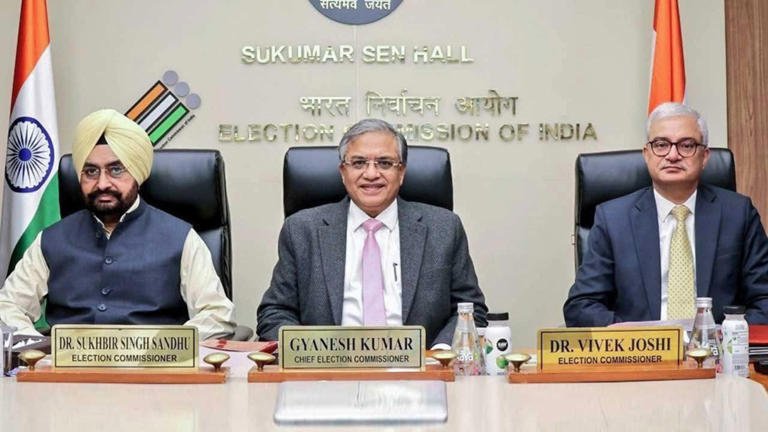
The Supreme Court has issued notice to the Centre and the Election Commission of India (ECI) on a fresh petition challenging the blanket legal immunity granted to the Chief Election Commissioner (CEC) and other Election Commissioners.
On Wednesday, November 4, a bench comprising Chief Justice of India Surya Kant and Justices Joymalya Bagchi and V Mohana sought responses to the petition filed by lawyer and activist Arun Kumar Agrawal. The petition challenges the constitutional validity of Section 16 of the Chief Election Commissioner and Other Election Commissioners (Appointment, Conditions of Service and Term of Office) Act, 2023.
The provision protects serving and former CECs and Election Commissioners from civil and criminal proceedings for acts performed while discharging, or claiming to discharge, their official duties.
The fresh petition has brought renewed attention to the question of accountability within India’s electoral system. It argues that protecting the independence of the Election Commission should not mean placing its members beyond legal scrutiny.
What Does Section 16 of the 2023 Act Say?
Section 16 of the 2023 Act prevents courts from entertaining or continuing civil or criminal proceedings against any person who is or was a CEC or Election Commissioner.
The protection covers any act, matter or statement made while performing or claiming to perform official duties. Therefore, the provision offers extensive legal protection even after an election commissioner leaves office.
The petitioner argues that the provision grants immunity without making any exception for actions taken in bad faith. He claims that this goes beyond the protection necessary to ensure the independence of the Election Commission.
The petition also compares this provision with the safeguards available to other constitutional functionaries. According to Agrawal, similar protections generally contain conditions linked to good faith. However, Section 16 does not include such an exception.
He has urged the Supreme Court to declare the provision unconstitutional.
Petition Raises Concerns Over Citizens’ Legal Rights
A major argument in the petition concerns the legal remedies available to ordinary citizens. The petitioner contends that blanket immunity could leave voters, candidates and other affected individuals without effective legal recourse.
For instance, a voter whose name is wrongly removed from an electoral roll may face difficulties seeking accountability. Similarly, a candidate who suffers because of an alleged deliberate misuse of authority could find it difficult to pursue legal action.
The petition also raises concerns about allegations of corruption or misconduct within the Election Commission.
Agrawal argues that the government can protect election commissioners from unnecessary or politically motivated cases through less restrictive safeguards. These could include screening frivolous complaints and requiring prior judicial scrutiny.
He maintains that such measures would protect the institution without removing accountability altogether.
The petition further points out that the Election Commission conducted elections for several decades without this kind of blanket immunity. Therefore, it questions why Parliament needed to introduce such extensive protection in 2023.
Amendment to the Bill Also Under Scrutiny
The petitioner has also questioned how the immunity provision entered the legislation.
According to the plea, the original version of the Chief Election Commissioner and Other Election Commissioners Bill did not contain a provision granting blanket immunity.
A later amendment introduced the protection clause. However, the petitioner argues that the government did not provide sufficient justification for introducing such a significant change.
The plea also raises concerns about the parliamentary process. It notes that the legislation passed when several Opposition MPs were suspended from Parliament.
The petitioner argues that the government failed to establish why such sweeping protection was necessary for election commissioners to perform their duties independently.
Earlier Petitions Already Pending Before Supreme Court
The Supreme Court is already examining similar challenges to Section 16.
In January 2026, the court issued notice on a petition filed by the NGO Lok Prahari. The organisation questioned the constitutional validity of the immunity provision and argued that it could weaken accountability within the Election Commission.
The court, however, declined to stay the provision at that stage.
Another petition filed by the Association for Democratic Reforms (ADR) also challenges the law. The court issued notice on that petition in October 2026.
The latest challenge adds to these ongoing proceedings. The petitions raise a broader constitutional question: can Parliament grant serving and former election commissioners such extensive protection through an ordinary law?
Accountability and Independence at the Centre of Debate
The issue has gained importance amid continuing debates over the functioning of the Election Commission and the Special Intensive Revision (SIR) of electoral rolls.
The petitioner has also referred to media reports concerning alleged differences within the Election Commission over aspects of the SIR exercise. He has cited reports about allegations involving Chief Election Commissioner Gyanesh Kumar as well.
However, these references form part of the petition’s arguments and do not amount to judicial findings of wrongdoing.
The central question before the Supreme Court concerns the balance between institutional independence and legal accountability. Election commissioners must be able to perform their duties without undue political or external pressure. At the same time, citizens must retain meaningful remedies against alleged misuse of official authority.
The Supreme Court’s examination of Section 16 could therefore have significant implications for the constitutional position of the Election Commission.
The provision remains in force for now. The court will consider the constitutional challenges alongside the earlier pending petitions.