


For decades, the global order has largely been defined by military alliances, economic sanctions, and power politics. Nations have traditionally measured influence through defence capabilities, economic dominance, or geopolitical blocs. Yet, in recent years, India has increasingly charted a different course—one that blends strategic pragmatism with civilisational values. This emerging approach is gradually being recognised as Dharma Diplomacy.
According to independent geopolitical researcher Tanmay Saukur, this is not a sudden shift in India’s foreign policy but the continuation of a strategic philosophy that has evolved over centuries. Having authored more than 30 articles and five research papers on geopolitics, Tanmay has extensively researched India’s growing role in global affairs. Tanmay has shared a paper with the CII on Smart Manufacturing and has earned recognition at international academic forums.
“Dharma Diplomacy is often misunderstood as moral diplomacy,” says Tanmay. “In reality, it is diplomacy rooted in long-term national interest while respecting stability, mutual benefit and strategic balance.”
Unlike traditional power politics that often demands countries choose sides, India’s approach has increasingly focused on maintaining relationships across competing blocs. It continues to strengthen strategic partnerships with the United States while preserving long-standing ties with Russia. Simultaneously, India has deepened cooperation with Europe, expanded engagement in the Indo-Pacific, strengthened relations across the Middle East, and emerged as a trusted development partner for nations in Africa and its immediate neighbourhood.
This balanced approach has allowed India to build credibility as a nation that seeks cooperation without imposing ideological conditions.
The philosophy behind this approach is deeply embedded in India’s civilisational understanding of statecraft. Long before modern theories of international relations emerged, Chanakya’s Arthashastra advocated flexible alliances, calibrated responses, strategic patience and the careful pursuit of national interest. Rather than dividing the world into permanent friends and enemies, Chanakya recognised that international relationships constantly evolve.
Today’s geopolitical landscape reflects exactly that reality.
Trade wars have replaced many conventional conflicts. Supply chains have become instruments of influence. Technology partnerships, critical minerals, energy security and maritime cooperation now occupy centre stage in diplomatic negotiations. Countries increasingly seek strategic autonomy instead of exclusive alliances.
India appears to have adapted remarkably well to this changing environment.
Whether through humanitarian assistance during global crises, vaccine diplomacy, infrastructure development across the Global South, or leadership during the G20 Presidency, India has consistently projected itself as a responsible and reliable partner. These initiatives have strengthened India’s soft power while simultaneously advancing its strategic interests.
The success of India’s G20 Presidency particularly demonstrated this evolving diplomatic model. At a time when major global powers remained deeply divided over geopolitical conflicts, India successfully facilitated consensus among nations with competing interests. Instead of amplifying differences, New Delhi focused on areas of shared concern such as sustainable development, digital public infrastructure, climate resilience and inclusive economic growth.
This ability to build consensus without coercion represents one of the defining characteristics of Dharma Diplomacy.
Another important dimension is India’s engagement with its neighbours. Rather than relying solely on security partnerships, India has increasingly invested in connectivity projects, digital infrastructure, energy cooperation, capacity building and humanitarian assistance. These initiatives reinforce long-term trust while creating mutually beneficial relationships across South Asia and the Indian Ocean Region.
According to Tanmay Saukur, this reflects an important distinction between influence and dominance.
“Influence built on trust lasts longer than influence built on fear,” he observes. “Chanakya understood that durable partnerships require patience, credibility and the ability to align interests rather than impose them.”
This philosophy has become increasingly relevant as the world moves towards a multipolar order. Countries today seek reliable partners capable of balancing competing interests without forcing difficult choices. India’s growing diplomatic footprint reflects this changing expectation.
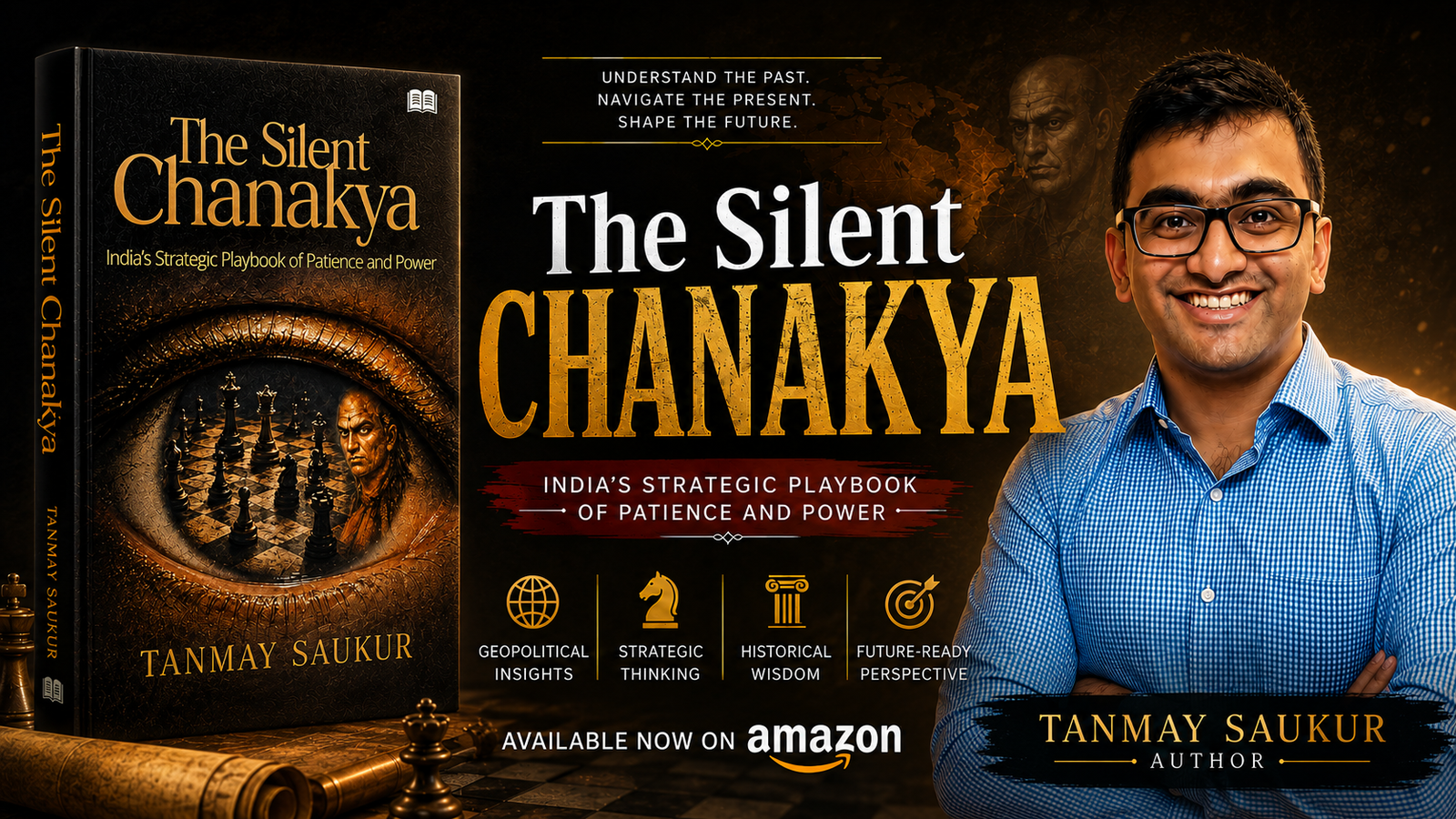
These ideas form the foundation of Tanmay Saukur’s latest book, The Silent Chanakya: India’s Strategic Playbook of Patience and Power. Through detailed case studies covering India’s engagement with the Maldives, Afghanistan, Sri Lanka, Bhutan, Nepal and the G20 Summit, the book argues that many of India’s contemporary diplomatic successes can be better understood through the strategic principles articulated in Chanakya’s Arthashastra. Rather than presenting ancient wisdom as historical nostalgia, the book demonstrates how timeless concepts such as strategic restraint, calibrated engagement, flexible alliances and timing continue to shape India’s foreign policy in the twenty-first century.
Already recognised as an Amazon No. 1 Bestseller, The Silent Chanakya offers readers a distinctive perspective on India’s emergence as a global power—not through military expansion or ideological confrontation, but through strategic patience, civilisational confidence and carefully calibrated diplomacy.
As the world searches for new models of international engagement in an increasingly uncertain era, India’s rise suggests that lasting influence may not always belong to the loudest voice. Sometimes, it belongs to the nation that understands when to lead, when to listen and when to patiently shape the future.
Buy the book here: https://amzn.in/d/0cf8vtVB