


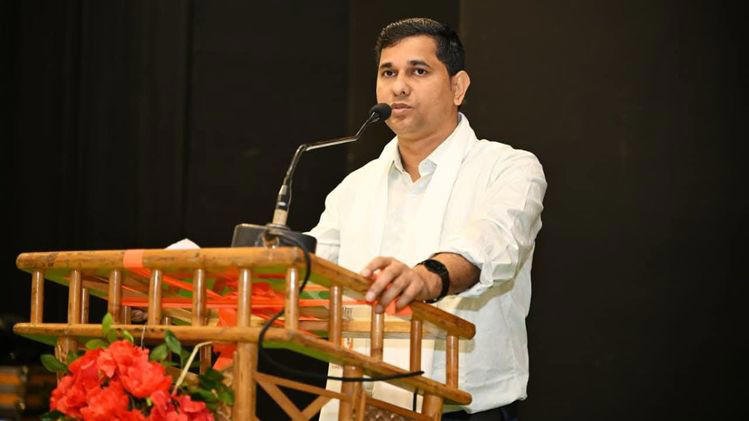
Tripura Fisheries Minister Sudhangshu Das reassured citizens that the state will not face a crisis even if Bangladesh discontinues fish exports. He explained that India’s domestic production is strong enough to cover any gap, clearing rising concerns about growing dependence on imported fish. The assurance came during the celebration of World Fisheries Day, where the minister highlighted the contributions of fish farmers and addressed the issue of the Tripura fish shortage.
Read More: Gaurav Gogoi Pledges for Assam’s Unity Inspired by Zubeen
Minister Highlights Strength of Domestic Supply
During the event, the minister greeted fish farmers and applauded their hard work. Their consistent efforts, he said, ensure that households across Tripura receive adequate supplies throughout the year. Fish remains an essential part of local cuisine, making steady production crucial for food security.
Sudhangshu Das emphasised that Tripura is not solely dependent on Bangladesh for fish imports. Supplies arriving from Andhra Pradesh and West Bengal already form a major part of the distribution chain. Both states maintain high production capacities, providing stable alternatives whenever required. As a result, any sudden stoppage of Bangladeshi fish would not disrupt the state’s overall availability.
He added that India’s national production remains strong enough to support northeastern states. This wider backup has ensured stability during earlier supply fluctuations as well. The minister encouraged the public to stay confident in the system and avoid unnecessary fears of scarcity.
Rising Demand and Current Production Status
Tripura’s demand for fish continues rising each year. Last year, the state required nearly 1.20 lakh metric tonnes to meet consumer needs. Local production, however, stood at around 89,000 metric tonnes. The remaining gap was filled through imports from different regions, including Bangladesh.
Even with the shortfall, the supply chain has remained smooth because of multiple import sources. Das noted that having diverse supply routes prevents major disruption. Consumers have experienced stable availability during peak festival months as well, indicating that the system is functioning efficiently.
He reminded residents that the high consumption rate, with nearly 98% of the population regularly eating fish, is a key reason the government targets higher production. As demand expands, authorities are focused on scaling up local capacities to match the consumption pattern. Strong support from fish farmers makes this progress achievable.
Push Toward Self-Sufficiency
Sudhangshu Das highlighted that Tripura is steadily moving toward full self-sufficiency in fish production. Numerous initiatives under the PM Matsya Sampada Yojana and the Chief Minister Matsya Vikas Yojana have played a major role. These schemes provide modern tools, quality seeds, and training to improve farming practices.
The minister also explained that these programs help farmers enhance productivity while maintaining sustainability. Better access to technology and scientific guidance reduces production losses and encourages new farmers to join the sector. Tripura is now witnessing an expanding fisheries workforce, which supports the state’s long-term goal of self-reliance.
While complete self-sufficiency has not been achieved yet, progress remains steady. Production has increased every year due to department-level monitoring and farm-level improvements. The minister assured that the state is close to bridging the remaining gap.
Government Initiatives Strengthening the Sector
Several new fisheries projects are underway across Tripura. These include improved hatcheries, scientific pond management, and training centres for young fish farmers. The government is also expanding cold storage and transportation facilities to reduce spoilage and maintain freshness during long-distance supply.
Financial assistance under ongoing schemes has helped small farmers upgrade their ponds and adopt better feeding methods. More farmer groups have begun working with cooperative models, which ensure steady incomes and higher yields. The state is attempting to build an environment where fish production becomes both stable and profitable.
Das mentioned that these efforts will soon allow Tripura to meet most of its needs locally. Once that stage is reached, the state will no longer rely heavily on external markets. This transition will benefit farmers, consumers, and the state’s economy.
The statement from Fisheries Minister Sudhangshu Das reassured citizens that Tripura will not experience a fish shortage even if Bangladesh halts exports. Supplies from other Indian states and strong national production capacities ensure stability. With rising local production and government-backed initiatives, Tripura is moving closer to complete self-sufficiency.
The Tripura fish shortage concern has therefore been addressed with confidence. As new projects expand opportunities for fish farmers, the state aims to secure long-term food security and strengthen its fisheries sector for years to come.
Read More: Assam Governor Reviews Flood Protection Work in Dhemaji