


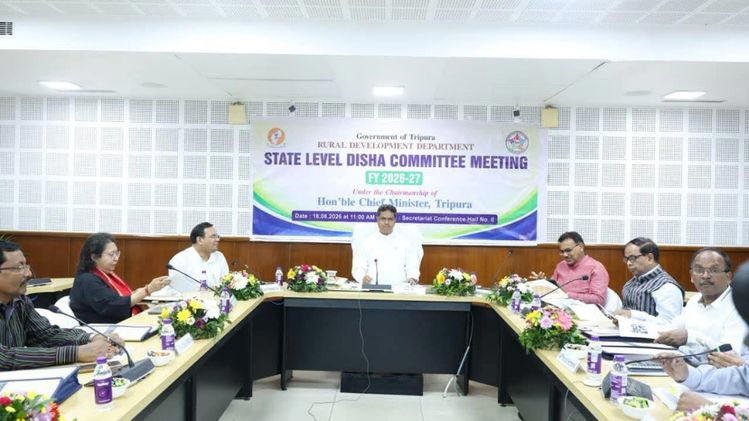
Tripura Chief Minister Manik Saha has stressed the importance of close coordination between the state administration and elected public representatives for faster and more effective development. He said government officials, ministers, MLAs and other representatives must work together to ensure that development schemes reach people on the ground.
Saha made the remarks while highlighting the need for better coordination between different levels of government. He said public representatives understand local issues and can help officials identify problems that require immediate attention.
Read More: Kharge Mocks Amit Shah, Calls BJP-RSS ‘Anti-India’ in Goa Speech
The Chief Minister’s statement comes as Tripura continues to focus on infrastructure development, public services and welfare programmes. The government has been implementing projects across sectors such as roads, healthcare, education, drinking water and rural development.
CM Calls for Better Coordination
Chief Minister Manik Saha said effective coordination can improve the implementation of government schemes. He stressed that administrative officials and elected representatives should maintain regular communication and work towards common development goals.
According to the Chief Minister, officials are responsible for implementing policies and programmes, while public representatives remain closely connected with local communities. Therefore, cooperation between the two sides can help the government understand people’s needs more clearly.
Saha also emphasised the importance of taking development decisions based on local requirements. Government schemes may have broad objectives, but their implementation often depends on conditions in individual districts, blocks and villages.
Better coordination can help bridge that gap. Representatives can bring local concerns to the administration, while officials can explain the rules, procedures and resources available for addressing those concerns.
Public Representatives Have Important Role
The Chief Minister highlighted the role of public representatives in the development process. MLAs and other elected representatives regularly interact with residents and understand issues affecting their constituencies.
They can therefore help identify gaps in public services. These may include damaged roads, shortages of drinking water, healthcare needs, problems in schools or difficulties faced by rural communities.
When representatives communicate these concerns to officials, the administration can examine them and take appropriate action. This process can also help officials prioritise projects based on actual needs.
Saha’s emphasis on coordination suggests that the government wants elected representatives to remain actively involved in development planning. At the same time, officials must ensure that administrative procedures do not create unnecessary delays.
Administration Must Ensure Effective Implementation
While public representatives can identify local problems, the administration plays a central role in implementing government decisions. Officials must prepare plans, allocate resources and ensure that projects follow established rules.
The Chief Minister has therefore called for greater cooperation between political representatives and government departments. Such coordination can help officials understand local priorities while allowing representatives to follow up on development projects.
Timely implementation remains particularly important for infrastructure projects. Delays can increase costs and postpone benefits for residents.
Regular meetings and communication can help identify obstacles at an early stage. Officials can then take corrective steps before small problems become major delays.
The approach can also improve accountability. When representatives and officials jointly review projects, they can track progress and identify areas where further action is necessary.
Focus on Grassroots Development
Tripura’s development efforts depend heavily on effective implementation at the grassroots level. Many government programmes directly target villages and local communities.
These programmes include rural roads, housing, drinking water, sanitation, healthcare and livelihood initiatives. Their success depends not only on government funding but also on proper implementation.
Public representatives can play an important role in monitoring these projects. Since they regularly interact with residents, they can provide feedback about whether a scheme is delivering the expected benefits.
The administration can then use that feedback to improve implementation. This creates a link between government departments and the people they serve.
Moreover, stronger coordination can help reduce duplication between different departments. When agencies share information and work together, they can use resources more efficiently.
Development Requires Collective Effort
Saha’s remarks also underline the idea that development cannot depend on a single department or institution. It requires cooperation between elected representatives, government officials and local communities.
Different development projects often involve multiple departments. A road project, for example, may require coordination between public works authorities, local administration and utility agencies.
Similarly, healthcare and education programmes require cooperation between district officials and local representatives. Effective communication can make such coordination easier.
Therefore, the Chief Minister has encouraged all stakeholders to work with a shared objective. The focus should remain on delivering services and improving living conditions rather than allowing administrative or political differences to slow development.
Better Communication Can Speed Up Projects
Regular communication between public representatives and officials can also improve the speed of decision-making. Local representatives can raise issues directly with the administration and seek updates on ongoing projects.
Officials, in turn, can provide information about project status, funding and administrative procedures. This can reduce misunderstandings and ensure that all stakeholders have a clearer picture of development work.
The approach may prove particularly useful in rural and remote areas. Residents in such locations can face difficulties in accessing government offices and services.
Public representatives can act as a link between these communities and the administration. Their feedback can help officials understand problems that may not appear in official reports.
Coordination Can Improve Public Trust
Better cooperation can also strengthen public confidence in the government. People are more likely to trust development programmes when they can see projects progressing and receive clear information about their implementation.
Delays and poor communication, on the other hand, can create frustration among residents. Regular monitoring and coordination can help address these concerns.
The government can also improve transparency by sharing information about development projects and their progress. Public representatives can help communicate this information to residents at the local level.
As a result, coordination can benefit not only project implementation but also the relationship between the government and citizens.
Tripura Focuses on Faster Development
The Chief Minister’s emphasis on coordination comes as Tripura continues to pursue development across several sectors. The state government is working to improve infrastructure, strengthen public services and expand welfare initiatives.
For these programmes to succeed, government departments must work efficiently with elected representatives. Local leaders can identify priorities, while officials can convert those priorities into practical development projects.
Saha’s message therefore places teamwork at the centre of Tripura’s development strategy. He wants administrative officials and public representatives to work together rather than operate separately.
The focus will remain on improving implementation and ensuring that government schemes reach their intended beneficiaries.
Coordination Key to Delivering Results
Tripura Chief Minister Manik Saha’s call for closer coordination highlights the importance of cooperation in the development process. Government policies can deliver results only when officials implement them effectively and local representatives help connect them with people’s needs.
Stronger communication can improve project monitoring, reduce delays and make government programmes more responsive. It can also help identify local problems and ensure that development efforts reach communities that need them most.
As Tripura continues to invest in infrastructure and public services, cooperation between the administration and public representatives will remain essential. A coordinated approach can help the state deliver development more efficiently and ensure that the benefits of government programmes reach people across both urban and rural areas.
Read More: Suvendu Adhikari Says Allocation for Women’s Cash Transfer Scheme Will Rise to Rs 48,000 Crore