


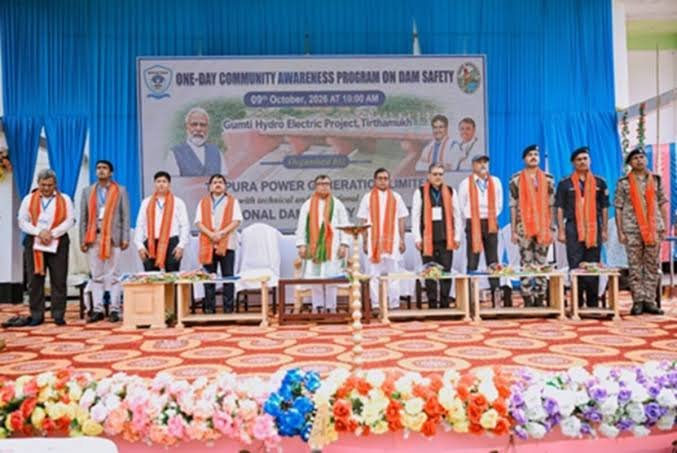
The Tripura dam safety awareness programme has renewed attention on dam maintenance, disaster preparedness and the protection of communities living downstream. Power Minister Ratan Lal Nath inaugurated the state-level community awareness programme on October 9, 2026, at the Gumti Hydro Electric Project in Tirthamukh, Gomati district. The event, organised by Tripura Power Generation Limited with support from the National Dam Safety Authority, brought together officials and local stakeholders to discuss preventive measures and public safety. The programme also highlighted plans to restore the flood-damaged Gumti hydropower facility with an estimated investment of ₹100 crore.
Infrastructure Expansion Fast-Tracked Across Border Connectivity Projects in Unakoti
Tripura Dam Safety Awareness Focuses on Downstream Communities
Power Minister Ratan Lal Nath addressed the gathering at Tirthamukh and stressed the importance of protecting people who live in areas below dams. Such communities may face risks during extreme rainfall, floods or other emergencies involving water infrastructure.
The programme aimed to improve public understanding of dam safety and the measures authorities take to monitor infrastructure. It also highlighted the need for cooperation between technical experts, government departments, disaster management teams and residents.
Dams serve several important purposes, including electricity generation, water storage and support for local economic activities. However, their safe operation requires regular inspections, maintenance and careful monitoring of changing conditions.
The consequences of dam-related emergencies can extend beyond the immediate structure. Communities downstream may depend on timely warnings and clear instructions when authorities identify a potential risk. Therefore, public awareness forms an important part of wider safety planning.
The event at Tirthamukh provided an opportunity to explain these concerns to local residents and students. Participants could learn why authorities monitor dams and how communities should respond to official safety instructions.
The National Dam Safety Authority supported the initiative by bringing attention to the importance of preventive measures. Its involvement also connected the local awareness programme with the wider national framework for dam safety.
Moreover, the programme highlighted the importance of sharing accurate information with residents. Clear communication can help people understand official warnings, identify appropriate sources of information and avoid confusion during emergencies.
Dam Safety Act and Regular Inspections
India enacted the Dam Safety Act in 2021 to strengthen the oversight of specified dams and establish a framework for their safe operation, maintenance and inspection. The legislation provides for institutional arrangements and responsibilities relating to dam safety.
During the awareness programme, Nath referred to the importance of preventive measures and the need to prepare for possible risks. Regular inspections help engineers assess a dam’s condition, identify defects and recommend maintenance or corrective action.
Pre-monsoon inspections can help authorities assess whether structures and associated systems are ready for seasonal rainfall. Post-monsoon inspections can help identify damage or changes following heavy rainfall and flooding.
However, inspections represent only one part of dam safety management. Authorities must also maintain relevant records, assess technical findings and respond appropriately when engineers identify problems.
Emergency preparedness is equally important. Authorities need suitable procedures for communicating warnings, coordinating agencies and informing people who may face risks downstream. Local awareness programmes can help residents understand why they should follow official instructions during emergencies.
The programme also underscored the importance of cooperation among technical agencies and local administrations. Engineers assess infrastructure, while disaster management teams and district officials help coordinate public safety measures.
For residents, the central message is that dam safety requires continuous attention rather than action only when a problem arises. Preventive inspections, timely maintenance and clear communication can help authorities manage risks and protect communities.
Gumti Hydropower Project Restoration Plan
The Gumti Hydro Electric Project at Tirthamukh is Tripura’s historic hydropower facility. The project harnesses water from the Raima and Saima river systems in the Dumboor area of Gomati district.
The facility originally had three generating units with a combined installed capacity of 15 megawatts. Over time, electricity generation declined, and the plant’s operating capacity had fallen substantially before the devastating floods of 2024 caused extensive damage.
The floods left the facility unable to generate electricity, prompting the state government to examine the possibility of restoring its operations. Technical assessments helped officials understand the damage and evaluate the work required for rehabilitation.
According to the minister’s announcement, the government plans to invest approximately ₹100 crore in restoring the project. Officials expect restoration work to begin in December 2026, with a target of bringing electricity generation back to around 10–11 megawatts after completion.
The government also sought technical assessments from institutions including the National Institute of Technology Agartala, the Indian Institute of Technology Guwahati, the National Hydroelectric Power Corporation and Bharat Heavy Electricals Limited. These assessments were intended to help determine the feasibility and requirements of restoration.
The proposed work highlights the relationship between infrastructure recovery and long-term safety management. Engineers must assess damaged equipment and relevant structures before determining the appropriate restoration measures.
However, the announced generation target remains a planned outcome rather than a completed result. Actual performance will depend on the restoration work, technical requirements and successful commissioning of the facility.
The project also has wider significance for the surrounding area. Dumboor’s water resources support fishing, tourism and other local economic activities. Therefore, the government must consider the facility’s broader role alongside electricity generation and infrastructure safety.
Community Preparedness and Public Safety Measures
Community awareness remains an important part of efforts to protect people living near dams and reservoirs. Residents who understand official warning systems and emergency instructions may be better prepared to respond when authorities identify a potential danger.
Students, local organisations and community representatives can also help spread accurate information about safety measures. Schools and public institutions provide useful settings for explaining why people should follow official instructions rather than rely on rumours during emergencies.
At the same time, residents should avoid entering restricted areas around dam structures or approaching dangerous water conditions. They should follow instructions issued by authorised officials and report visible concerns through appropriate channels.
Government departments also need to coordinate their responsibilities. Dam operators, engineers, district administrations and disaster management agencies each have different roles in monitoring conditions and preparing for emergencies.
The October 9 programme brought these issues into focus at a location closely associated with Tripura’s hydropower infrastructure. It connected public awareness with the technical work required to maintain and restore an important facility.
The restoration plan and awareness initiative address related but distinct priorities. Rehabilitation aims to recover the plant’s electricity generation capacity, while dam safety measures focus on monitoring infrastructure and protecting people.
Continued public communication, regular technical assessments and coordination among agencies will remain important as the government moves forward with the restoration plan. The programme’s longer-term value will depend on sustained attention to these responsibilities beyond the event itself.
Conclusion
The Tripura dam safety awareness programme at Tirthamukh highlighted the importance of preventive inspections, emergency preparedness and protection for people living downstream of dams. Power Minister Ratan Lal Nath addressed the one-day event on October 9, 2026, which Tripura Power Generation Limited organised with support from the National Dam Safety Authority. The programme encouraged greater public understanding of the measures required to manage risks around dam infrastructure.
The event also brought attention to the proposed ₹100-crore restoration of the Gumti Hydro Electric Project, which suffered extensive damage during the 2024 floods. The government plans to begin restoration work in December 2026 and aims to recover electricity generation to approximately 10–11 megawatts. Technical assessments will help guide the work, although the target depends on successful restoration and commissioning.
Ultimately, dam safety requires sustained cooperation between engineers, government departments, disaster management agencies and local communities. Regular inspections, timely maintenance and clear public communication can help authorities address risks and improve preparedness. As the government pursues the Gumti project’s restoration, maintaining a strong focus on infrastructure safety and downstream protection will remain essential.
FAQs
1. Where did the Tripura dam safety awareness programme take place?
The programme took place at the Gumti Hydro Electric Project in Tirthamukh, Gomati district, on October 9, 2026.
2. Who inaugurated the dam safety awareness programme?
Tripura Power Minister Ratan Lal Nath inaugurated and addressed the one-day community awareness programme, which Tripura Power Generation Limited organised with support from the National Dam Safety Authority.
3. Why is dam safety awareness important for downstream communities?
People living downstream may face risks during floods or other dam-related emergencies. Awareness programmes explain safety precautions, official warnings and the importance of following instructions from authorised agencies.
4. How much will Tripura invest in restoring the Gumti hydropower project?
The state government has announced an estimated investment of ₹100 crore. Restoration work is expected to begin in December 2026, with a generation target of approximately 10–11 megawatts after completion.
5. What role does the Dam Safety Act, 2021, play in India?
The Act establishes a legal framework for the safe surveillance, inspection, operation and maintenance of specified dams. It also provides institutional arrangements to strengthen dam safety management.