


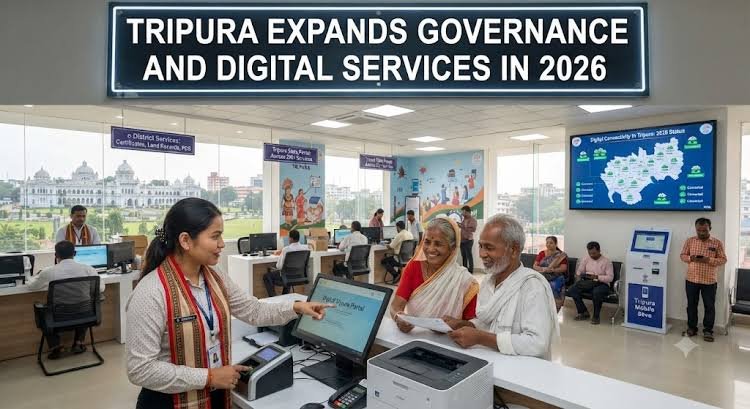
Tripura has expanded its unified digital governance framework across all eight districts through the UNNOTI unified services platform. The Tripura unified digital governance initiative brings multiple government services and schemes into a common citizen-facing system while connecting district-level administration with state technology infrastructure. The platform is designed to make public services easier to discover, apply for and track online.
The development marks another step in Tripura’s broader digital transformation. The state has already built interconnected systems for finance, land administration, healthcare, education, transport, welfare and justice. Moreover, NIC Tripura reports that all eight districts now have high-capacity network connectivity supporting government applications and administrative operations.
Tripura Hosts State Consultation Panel on Technology in Governance at IT Bhavan
Tripura Unified Digital Governance Reaches All Eight Districts
The Tripura unified digital governance system is built around UNNOTI, described by the state as a Unified Digital Citizen Services Platform. The portal currently connects 27 government departments and lists more than 100 services and schemes for citizens. It also provides application tracking and access to the CM Helpline 1905.
UNNOTI covers all eight districts of Tripura. These include West Tripura, Sepahijala, Khowai, South Tripura, Gomati, Dhalai, Unakoti and North Tripura. The platform also provides district-level information covering headquarters and subdivisions, creating a common digital access point for residents across the state.
The coverage is significant because government services often operate through different departments and administrative levels. A unified platform can reduce the need for citizens to search separately for individual departmental systems.
Furthermore, the portal allows users to browse services by department or search directly for a particular scheme or certificate. This approach can make digital services easier to navigate, particularly when residents are unfamiliar with the department responsible for a particular benefit.
The system also includes application-status tracking. Therefore, citizens can use the same platform not only to discover services but also to follow applications after submission.
Unified Portal Connects Multiple Government Services
The central objective of UNNOTI is to bring services together rather than leave citizens dependent on separate digital platforms. The portal currently promotes more than 100 government services and schemes through one interface.
Services listed on the platform include areas such as certificates, pensions, scholarships and ration-card-related applications. The portal also provides access to verification functions and other citizen utilities.
The approach builds on Tripura’s earlier e-District infrastructure. The official e-District portal explains that the system was designed to improve service delivery at district and sub-district levels through workflow automation, backend computerisation and data digitisation.
UNNOTI therefore represents an evolution of the state’s wider e-governance architecture rather than an entirely isolated digital project. Earlier systems established electronic service delivery, while the unified platform seeks to make access more consolidated.
A unified interface can also help citizens avoid confusion caused by multiple portals. Instead of remembering different websites or processes, residents can begin with one service-discovery platform and then follow the relevant application process.
However, integration remains a continuing process. Government departments must maintain accurate service information, update application workflows and ensure that backend systems communicate reliably.
Digital Infrastructure Supports Tripura’s Governance Network
The expansion of Tripura unified digital governance depends on the state’s underlying connectivity and data infrastructure. NIC Tripura reports that all eight districts are interconnected through high-speed primary links, with additional failover connectivity to support continuity.
The state’s digital backbone includes NICNET, the National Knowledge Network, the Tripura State Wide Area Network and other connectivity systems. These networks connect government offices and critical institutions across the state.
NIC also reports that Tripura hosts mission-critical government applications through infrastructure including the Mini Data Centre, State Data Centre, Container Data Centre and National Data Centre. This provides the technical foundation for digital services and administrative applications.
District connectivity is particularly important for a state where citizens live across urban, rural and geographically difficult areas. A centralised portal becomes more useful when government offices at different levels can access the same digital ecosystem.
The network also supports video conferencing between the state headquarters and district administrations. According to NIC, Tripura has video-conferencing facilities at state and district levels and conducts a large number of administrative and training sessions through the system.
Consequently, the unified portal forms only one part of a much larger digital governance structure. Connectivity, hosting, cybersecurity and departmental integration all influence how effectively citizens can use online services.
District Administration Gets Stronger Digital Monitoring Tools
Tripura has also developed digital systems that help senior officials monitor government programmes. NIC’s Tripura digital governance review identifies Tripura Darpan as one such platform. Launched in 2017, it provides real-time dashboards for the Chief Minister and District Magistrates.
The District Magistrate Dashboard has been rolled out across all eight districts. Integrated analytical dashboards also monitor key performance indicators associated with 19 flagship schemes. This gives administrators a data-based mechanism for tracking programme implementation.
Such systems complement citizen-facing portals. While UNNOTI focuses on access to services and schemes, administrative dashboards focus more heavily on implementation and monitoring.
Similarly, other digital systems operate across specific government functions. eProsecution, for example, is operational across all eight districts and supports electronic coordination between police and prosecution authorities. eCourts services are also operational across the state’s judicial infrastructure.
The wider ecosystem demonstrates that Tripura’s digital transformation involves both front-end citizen services and back-end administrative processes. Both sides need to function together if technology is to improve public service delivery.
Moreover, electronic systems can provide better records and tracking when departments use them consistently. Digital workflows can reduce paperwork while making it easier for authorised officials to monitor pending applications and administrative actions.
UNNOTI Builds on Earlier E-Governance Reforms
The idea behind the unified portal predates its current implementation. A Department of Administrative Reforms and Public Grievances report described UNNOTI as a project intended to unify e-service delivery in Tripura. The project aimed to integrate isolated service platforms and improve citizen access through a common system.
The same report identified Aadhaar-seeded ration-card information as one component of the proposed service architecture and discussed recommendations for integrating high-volume services and schemes. The broader objective was to create a more unified service-delivery environment.
The current UNNOTI platform shows that this digital integration has moved into a wider operational phase. Its present interface provides access to more than 100 services and schemes while extending coverage across all eight districts.
The portal also provides a direct connection to the state’s CM Helpline 1905. The current platform identifies the helpline as a 24-hour service for UNNOTI-related queries.
This support mechanism can be important for citizens who encounter difficulties while using online services. Digital access becomes more practical when users have a channel for resolving application or service-related problems.
At the same time, digital governance should not eliminate offline assistance for citizens who lack reliable internet access or digital skills. Government offices, service centres and frontline officials remain important for inclusive service delivery.
Citizen Access Becomes Central to Digital Transformation
The main test for Tripura unified digital governance will be whether residents experience simpler and faster access to public services. Technology can consolidate services, but the real benefit depends on how well the underlying administrative processes operate.
The current UNNOTI platform reports more than 12.48 lakh citizens served and over 1.44 lakh applications processed. It also reports an average processing service-level target of less than 48 hours across its connected services. These are platform-reported figures and should be understood as operational indicators rather than independent assessments of every service.
The system’s district-wide coverage also creates a foundation for more consistent service access. Residents in Belonia, Kailashahar, Dharmanagar, Ambassa, Udaipur and other district centres can access the same broad digital platform as residents of Agartala.
Furthermore, a common interface can help the government standardise information about eligibility, applications and service procedures. Clear information can reduce unnecessary visits to offices and improve awareness of available schemes.
However, digital inclusion remains important. Reliable connectivity, language accessibility, data security and assistance for people unfamiliar with online applications will influence the effectiveness of the system.
Future Scope for Tripura’s Smart Governance Network
The expansion of UNNOTI provides Tripura with a foundation for further integration. As more departmental services connect to the platform, citizens could increasingly use one digital entry point for a wider range of government interactions.
The state’s existing technology infrastructure provides room for such expansion. NIC reports that numerous government applications already operate across sectors including healthcare, education, land records, transport, municipalities, finance and welfare.
Future progress will depend on interoperability between these systems. Departments need to exchange information securely while avoiding unnecessary duplication of citizen data.
Cybersecurity will also remain essential as more services move online. Strong authentication, secure infrastructure, responsible data management and regular system monitoring can help protect government services and citizen information.
Additionally, digital platforms should continue improving accessibility. Mobile-friendly interfaces, clear instructions, multilingual support and assisted service channels can help ensure that technological expansion benefits people across different communities.
The state’s current approach indicates that digital governance is moving beyond individual departmental websites. Instead, Tripura is developing an interconnected model combining citizen services, administrative dashboards, digital infrastructure and district-level connectivity.
Conclusion
The Tripura unified digital governance initiative marks an important expansion of the state’s citizen-service infrastructure. Through UNNOTI, more than 100 government services and schemes are being brought together on a common platform serving all eight districts.
The initiative builds on years of investment in e-District, digital networks, departmental applications and administrative dashboards. Therefore, its long-term impact will depend on continued integration, reliable infrastructure, cybersecurity and accessible support for citizens.
FAQs
What is Tripura unified digital governance?
Tripura unified digital governance refers to the state’s effort to integrate citizen services, departmental systems and digital administrative infrastructure. UNNOTI is the state’s unified citizen-services platform.
What is UNNOTI?
UNNOTI is Tripura’s Unified Digital Citizen Services Platform. The current portal provides access to more than 100 government services and schemes and allows users to track applications.
Does UNNOTI cover all eight districts?
Yes. The platform identifies service coverage across all eight districts: West Tripura, Sepahijala, Khowai, South Tripura, Gomati, Dhalai, Unakoti and North Tripura.
How does Tripura support its digital governance infrastructure?
NIC Tripura operates connectivity and hosting infrastructure including NICNET, NKN, TSWAN and government data centres. All eight districts have high-capacity network connectivity supporting digital government applications.
What other digital governance systems does Tripura use?
Tripura operates several digital platforms, including e-District, eGRAS, eOffice, Tripura Darpan, eCourts, eProsecution and digital systems for healthcare, land records, transport and welfare delivery.