


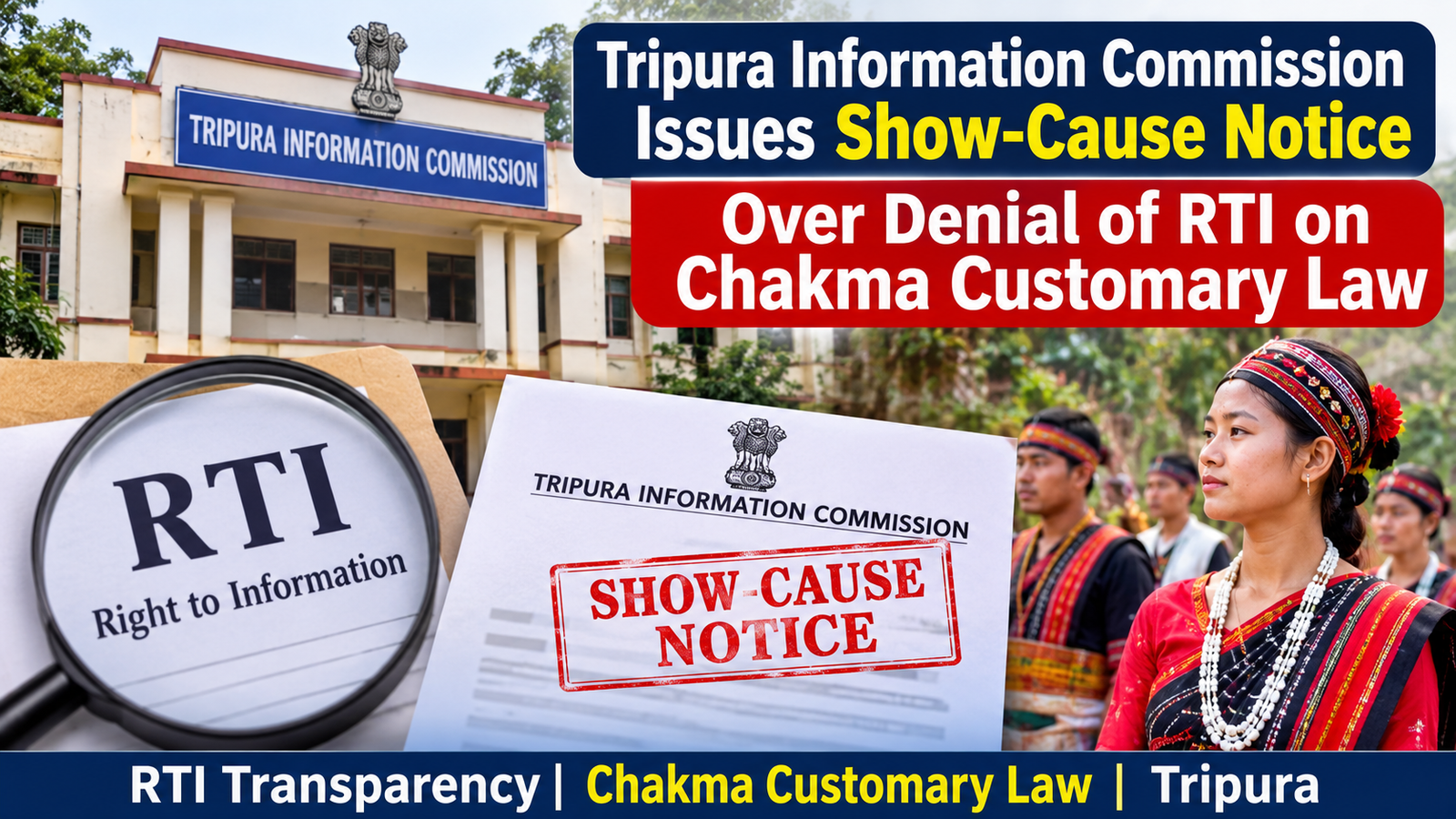
The Tripura Information Commission has issued a show-cause notice to a senior Tribal Welfare Department official over the denial of information concerning the proposed Chakma Customary Law Act, 2022. Chief Information Commissioner Binoy Shankar Mishra issued the notice to S. Prabhu, Additional Secretary of the department, questioning his handling of a Right to Information (RTI) application filed by Jagdish Rawat of the Chakma Development Foundation of India (CDFI).
The Commission found that the official had relied on legally unsustainable grounds to withhold the requested documents. It has also sought an explanation on why disciplinary proceedings should not begin and why the maximum penalty of ₹25,000 should not be imposed. The order highlights alleged procedural violations, misleading information and a delay of 1,131 days in handling the RTI request.
Read More: Tripura Seeks Better SC Student Scholarship Implementation
Key Facts About the Tripura RTI Case
- Department: Tripura Tribal Welfare Department
- Authority: Tripura Information Commission
- Chief Information Commissioner: Binoy Shankar Mishra
- Official issued notice: S. Prabhu, Additional Secretary
- RTI applicant: Jagdish Rawat, Chakma Development Foundation of India
- RTI application date: August 28, 2023
- Order made available: November 19, 2026
- Delay identified: 1,131 days
- Maximum proposed penalty: ₹25,000
- Legal provision: Sections 8(1)(c) and 20(2) of the RTI Act
Tripura Information Commission Questions Tribal Welfare Official
The Tripura Information Commission has questioned the handling of an RTI application seeking official records related to the proposed Chakma Customary Law Act, 2022.
Chief Information Commissioner Binoy Shankar Mishra issued the show-cause notice to S. Prabhu, who serves as Additional Secretary in the Tribal Welfare Department.
The Commission took action following an appeal filed by Jagdish Rawat, office secretary of the Chakma Development Foundation of India (CDFI).
According to the order, Prabhu failed to provide the requested information and relied on grounds that the Commission considered legally unsustainable.
What Information Did the RTI Applicant Seek?
Jagdish Rawat submitted the RTI application to the Tribal Welfare Department on August 28, 2023.
He sought several documents concerning the proposed Chakma Customary Law Act, 2022, including:
- Copies of official communications relating to the proposed legislation.
- Submissions made by Chakma organisations.
- The Tribal Welfare Department’s views on the proposed law.
- A certified copy of the Act.
However, Prabhu, who was serving as the Public Information Officer (PIO), rejected the application, claiming that the matter was pending before the state legislature.
He later acted as the First Appellate Authority and upheld the rejection. The department also forwarded the application to a private organisation, Chakma Miley Jodha (Chakma Women’s Association), for the requested information.
Rawat challenged these decisions before the Tripura Information Commission, arguing that the reasons for withholding the documents had no legal basis.
Commission Finds Legal and Procedural Violations
In its order, made available on November 19, the Commission found that no legislative privilege had been established to justify withholding the requested records.
It also ruled that transferring an RTI application to a private organisation was legally unsustainable under the statutory framework.
Furthermore, the Commission questioned Prabhu’s role as both the Public Information Officer and First Appellate Authority. It observed that he had effectively reviewed his own earlier decision.
The order also referred to the Delhi High Court’s November 18, 2011, judgment in Suhas Chakma v. Union of India and Others, which examined the limits of review powers under the RTI framework.
Commission Flags 1,131-Day Delay and ₹25,000 Penalty
Another major concern involved the delay in processing the information request.
The Commission identified a delay of 1,131 days between September 2, 2023, and October 6, 2026.
Under the RTI Act, the penalty calculated at ₹250 per day would amount to ₹2,82,750. However, the law caps the maximum monetary penalty at ₹25,000.
Therefore, the Commission has sought an explanation on why the maximum statutory penalty should not be imposed.
It also found that the applicant had received incorrect, incomplete and misleading information.
The show-cause notice invokes Section 20(2) of the RTI Act, read with applicable service rules, and asks Prabhu to explain why disciplinary proceedings should not begin.
Controversy Surrounding the Chakma Customary Law Act
The proposed Chakma Customary Law Act has faced opposition from the Chakma Development Foundation of India, Chakma Miley Jodha and other groups.
According to the material submitted by the applicant, the Tripura Law Department had also rejected the proposed legislation.
The latest order has brought renewed attention to the controversy, particularly the questions surrounding transparency, access to government records and the handling of customary law-related matters in Tripura.
Frequently Asked Questions (FAQs)
Q1. Why did the Tripura Information Commission issue a show-cause notice?
The Commission questioned the denial of RTI information concerning the proposed Chakma Customary Law Act, 2022, and alleged procedural violations.
Q2. Who received the show-cause notice?
S. Prabhu, Additional Secretary of the Tripura Tribal Welfare Department.
Q3. Who filed the RTI application?
Jagdish Rawat, office secretary of the Chakma Development Foundation of India.
Q4. What is the maximum penalty under consideration?
The Commission has sought an explanation on why the maximum penalty of ₹25,000 should not be imposed.
Q5. What is the main issue surrounding the Chakma Customary Law Act?
The proposed legislation has faced opposition from several Chakma organisations, while the RTI applicant sought official documents and government views concerning the law.
Also Read: Assam CM Highlights Child Welfare Schemes on Children’s Day