


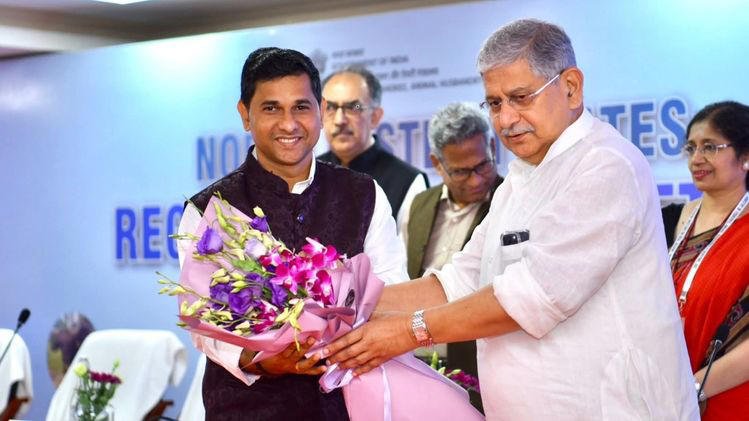
Tripura’s Animal Resources Development Department and Fisheries Minister Sudhangshu Das on May 25 urged the Centre to revise the current funding pattern under the Pradhan Mantri Matsya Sampada Yojana (PMMSY) for Northeastern states. The minister proposed replacing the existing 60:40 funding model with a 90:10 ratio, stating that the current arrangement places significant financial pressure on small and marginal farmers across the region.
The appeal also included a demand for timely release of approved funds to ensure smooth implementation of fisheries projects and prevent delays that affect beneficiaries.
Tripura argued that fisheries continue to emerge as a vital economic sector in the Northeast and require stronger financial backing to unlock their full potential.
Tripura Demands Revision of Existing 60:40 Funding Pattern
During discussions on fisheries development, Fisheries Minister Sudhangshu Das highlighted that the present 60:40 funding ratio under PMMSY does not fully address the realities of Northeastern states.
Under the current structure, states are expected to contribute 40 percent of project costs. According to the minister, this requirement creates challenges for implementation, especially in regions where farmers often have limited financial capacity.
Das stressed that many beneficiaries under fisheries programmes belong to the small and marginal category and may struggle to participate when the state’s financial contribution becomes difficult to mobilise.
Tripura therefore proposed a revised 90:10 funding structure, under which the Centre would bear 90 percent of project expenditure while states would contribute the remaining 10 percent.
State officials believe this approach would increase participation and improve access to government-backed fisheries initiatives.
Small and Marginal Farmers at the Centre of the Demand
Tripura linked its proposal directly to the welfare of small and marginal fish farmers.
Officials stated that these farmers play a major role in sustaining local fish production but often operate with limited resources and infrastructure support.
The state argued that a higher central contribution would reduce pressure on both governments and beneficiaries and make fisheries schemes more accessible.
Many fisheries projects require investment in pond development, hatcheries, fish seed production, feed management, and storage infrastructure. For smaller participants, arranging financial support remains a challenge.
Tripura believes a revised funding pattern would encourage wider adoption of modern aquaculture practices and improve long-term productivity.
Timely Release of Funds Remains a Key Concern
Apart from seeking changes in the funding formula, Tripura strongly emphasised the importance of releasing funds on schedule.
According to the state government, delayed fund allocation affects project timelines and disrupts implementation plans.
Since fisheries activities often depend on seasonal cycles, postponements can reduce productivity and limit outcomes.
The government argued that predictable and timely financial support would help departments complete projects efficiently and ensure beneficiaries receive assistance when required.
Officials also noted that faster disbursement could improve coordination between departments and reduce administrative delays.
PMMSY Seen as a Major Opportunity for Fisheries Growth
The Pradhan Mantri Matsya Sampada Yojana has become one of India’s flagship programmes aimed at transforming the fisheries sector.
The scheme focuses on increasing fish production, improving infrastructure, generating employment, and creating stronger market systems.
For Tripura and other Northeastern states, PMMSY has opened opportunities to expand aquaculture and strengthen local economies.
State authorities believe that with improved funding support, projects under the scheme could achieve greater reach and faster implementation.
Tripura has continued to prioritise fisheries as an important contributor to rural development and income generation.
Northeast’s Unique Challenges Need a Different Funding Approach
Tripura maintained that Northeastern states face conditions that require tailored policy support.
Geographical barriers, higher infrastructure costs, transportation challenges, and dispersed populations often increase implementation expenses.
State officials argued that applying a uniform funding model may not produce equal outcomes across regions.
The proposed 90:10 structure, according to the state, would better reflect local conditions and strengthen execution capacity.
Supporters of the move believe such financial flexibility could accelerate infrastructure development and support inclusive growth.
Fisheries Sector Expected to Drive Rural Economic Growth
Tripura sees fisheries as an important sector for creating employment and strengthening rural livelihoods.
Beyond fish production, the sector supports activities such as processing, transportation, cold storage, and local markets.
The government believes that stronger investment through PMMSY can improve production capacity and reduce dependency on external supply.
Officials also pointed out that greater financial support could encourage youth participation and promote entrepreneurship in fisheries-related activities.
As discussions continue with the Centre, Tripura remains hopeful that a revised funding ratio and timely release of funds will strengthen PMMSY implementation and provide meaningful support to fish farmers across the Northeast.