


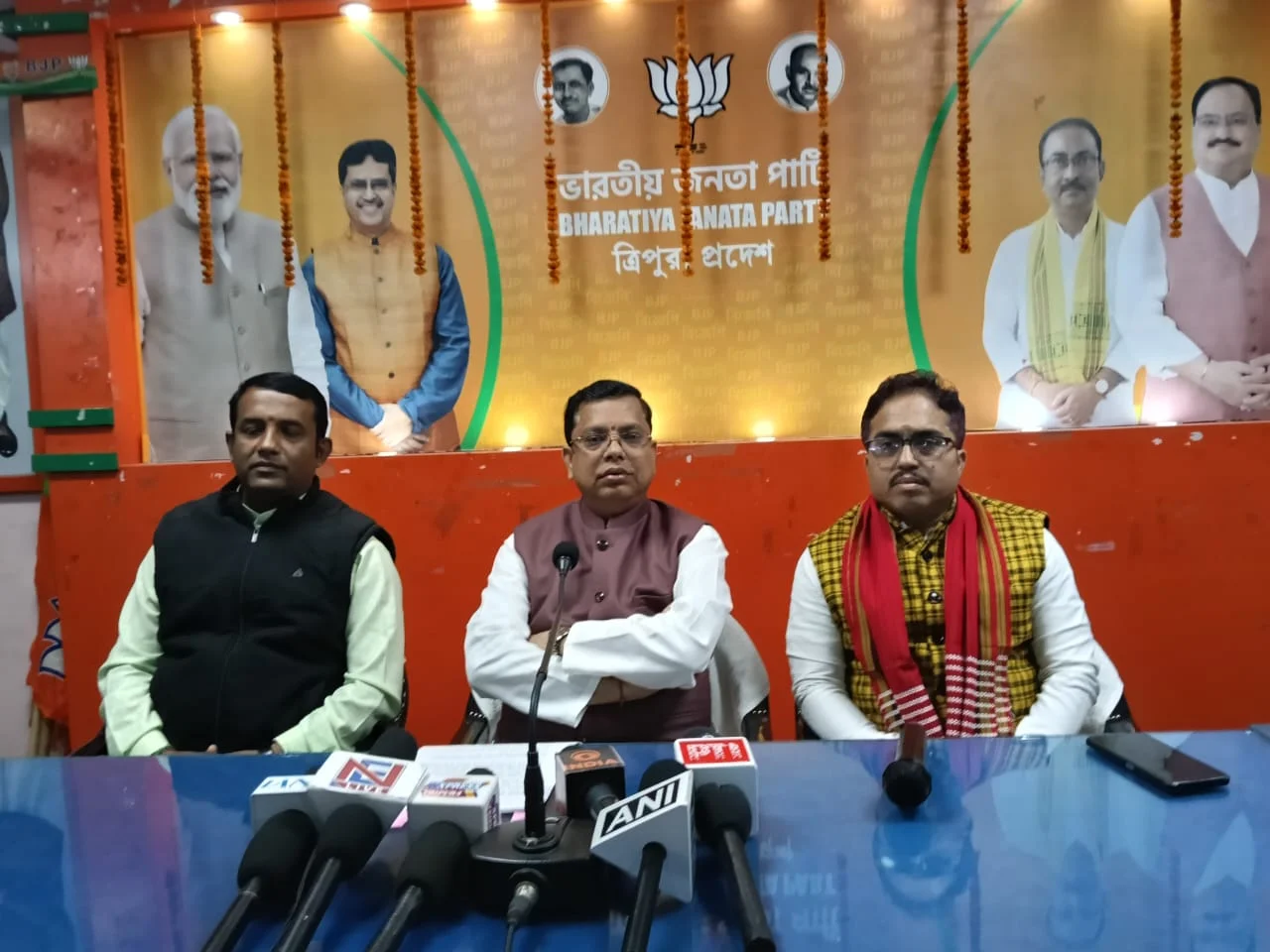
Tripura minister Tinku Roy on Friday accused the opposition of deliberately spreading misinformation over the alleged renaming of the Mahatma Gandhi National Rural Employment Guarantee Act (MGNREGA). He said daily protests across the state were misleading people and creating unnecessary confusion.
Addressing a press conference, Roy dismissed claims that the government had abruptly removed Mahatma Gandhi’s name from the rural employment scheme. He urged citizens to understand the historical evolution of rural employment programmes in India before drawing conclusions.
Read More: No Nipah Virus Case in Tripura, CM Manik Saha Assures
Rural Employment Schemes Existed Before MGNREGA
Roy explained that India introduced several rural employment and social security initiatives long before MGNREGA came into existence. Programmes such as Relief Work, Food for Work, and the National Rural Employment Programme (NREP) laid the foundation for future employment schemes.
According to him, these initiatives eventually evolved into the National Rural Employment Guarantee Act in 2005. Later, in 2009, Mahatma Gandhi’s name was added to the scheme, which then became popularly known as MGNREGA.
He said the current restructuring reflects the natural progression of rural development policies over time rather than any political motive.
VB-G Ram Ji Project Replaces MGNREGA Framework
Roy said that after nearly two decades, the scheme has undergone a comprehensive reform. It has now been renamed the Viksit Bharat Guarantee for Rozgar and Ajeevika Mission (Gramin), also referred to as the VB-G Ram Ji Project.
Describing the new framework as a significant upgrade, the minister said the restructured law addresses several limitations of the previous scheme. He added that the focus has shifted toward productivity, transparency, and long-term rural development.
Employment Days Increased, Transparency Strengthened
One of the major changes under the new project is the increase in guaranteed employment days. Roy said the limit has been raised from 100 days to 125 days per household.
He also claimed that the new framework improves planning and accountability. Structural weaknesses present under MGNREGA have been corrected to reduce misuse and strengthen monitoring mechanisms.
According to the minister, the project aims to create durable assets in rural areas. It also seeks to boost incomes and improve resilience against natural disasters and financial shocks.
NDA’s Spending Reflects Commitment to Rural Development
Highlighting government expenditure, Roy compared allocations made by successive administrations. He said the UPA government spent ₹2.13 lakh crore on MGNREGA during its tenure.
In contrast, he claimed the NDA government allocated nearly ₹7.8 lakh crore for rural employment programmes between 2015 and 2025. Roy said the figures reflect the NDA’s sustained commitment to rural welfare and job creation.
“These numbers speak for themselves,” he said, adding that financial support for rural livelihoods has increased significantly in recent years.
Opposition Accused of Misleading the Public
Roy strongly criticized the opposition for focusing only on the scheme’s name rather than its impact. He said protests were being used to distract people from discussions on employment generation and wage benefits.
According to him, such narratives aim to damage the image of developmental initiatives. He urged citizens not to fall prey to rumors or politically motivated misinformation.
Government Reaffirms Support for Rural Communities
Concluding his remarks, Roy reaffirmed the government’s commitment to protecting the interests of rural communities. He said the focus remains on employment security, income growth, and sustainable rural development.
He added that the government would continue to refine policies to meet the changing needs of rural India.
Also Read: Assam guv highlights role of GI products in heritage – Prime 24 Seven