


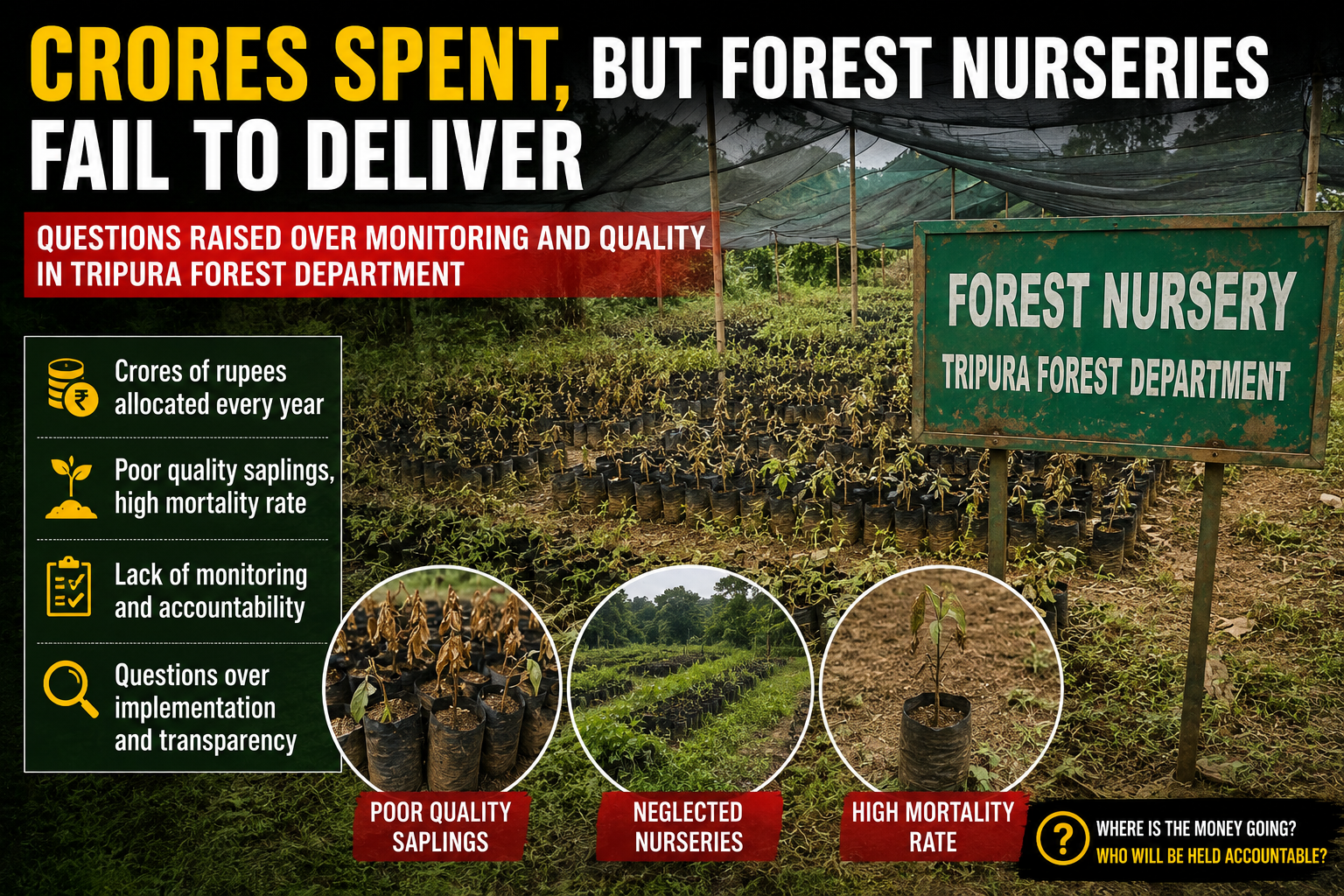
Serious concerns have emerged regarding the functioning of forest nurseries and research centres operated by the Forest Department across Tripura. Despite the expenditure of crores of rupees on nursery development, plantation activities, and forestry programmes, allegations suggest that many facilities are struggling to produce sufficient quality saplings.
Stakeholders have also raised concerns about inadequate monitoring, weak accountability, and declining operational efficiency. Experts warn that poor nursery performance could affect afforestation projects, biodiversity conservation, and green-cover expansion goals. As a result, calls for independent audits and stronger oversight have gained momentum across the state.
Read More: Tripura CM Meets Surrendered Militants Amid Blockade Threat
Key Facts
- Location: Tripura
- Department Involved: Forest Department
- Issue: Alleged poor performance of forest nurseries and research centres
- Primary Concern: Lack of quality sapling production
- Additional Concerns: Weak monitoring, poor accountability, resource utilization
- Affected Areas: Afforestation, biodiversity conservation, plantation programmes
- Demand: Independent assessment and performance audit
- Current Status: Allegations have sparked public debate
Concerns Grow Over Forest Nursery Operations
Forest nurseries and research centres play a vital role in supporting plantation and conservation programmes across Tripura.
However, concerns are growing over their effectiveness. Sources familiar with forestry operations claim that many nurseries are failing to produce adequate quantities of quality planting materials despite substantial financial investments over the years.
Consequently, questions are being raised about planning, implementation, and long-term management practices.
Nurseries Expected to Support Green Initiatives
The Forest Department established these facilities to produce saplings of timber species, bamboo, fruit-bearing trees, medicinal plants, and ornamental species.
These nurseries support afforestation drives, biodiversity conservation projects, and livelihood programmes. Furthermore, they supply planting materials for government plantations and community-based forestry initiatives.
Therefore, their performance directly influences the success of environmental programmes across the state.
Shortage of Quality Saplings Alleged
Field-level observations and stakeholder feedback reportedly indicate that several nurseries struggle to maintain adequate stocks of quality saplings.
Sources allege that improved varieties of bamboo, fruit plants, medicinal species, and commercially valuable trees are often unavailable in sufficient numbers.
As a result, farmers, local communities, and plantation projects may face challenges in accessing quality planting materials.
The situation has also sparked concerns about whether nursery production is meeting the growing demand generated by large-scale plantation programmes.
Questions Over Resource Utilization
Critics argue that the government spends significant public funds each year on nursery maintenance, infrastructure development, and plantation-related activities.
However, they claim that the expected results are not always visible at the field level. Therefore, concerns have emerged regarding resource utilization and operational efficiency.
Observers believe stronger performance monitoring could help ensure better outcomes from forestry investments.
Monitoring and Supervision Under Scrutiny
Another major issue highlighted by stakeholders is the alleged lack of regular monitoring by senior officials.
According to sources, inspections and field visits have become less frequent in several areas. Consequently, oversight of nursery operations and research activities may have weakened.
Experts suggest that consistent monitoring helps identify problems early and improves accountability among field-level staff.
Without effective supervision, operational shortcomings can continue for extended periods.
Why Nursery Quality Matters
Forestry experts emphasize that nurseries form the foundation of successful afforestation and ecological restoration programmes.
Healthy and scientifically managed saplings generally lead to better plantation survival rates. In contrast, poor-quality planting materials can reduce the effectiveness of plantation drives.
Therefore, nursery performance has a direct impact on forest regeneration, biodiversity conservation, and environmental sustainability.
Any weakness at the nursery stage can affect long-term forestry outcomes.
Calls for Independent Assessment
Several stakeholders have called for an independent evaluation of forest nurseries and research centres across Tripura.
They want authorities to review expenditure patterns, sapling production figures, infrastructure conditions, and plantation outcomes.
In addition, environmental activists have urged the government to introduce greater transparency and accountability in forestry programmes.
Supporters of the proposal believe such an assessment could identify operational gaps and recommend corrective measures.
Need for Stronger Accountability
Sources within the forestry sector also point to administrative challenges and weak coordination between headquarters and field units.
According to them, stronger monitoring systems, periodic audits, scientific nursery management, and performance-based evaluations could improve efficiency.
Moreover, regular reviews could help ensure that public funds achieve their intended environmental and developmental objectives.
Importance of the Issue
The matter assumes greater significance because Tripura has announced ambitious plantation programmes and green-cover expansion initiatives.
As the state pursues environmental conservation goals, the availability of healthy and high-quality planting materials becomes increasingly important.
Therefore, improving nursery performance remains critical for the success of future forestry and ecological restoration projects.
Location Context
Tripura is one of Northeast India’s most forest-rich states and plays an important role in regional biodiversity conservation. Effective nursery management is essential for maintaining ecological balance, supporting rural livelihoods, and strengthening the state’s long-term environmental sustainability goals.
Questions and Answers
What is the main issue?
Concerns have been raised about the performance of forest nurseries and research centres in Tripura despite significant public spending.
Why are forest nurseries important?
They produce saplings needed for afforestation, biodiversity conservation, and plantation programmes.
What concerns have stakeholders raised?
Stakeholders have highlighted alleged shortages of quality saplings, weak monitoring, and poor accountability.
How could this affect Tripura?
Poor nursery performance may impact plantation survival rates, forest regeneration, and green-cover expansion projects.
What are experts recommending?
Experts recommend stronger monitoring, scientific management practices, regular audits, and performance evaluations.
What do activists want?
Environmental activists are demanding an independent assessment and greater transparency in forestry programmes.
Also Read: FPAK Condemns Claims Against Injured Manipur Footballer