


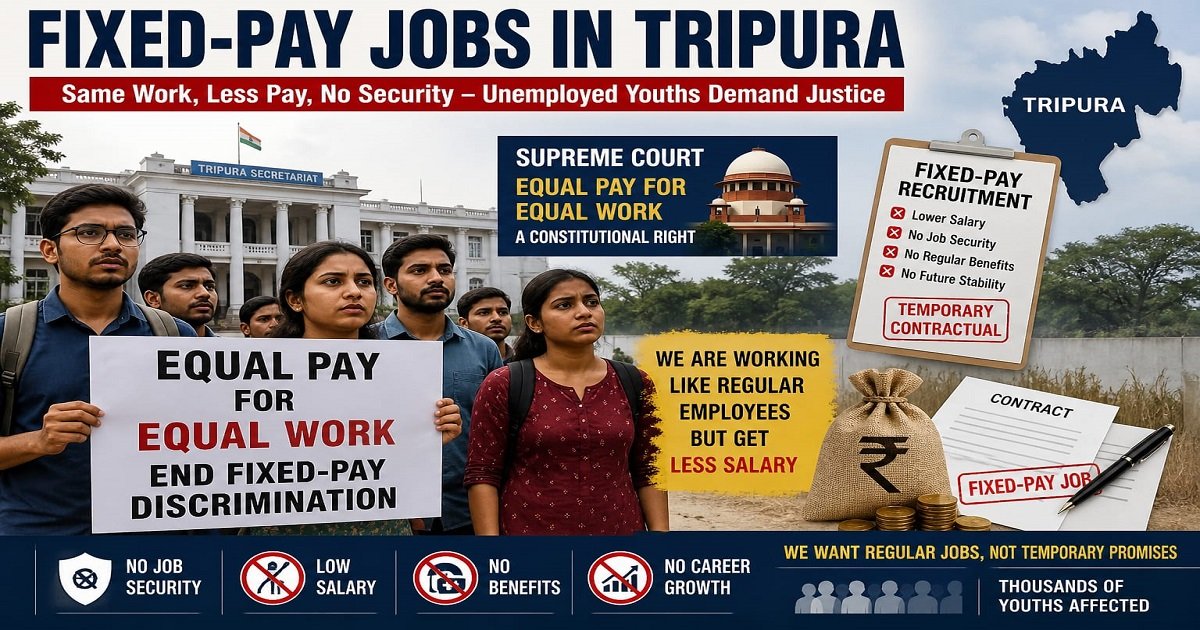
A fresh controversy has emerged in Tripura after the Society for Entrepreneurship Development issued a recruitment notification for over 55 contractual posts across multiple departments. The move has reignited debate over fixed-pay jobs and lack of permanent employment opportunities. While the notification invites applications for various technical and administrative roles, most positions offer short-term contracts. Consequently, unemployed youths and observers have raised concerns about job security and fairness. The issue has also revived discussions on the principle of equal pay for equal work.
Read More: Tripura TTAADC Job Row: No Action on 200 Appointments
Key Facts
- Organization: Society for Entrepreneurship Development
- Location: Tripura
- Posts Announced: 55+ contractual positions
- Application Dates: May 4 to May 22, 2026
- Contract Duration: 6 to 11 months
- Salary Range: ₹20,000 to ₹1.5 lakh per month
- Sectors Covered: Education, healthcare, tourism, rural development, climate change
- Application Fee: ₹200 per applicant
Recruitment Notification Triggers Concerns
The Society for Entrepreneurship Development released a notification on April 30, 2026, inviting online applications for multiple posts. These include officers, coordinators, therapists, programmers, and support staff.
However, most positions offer only short-term contracts. As a result, the announcement has triggered criticism among job seekers who seek stable employment.
Wide Range of Posts and Salaries
The recruitment drive covers diverse roles such as Resorts Manager, Assistant Programmer, Occupational Therapist, Audiologist, Neurologist, and Data Analyst. It also includes positions like Project Assistant and Multi-Tasking Staff.
While the Neurologist post offers the highest salary of ₹1.5 lakh per month, many other roles provide salaries between ₹20,000 and ₹75,000. Therefore, the pay structure varies widely depending on the role and expertise required.
Youth Express Frustration Over Job Security
Many unemployed youths have voiced dissatisfaction with the continued reliance on contractual recruitment. They argue that temporary jobs do not provide long-term stability.
One postgraduate applicant from Agartala said that political leaders had earlier promised regular government jobs. However, most current opportunities remain contractual.
Similarly, an engineering graduate questioned how young professionals can plan their future with six- or eleven-month contracts. These concerns highlight growing frustration among educated job seekers.
Debate Over Application Fees and Fairness
In addition, applicants have raised concerns about the ₹200 application fee. Many candidates claim they repeatedly pay fees for multiple applications without securing permanent jobs.
Some applicants believe that frequent recruitment drives with fees create financial pressure on unemployed youths. Consequently, this has added another layer of criticism to the issue.
Equal Pay Debate Resurfaces
The controversy has also revived discussions on the principle of equal pay for equal work. Critics argue that many contractual employees perform the same duties as permanent staff but receive lower salaries and fewer benefits.
They point out that courts, including the Supreme Court of India, have previously supported equal pay for similar work. However, the practice remains uneven in many sectors.
Political Reactions and Silence
Political observers note that the issue has gained significance because of earlier election promises. Before the 2018 Assembly elections, the Bharatiya Janata Party had criticized fixed-pay jobs and promised regular employment.
However, many youths now claim that contractual recruitment continues under different administrations. At the same time, they have expressed disappointment over the limited response from opposition parties like Congress and CPI(M).
Some youths allege that political parties criticize such policies only during elections but fail to act consistently afterward.
Question–Answer Section
Q1: What triggered the controversy in Tripura?
A SOFED notification announcing over 55 contractual jobs sparked the debate.
Q2: What type of jobs are being offered?
Most positions are contractual roles lasting 6 to 11 months.
Q3: Why are youths protesting?
They are concerned about lack of job security and limited permanent opportunities.
Q4: What is the salary range?
Salaries range from ₹20,000 to ₹1.5 lakh per month.
Q5: What additional concern did applicants raise?
They questioned the repeated collection of application fees.
Location Context
Tripura, a northeastern state of India, faces ongoing challenges related to employment generation. Therefore, recruitment policies and job security remain critical issues for the region’s youth.
Also Read: Gangtok GMC New Mayor Oath Ceremony