


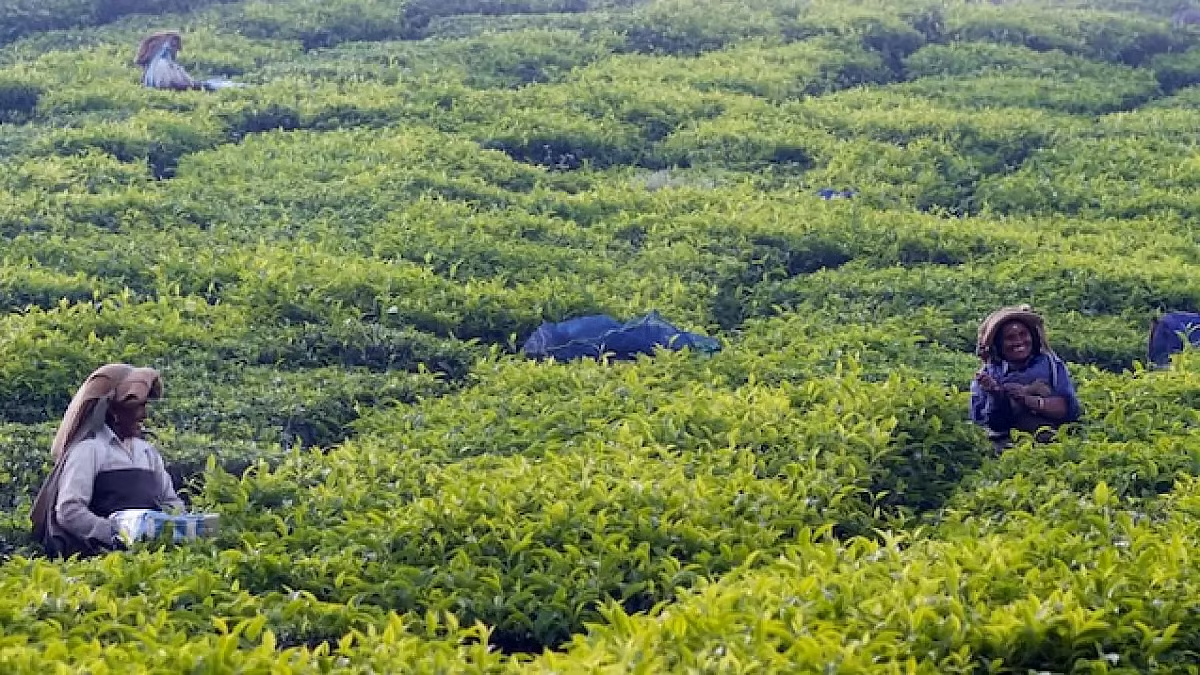
Unpredictable rainfall patterns are creating growing challenges for tea production in Tripura’s Unakoti district, where several estates cultivate orthodox and specialty teas. The Unakoti tea production sector has faced pressure from changing rainfall distribution, rising temperatures and labour shortages. These factors have affected bush growth and contributed to declining output at some of the district’s major estates.
The most detailed recent production data comes from Manu Valley, Tripura’s largest tea estate. Its reported output fell from 24 lakh kg in 2022 to 22 lakh kg in 2023 and 21 lakh kg in 2024. Estate management attributed the decline partly to changing rainfall patterns and excessive rain during critical periods.
Sikkim Special Gram Sabha Drives Awareness of Watershed Schemes and SHG Livelihoods
Unakoti Tea Production Faces Changing Rainfall Patterns
The Unakoti tea production sector depends heavily on a suitable balance of rainfall, temperature and sunlight. Tea bushes require adequate moisture for healthy growth, but excessive or poorly timed rainfall can also interfere with plantation operations and crop development.
Manu Valley’s management reported that rainfall patterns have changed noticeably in recent years. According to the estate’s HR manager, rain that previously arrived during January or February was increasingly beginning around April. At the same time, excessive rainfall during May and June affected the normal growth of tea bushes.
The problem is therefore not simply the total amount of annual rainfall. Its timing and distribution also matter. Tea plants need moisture across the growing cycle, while prolonged dry periods followed by concentrated rainfall can create different stresses for the crop.
Tea Board information describes Tripura as a tea-growing state with annual rainfall of about 2,100 mm and temperatures ranging from roughly 10°C to 35°C. The board also notes that the state’s rainfall has traditionally been relatively well distributed, supporting tea cultivation.
Recent estate-level reports suggest that this traditional pattern is becoming less predictable. Consequently, producers must manage plantations under conditions that can differ from established seasonal expectations.
Orthodox Tea Gains Greater Importance in Unakoti
The Unakoti tea production landscape includes estates producing orthodox, green, specialty and CTC teas. Luxmi’s current estate information lists several Unakoti gardens producing orthodox and specialty teas, including Kalishasan, Golokpur, Sarojini, Jagannathpur and Pearacherra.
Manu Valley presents a different production profile. Luxmi describes the estate as Tripura’s largest tea garden and says it processes fine CTC tea. However, a 2025 report said the estate had stopped producing green tea and was concentrating on orthodox tea because of declining yields.
That shift illustrates how production decisions can change when estates face pressure on overall yields and operating conditions. Orthodox tea can occupy an important position in Tripura’s premium and specialty tea segment, although production volumes vary according to estate conditions.
Unakoti also has a growing identity around specialty teas. Luxmi’s estates in the district include gardens producing orthodox, green and specialty varieties. Its Golokpur estate, for example, produces teas marketed under Silver Flame and Golden Glow names.
Meanwhile, a women-led tea enterprise from Unakoti secured a 140-kg bulk order for specialty teas at the Tripura Reverse Buyer-Seller Meet in June 2026. The order included orthodox, green, white, premium and blue teas, showing that smaller producers are also entering wider markets.
Late-Season Output Faces Multiple Pressures
The Unakoti tea production challenge cannot be attributed to rainfall alone. Labour availability has emerged as another significant constraint for estates attempting to maintain regular plucking and processing operations.
Manu Valley reported in 2025 that only around 300 of its 900 registered workers were regularly attending work. Management linked the shortage partly to workers choosing other employment opportunities. The estate introduced mechanical plucking machines and trained tribal villagers as part of its response, although management said manual plucking remained important for quality production.
Tea production depends on timely plucking because mature leaves need to reach processing facilities within appropriate periods. Labour shortages can therefore affect how efficiently estates harvest available flushes.
Production costs have also increased. The 2025 report from Manu Valley put production costs above ₹180 per kg, while the reported auction price was around ₹206 per kg. Such a narrow margin can make climate-related production losses more difficult for estates to absorb.
Furthermore, the timing of rainfall can complicate field operations. Heavy rain may restrict workers from entering plantations, affect access roads and interfere with harvesting schedules. Even when the bushes receive sufficient moisture, operational disruptions can reduce the amount of usable crop that reaches factories.
The combined effect is significant because tea estates must manage biological production and commercial operations at the same time. Weather affects the crop, while labour and market conditions affect how efficiently producers can turn that crop into saleable tea.
Unakoti Estates Adapt to Climate and Market Risks
The Unakoti tea production sector is already showing signs of adaptation. Replanting represents one long-term measure. Manu Valley has been replanting around 5 to 10 hectares annually, according to the 2025 report, to maintain plantation productivity.
The estate also introduced 50 plucking machines and trained around 100 tribal villagers. These steps were intended to reduce pressure created by labour shortages, although the estate continued to regard manual plucking as important for quality.
Other estates are pursuing differentiated products rather than depending entirely on conventional bulk tea. Luxmi’s Unakoti gardens produce orthodox, green and specialty teas, giving the district a broader product base.
Market access remains another concern. Tripura’s Tea Board profile identifies Guwahati in Assam as the nearest tea auction centre. Transporting tea to markets outside the state can therefore add logistical costs for producers.
The proposed development of an auction centre in Agartala has previously been discussed as a way to improve local tea marketing and reduce transportation burdens. However, such proposals should be distinguished from an operational auction market unless implementation is formally confirmed.
At the same time, Tripura has an expanding small and specialty tea segment. The 2026 NatureliQ Tea order from Unakoti demonstrates that producers can seek buyers beyond conventional auction channels. Such diversification may offer additional market opportunities, although it does not eliminate the underlying production challenges.
Climate Data Highlights Need for Long-Term Monitoring
The Unakoti tea production outlook will depend partly on how rainfall patterns develop over coming seasons. Tripura now has an official rainfall telemetry dataset that records hourly observations through monitoring stations across the state. The National Water Data Portal lists data for 2026–2030 and identifies rainfall and climate as key dataset parameters.
Such long-term weather records can help researchers and agricultural authorities examine changes in rainfall timing and intensity. Estate-level production records can then be compared with rainfall data to identify relationships between weather conditions and tea yields.
That information could support more targeted plantation planning. For example, producers can assess whether particular areas experience recurring moisture stress, excessive rainfall or other conditions that affect crop performance.
The issue also extends beyond individual estates. Tea remains the second-largest organised industry in Tripura after rubber, according to the Tea Board. The sector therefore has wider implications for employment, rural livelihoods and the state’s agricultural economy.
A 2026 study on tea-worker livelihoods in Unakoti also highlighted continuing economic vulnerability among estate communities. It reported that around 3,166 of Tripura’s 6,585 tea-worker families had received land titles under the state’s tea-worker land scheme by March 2026.
Therefore, climate-related production pressure can affect more than factory output. Changes in productivity can influence employment, household income and the long-term viability of plantation communities.
Conclusion
The Unakoti tea production sector is facing a combination of changing rainfall patterns, production pressures, labour shortages and market constraints. Recent data from Manu Valley shows a decline in output between 2022 and 2024, while estate management has identified uneven rainfall and excessive rain during key months as important challenges.
Unakoti nevertheless retains a diverse tea base, with estates producing orthodox, green, specialty and CTC varieties. Producers are responding through replanting, mechanisation, product diversification and efforts to reach wider markets.
The long-term outlook will depend on how effectively estates adapt to changing weather conditions while maintaining labour availability and market access. Better use of local climate data could also help the industry understand rainfall trends and make more informed plantation decisions.
FAQs
What is affecting Unakoti tea production?
Unakoti tea production is facing pressure from changing rainfall patterns, excessive rain during some periods, labour shortages and rising production costs. Manu Valley reported declining output between 2022 and 2024.
Which tea varieties are produced in Unakoti?
Unakoti estates produce several varieties, including orthodox, green, specialty and CTC teas. Luxmi’s estates in the district include gardens producing orthodox and specialty teas.
Why does rainfall distribution matter for tea?
Tea bushes require adequate and reasonably well-distributed moisture. Long dry periods followed by concentrated heavy rainfall can affect bush growth and plantation operations.
Which is Tripura’s largest tea estate?
Manu Valley in Unakoti district is described by Luxmi as Tripura’s largest tea estate. It covers about 493 hectares according to the company’s current estate information.
How is the tea industry responding to production challenges?
Estates have used measures such as replanting and mechanical plucking, while some producers are expanding specialty and orthodox tea offerings. Better climate monitoring may also support longer-term plantation planning.