


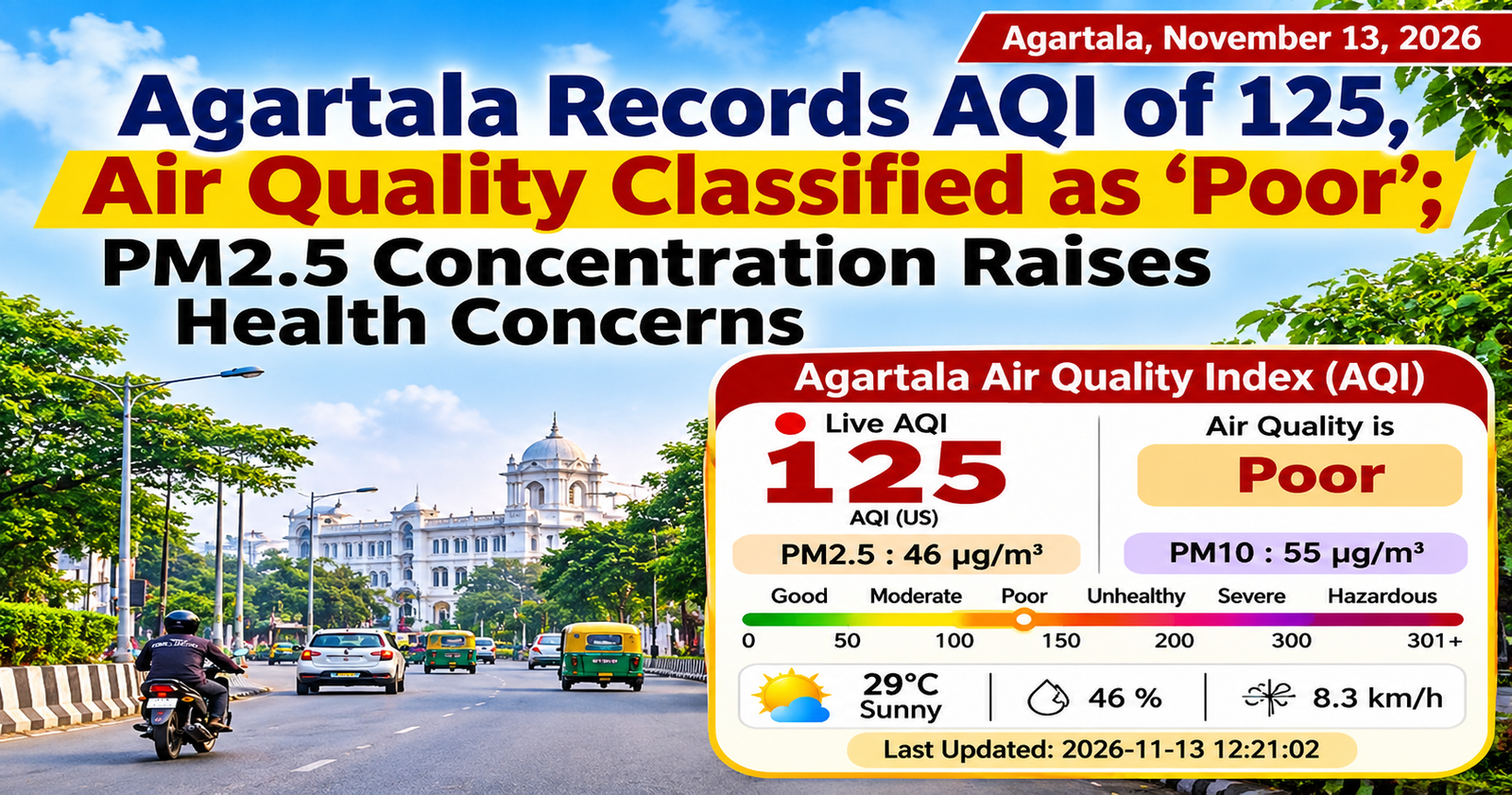
Air pollution has raised fresh concerns in Agartala after a real-time air quality report recorded an Air Quality Index (AQI) of 125 on November 13, 2026. According to AQI.in, the reading falls under the ‘Poor’ category on the US AQI scale. The report recorded PM2.5 concentration at 46 micrograms per cubic metre (µg/m³), while PM10 stood at 55 µg/m³. The AQI also increased from 123 to 125 within approximately one hour. Although this short-term change does not establish a long-term pollution trend, it highlights the need for regular monitoring and preventive action to protect public health.
Read More: ONGC Apprentice Recruitment 2026: 200 Agartala Seats
Key Facts About Agartala Air Quality
- Location: Agartala, Tripura
- Date: November 13, 2026
- Recorded AQI: 125 (US AQI scale)
- Air quality category: Poor (US AQI classification)
- PM2.5 concentration: 46 µg/m³
- PM10 concentration: 55 µg/m³
- Earlier AQI reading: 123 at 11:21 AM
- Latest update: 12:21 PM
- Temperature: 29°C
- Humidity: 46%
- Wind speed: 8.3 km/h
- Data source: AQI.in
Agartala AQI Rises from 123 to 125
The latest report showed an AQI of 125 at approximately 12:21 PM on Friday. One hour earlier, the reading stood at 123.
During this period, PM2.5 concentration increased from 44 to 46 µg/m³. However, PM10 levels declined from 65 to 55 µg/m³.
The weather report showed sunny conditions, a temperature of around 29°C and humidity of 46%. Wind speed stood at approximately 8.3 kilometres per hour.
These figures provide a snapshot of pollution levels during the afternoon. However, residents and authorities need longer-term monitoring data to understand whether Agartala faces a sustained rise in air pollution.
Important Difference Between US and Indian AQI Scales
The AQI.in report classified the reading of 125 as ‘Poor’ under the US AQI scale. However, India’s Central Pollution Control Board (CPCB) follows a different classification system.
Under India’s National Air Quality Index, the categories are:
| AQI Range | Indian Classification |
|---|---|
| 0–50 | Good |
| 51–100 | Satisfactory |
| 101–200 | Moderate |
| 201–300 | Poor |
| 301–400 | Very Poor |
| 401–500 | Severe |
Therefore, an AQI reading of 125 falls under the ‘Moderate’ category on India’s official scale, not ‘Poor’.
This distinction matters because different countries use different AQI calculation methods and health classifications. Residents should check the applicable Indian AQI reports when assessing local air quality.
Why PM2.5 Pollution Raises Health Concerns
PM2.5 and PM10 are two major indicators of particulate air pollution.
PM2.5 refers to extremely fine particles measuring 2.5 micrometres or less. These particles can travel deep into the lungs and may enter the bloodstream.
PM10 includes particles measuring up to 10 micrometres. Road dust, construction work and other airborne materials often contribute to these particles.
The main concern with PM2.5 is its small size. People may breathe these particles even when the sky appears clear.
Prolonged exposure can worsen asthma, trigger breathing difficulties and increase respiratory and cardiovascular health risks. Children, elderly people and individuals with existing heart or lung conditions face greater risks.
What Is Causing Air Pollution in Agartala?
Agartala has traditionally been known for its greenery and relatively compact urban landscape. However, increasing urban activity can affect its air quality.
Several everyday activities may contribute to pollution:
1. Vehicle emissions: Increasing numbers of cars, buses, trucks, auto-rickshaws and two-wheelers release pollutants. Traffic congestion can further increase people’s exposure to exhaust fumes.
2. Road dust: Damaged roads, uncovered construction materials and roadside excavation can release dust into the air.
3. Construction activities: Building projects and demolition work can increase airborne dust, particularly when workers fail to cover sand, cement and other materials.
4. Open waste burning: Burning garbage, plastic and dry leaves releases smoke and harmful pollutants.
5. Diesel generators: Generators and emissions from commercial establishments may also contribute to local air pollution.
However, the exact contribution of each source to Agartala’s current AQI requires scientific assessment.
What Can Authorities Do to Improve Agartala’s Air Quality?
The Agartala Municipal Corporation, Tripura State Pollution Control Board and Traffic Department can work together to develop a practical clean-air strategy.
Regular road cleaning, mechanical sweeping and controlled water sprinkling in dusty areas can help reduce airborne particles.
Authorities should also enforce dust-control rules at construction sites. Builders and contractors must cover sand, cement and other materials during storage and transportation.
Furthermore, municipal authorities should prevent open garbage burning and improve waste collection and disposal systems.
Better traffic management, organised parking and improved public transport can reduce congestion and unnecessary vehicle emissions. Regular vehicle pollution checks should also remain a priority.
The authorities should establish reliable air quality monitoring stations at important locations across Agartala. Regular public reports would help residents understand pollution levels in different neighbourhoods.
Citizens Also Have a Role in Controlling Pollution
Government action alone cannot solve the problem. Residents can also help improve the city’s air quality through simple daily habits.
People should avoid burning household waste, maintain their vehicles properly and use public transport whenever possible.
Schools, colleges, local clubs and community organisations can organise awareness programmes about air pollution and environmental protection.
Residents should also protect existing trees and green spaces while supporting plantation drives in residential areas, parks and along roads.
Why Agartala Needs a Long-Term Clean Air Plan
Agartala serves as Tripura’s administrative and commercial centre. Its growing population, transport network and construction activities make environmental planning increasingly important.
For a city in Northeast India known for its natural greenery, protecting clean air should remain a major development priority.
Urban progress should not depend only on new roads, buildings, flyovers and streetlights. Clean air, safe drinking water, green spaces, proper drainage and scientific waste management are equally important.
Frequently Asked Questions
1. What AQI did Agartala record on November 13, 2026?
Agartala recorded an AQI of 125 at approximately 12:21 PM, according to AQI.in.
2. Why did the report classify the AQI as Poor?
The website displayed the ‘Poor’ category under the US AQI scale. Under India’s CPCB classification, 125 falls in the ‘Moderate’ category.
3. What was the PM2.5 concentration in Agartala?
The report recorded PM2.5 at 46 µg/m³.
4. What was the PM10 concentration?
PM10 stood at 55 µg/m³.
5. What causes air pollution in Agartala?
Potential sources include vehicle emissions, road dust, construction activities, open waste burning and diesel generators.
6. Who should take extra precautions during periods of poor air quality?
Children, elderly people and individuals with asthma or existing heart and lung conditions should take additional care.
Conclusion
Agartala’s AQI reading of 125 has highlighted the importance of monitoring air pollution in Tripura’s capital. Although the reading falls under the Moderate category on India’s official AQI scale, the recorded PM2.5 concentration deserves attention.
Authorities must strengthen pollution monitoring, control road dust and enforce construction and waste-management rules. At the same time, residents should adopt cleaner habits and protect the city’s green spaces.
Preventing air pollution today will help Agartala maintain a healthier environment as the city continues to grow.
Also Read: Meghalaya JNC Opposes 232-Hectare Tribal Land Transfer