


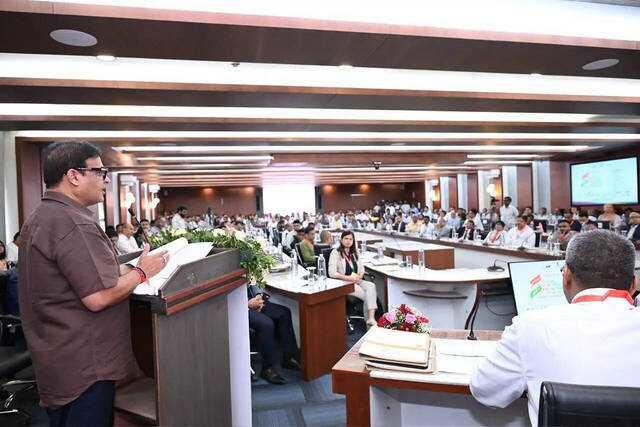
Assam Chief Minister Himanta Biswa Sarma has launched the North East Seva First Innovation Challenge 2026 (NESFIC) to promote innovation among young people. The initiative aims to connect young innovators with government departments, industries and institutions.
NESFIC 2026 was launched at the Assam Administrative Staff College in Khanapara on September 25. The programme was organised as part of the Seva Sankalp Abhiyaan 2026. It seeks to turn real-world problems into opportunities for technology, entrepreneurship and innovation.
The initiative will give young innovators an opportunity to work on problems faced by government departments, industries and citizens. It will also provide support for testing and developing their solutions.
50 Real-World Challenges Identified
A total of 50 real-world challenges have been identified under NESFIC 2026. Government departments have contributed 40 challenges. Industry organisations have contributed the remaining 10.
The challenges cover several sectors. These include healthcare, agriculture, flood management, urban infrastructure, energy and technology.
The programme is open to startups, companies, individual innovators, researchers, professionals and student teams. Higher education institutions across the country can also participate.
The challenges are based on practical problems. This means participants will not only develop ideas. They will also have the opportunity to test their solutions in real situations.
The initiative aims to create a direct connection between innovators and the organisations that need these solutions.
Focus on Healthcare and Maternal Care
Healthcare is one of the major areas covered by the innovation challenge.
The Health and Family Welfare Department has submitted eight challenges. Five of these focus on mothers and newborn children.
The challenges include early detection of pregnancy-induced hypertension. They also include improving access to obstetric ultrasound in remote areas.
Other challenges focus on infection control in labour rooms. Faster identification and referral of sick newborns is another priority.
Early detection of congenital deformities is also included.
The government hopes that technology can help frontline health workers identify risks earlier. This could be particularly useful in remote tea garden areas and riverine communities known as char areas.
Technology for Flood Management
Flood management is another important area under NESFIC.
Assam regularly faces challenges linked to floods and waterlogging. The innovation challenge seeks technology-based solutions that can improve early warnings and response systems.
The Science and Technology Department has proposed challenges involving satellite technology, drones and artificial intelligence.
These include crop-health monitoring and wetland mapping. Another challenge focuses on detecting encroachment on government land.
A digital twin for flood management and early warning is also among the proposed solutions.
The government believes that even a few additional hours of warning could help authorities protect people, homes and livelihoods during floods.
Tackling Urban Drainage Problems
The challenge also includes problems related to Guwahati’s urban infrastructure.
The Housing and Urban Affairs Department is looking for technology that can automatically identify blocked culverts. Such a system could help authorities respond to drainage problems more quickly.
Urban waterlogging remains a major concern during heavy rainfall. Technology that can identify blockages at an early stage could support faster action.
The initiative therefore connects innovation with problems that people encounter in their daily lives.
Helping Startups Find Their First Customers
One of the key objectives of NESFIC is to help young startups overcome difficulties in entering government markets.
New startups often have innovative products. However, they may lack the previous experience or financial credentials required under conventional procurement systems.
NESFIC seeks to create a different pathway. The government could become the first customer for successful innovations developed through the challenge.
This would give startups an opportunity to test their products. It could also help them gain practical experience and build a track record.
The programme is therefore designed to move ideas beyond the prototype stage. It aims to help successful solutions reach actual users.
150 Startups to Be Selected
The programme has a structured selection and development process.
According to the roadmap, 150 startups will be selected at the Northeast Innovation Conclave in Guwahati in late November. Three startups will be shortlisted for each of the 50 challenges.
Selected startups will receive idea-stage support under the Assam Startup Policy. They will also work closely with the departments or organisations that have submitted the challenges.
The startups will receive access to relevant data and testing sites. Mentoring support will also be provided through partner institutions.
Grants of Up to ₹40 Lakh
Financial support is another major component of NESFIC 2026.
At the Demo Day scheduled for February 2027, the selected startup for each challenge will receive a minimum viable product grant of ₹20 lakh.
Deep-technology solutions will be eligible for grants of up to ₹40 lakh.
The funding is intended to help innovators develop their solutions further. It can also support testing and the creation of products that are ready for real-world use.
New Partnerships to Strengthen Startup Ecosystem
Three Memorandums of Understanding were also exchanged during the launch.
One agreement was signed between IIM Kolkata Innovation Park and Assam Startup. It will support a three-year cohort-based accelerator programme for startups in Assam.
Another agreement between the Software Technology Parks of India and Assam Startup will facilitate the establishment of a Centre of Entrepreneurship in Guwahati.
The centre is expected to provide incubation facilities, emerging-technology laboratories and industry access.
A third agreement with India Accelerator proposes a fund pool of up to ₹100 crore for startups from the Northeast. Assam Startup will serve as the Enablement and Knowledge Partner.
Encouraging Students to Become Innovators
Sarma has also called upon educational institutions across the Northeast to participate in NESFIC.
Engineering colleges, polytechnics and ITIs are among the institutions encouraged to take part.
The initiative seeks to show students that innovation does not always begin in a large company. Ideas can emerge from college laboratories, workshops and even hostel rooms.
By connecting students with government and industry, NESFIC aims to give young people practical opportunities to solve real problems.
Assam Seeks to Build an Innovation Culture
The Assam government has positioned NESFIC as more than a conventional innovation competition.
The initiative seeks to create a complete pathway from identifying a problem to developing a solution. It also aims to provide testing opportunities, mentoring, financial support and potential customers.
For Assam, the programme could create stronger links between education, entrepreneurship, industry and government.
The initiative also reflects the state’s broader effort to build a stronger startup ecosystem in the Northeast. Its progress will depend on how many ideas can eventually move from development to actual implementation.
With NESFIC 2026, Assam is seeking to give young innovators a platform to develop practical solutions while creating new opportunities for entrepreneurship and technology-led growth.