


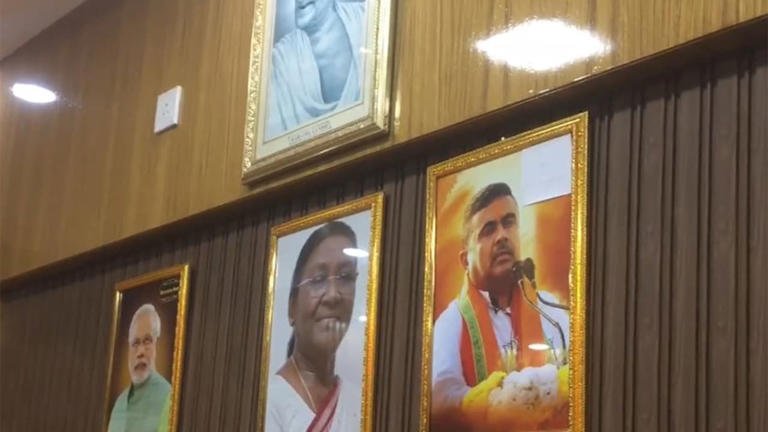
Workers of the Bharatiya Janata Party reportedly replaced the portrait of former Mamata Banerjee inside the mayor’s chamber in Asansol, triggering fresh political controversy in West Bengal.
The incident quickly drew strong reactions from both the BJP and the All India Trinamool Congress (TMC), with leaders from both parties accusing each other of politicising administrative spaces and attempting to dominate political narratives after the recent change in power in the state.
Read More: Assam Government Enforces Measures for Timely Pension Payments
According to local reports, BJP workers entered the chamber and replaced Mamata Banerjee’s portrait with photographs linked to the new political leadership and government administration.
The development sparked heated political debate and attracted attention across social media platforms and regional political circles.
Officials have not reported any major violence linked to the incident. However, political tensions reportedly increased following the controversy.
BJP workers remove Mamata Banerjee’s portrait
According to local political sources, BJP workers entered the mayor’s chamber in Asansol and removed the portrait of Mamata Banerjee that had remained displayed during the previous administration.
The workers then reportedly installed portraits associated with the new political leadership following the recent shift in power in West Bengal.
BJP supporters described the move as symbolic of political change and administrative transition after the party’s rise to power in the state.
Party workers also argued that government offices should reflect the current administration and leadership structure.
Videos and photographs linked to the incident circulated widely on social media, intensifying political discussion around the issue.
Observers noted that symbolic political gestures involving portraits and official spaces often carry strong political messaging in Indian politics.
TMC criticises BJP over incident
Leaders of the Trinamool Congress strongly criticised the incident and accused BJP workers of disrespecting democratic traditions and political decorum.
Several TMC representatives argued that the removal of Mamata Banerjee’s portrait reflected political intolerance and unnecessary provocation.
Party leaders also accused the BJP of attempting to erase the legacy and influence of the former Chief Minister through symbolic actions.
According to TMC representatives, administrative offices should not become platforms for political confrontation or partisan display.
Some opposition leaders further alleged that the incident demonstrated rising political aggression after the recent electoral developments in West Bengal.
Observers noted that political symbolism often becomes highly sensitive during periods of transition and power shifts.
BJP defends action as political transition
BJP leaders defended the action and stated that the changes reflected the new political reality following the change in government in West Bengal.
Party representatives argued that portraits displayed in administrative offices often change after shifts in political leadership and government administration.
According to BJP supporters, the move symbolised democratic transition rather than personal disrespect toward Mamata Banerjee.
Some BJP leaders also criticised the previous administration and claimed the party now wants to establish a new administrative culture in the state.
The ruling party maintained that the incident should not receive unnecessary political interpretation beyond its symbolic significance.
Political observers, however, noted that such actions often deepen political confrontation between rival parties.
Political tensions continue in West Bengal
The incident in Asansol reflects the continuing political tensions in West Bengal following the recent change in power in the state.
Political rivalry between the BJP and the TMC remains intense across several districts, with both parties frequently clashing over administrative, symbolic, and organisational issues.
Observers noted that symbolic actions involving portraits, names, and public spaces often become politically charged during transitions in government.
The latest controversy also reflects the broader struggle between the BJP and TMC over political identity, legacy, and public influence in the state.
Political analysts believe tensions may continue as both parties attempt to consolidate support and shape public narratives after the elections.
Several political controversies have already emerged following the formation of the new government.
Asansol remains politically important
Asansol continues holding significant political importance in West Bengal because of its industrial profile, urban population, and electoral relevance.
The city has witnessed intense political competition between the BJP and TMC in recent years, especially during Assembly and parliamentary elections.
Observers noted that political symbolism and administrative control in important urban centres like Asansol often carry broader political significance.
The mayor’s chamber controversy therefore attracted statewide attention because of the city’s strategic political importance.
Local political leaders from both parties reportedly held discussions with supporters following the incident.
Authorities continued monitoring the situation to prevent escalation and maintain public order in the region.
Social media reactions intensify debate
The incident quickly became a major topic of discussion on social media platforms.
Supporters of the BJP praised the move as a reflection of democratic change and political transition after the election results.
Meanwhile, TMC supporters criticised the action and described it as politically motivated and disrespectful toward Mamata Banerjee.
Several users debated whether portraits in government offices should reflect current leadership or remain politically neutral.
Political commentators also discussed the symbolic importance of portraits and imagery in Indian political culture.
Observers noted that social media has increasingly amplified local political incidents into wider state and national debates.
Experts discuss symbolism in politics
Political analysts explained that portraits and symbols often hold strong emotional and political significance in Indian public life.
Changes involving portraits in administrative offices frequently represent shifts in power, authority, and political messaging.
Experts noted that such symbolic acts can energise supporters but may also intensify rivalry and emotional reactions among political opponents.
Observers also pointed out that transitions in government often involve changes in official imagery, slogans, and symbolic representation.
However, analysts cautioned that excessive politicisation of administrative spaces can deepen political polarisation and distract attention from governance issues.
The Asansol incident therefore became more than a local controversy because of its symbolic and political implications.
Political atmosphere remains charged
The controversy surrounding the replacement of Mamata Banerjee’s portrait reflects the highly charged political atmosphere currently prevailing in West Bengal.
Both the BJP and TMC continue engaging in aggressive political messaging as they attempt to shape public perception after the state’s recent political transition.
While BJP supporters view the action as a symbol of change and new governance, TMC leaders see it as an unnecessary political provocation.
The incident has therefore become another flashpoint in the ongoing rivalry between the two major political forces in West Bengal.
As political tensions continue, observers expect further symbolic and administrative controversies to emerge in the coming months as both parties strengthen their political narratives and organisational presence across the state.
Read more: Arunachal Governor Parnaik, CDS Chauhan Discuss Border Security