


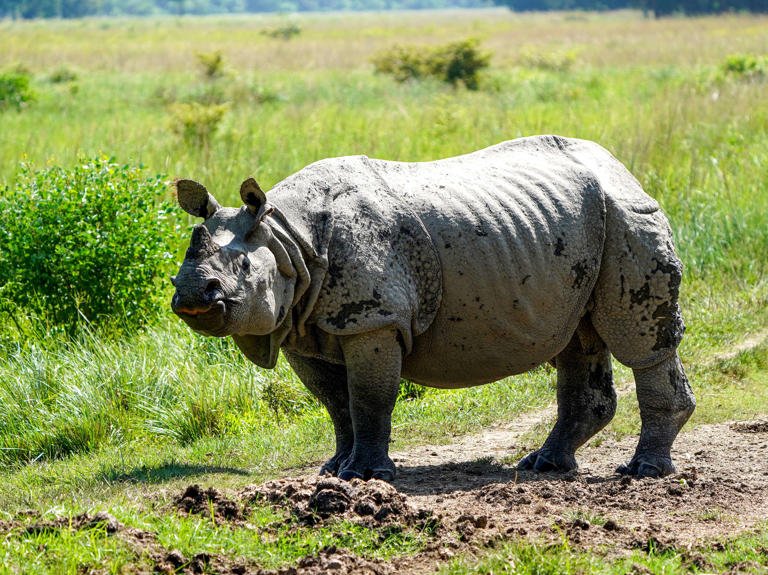
The Bihar government has stepped up plans to bring greater one-horned rhinoceroses back to the wild in the Valmiki Tiger Reserve (VTR).
The state plans to prepare a detailed rehabilitation and conservation programme for the reserve. Officials expect to complete the plan within the next one to two months.
Bihar Environment, Forest and Climate Change Minister Ramchandra Prasad shared the plan during a programme at Patna Zoo on World Rhino Day.
Rhinos May Come From Assam and West Bengal
Once officials finalise the plan, Bihar may source rhinos from Assam and West Bengal.
Both states have established populations of the greater one-horned rhinoceros. Assam remains a major stronghold for the species. Kaziranga National Park supports the world’s largest population of one-horned rhinos.
West Bengal also has established rhino populations in protected areas such as Jaldapara and Gorumara.
The proposed transfers would support Bihar’s efforts to restore rhinos in suitable habitats within VTR.
Valmiki Offers Suitable Rhino Habitat
Valmiki Tiger Reserve lies in Bihar’s West Champaran district along the Nepal border. The reserve contains grasslands, wetlands and other habitats that can support large herbivores.
Scientific research has previously identified VTR as a suitable location for greater one-horned rhino reintroduction. Researchers assessed several potential sites across the species’ former range and listed Valmiki among the priority locations for reintroduction.
The reserve already receives occasional rhinos from Nepal’s Chitwan National Park. A planned reintroduction could help establish a stronger population inside Bihar.
Conservation Plan to Guide the Project
The Bihar government wants experts to assess the reserve before officials move ahead with the transfers.
The proposed plan will consider habitat conditions, security and long-term conservation needs. Officials will also need to identify suitable areas where rhinos can live and breed safely.
Earlier conservation work at VTR has focused on habitat management and wildlife protection. A task force has also examined areas such as Kamali and Madanpur for possible rhino reintroduction.
Assam Has Experience With Rhino Translocation
Assam has extensive experience with rhino translocation programmes.
The state previously carried out rhino transfers under the Indian Rhino Vision 2020 programme. The initiative helped strengthen rhino populations in areas such as Manas National Park.
Assam’s forest department records several rhino translocation exercises involving protected areas such as Kaziranga and Pobitora.
This experience could provide useful expertise for future transfers to Bihar.
Project Rhino Gets National Support
The proposed VTR initiative comes as India expands its national focus on rhino conservation.
On World Rhino Day, Prime Minister Narendra Modi announced the launch of Project Rhino. The initiative will provide financial and technical support to rhino range states.
The programme will focus on protection, habitat management, genetic improvement and understanding rhino population dynamics.
The new initiative could support conservation programmes in Bihar and other states where rhinos have returned or remain protected.
Conservation Efforts Expand Beyond Assam
India’s greater one-horned rhino population has historically extended across parts of the northern and northeastern regions.
Today, major populations occur in Assam and West Bengal, along with protected populations in other parts of the country. Conservation programmes have also helped restore rhinos to areas where they had previously disappeared.
The reintroduction plan for VTR could strengthen this wider conservation network. It could also help restore a species that once occupied larger parts of the Gangetic floodplains.
VTR Prepares for Rhino Return
The Bihar government now plans to complete its detailed conservation and rehabilitation strategy before moving ahead with the proposed transfers.
If officials approve the plan, rhinos could eventually arrive from Assam and West Bengal. The project would mark another step in Bihar’s efforts to strengthen wildlife conservation.
The success of the programme will depend on suitable habitat, strong protection measures and long-term monitoring. Local community participation will also remain important for ensuring the safety of both rhinos and people around Valmiki Tiger Reserve.