


Every few decades, a country undergoes a shift so subtle that most people recognise it only in hindsight. India, in 2025, is living through one such transformation—a digital behavioural revolution that is not driven by government mandates or corporate strategies, but by everyday habits of ordinary citizens.
These habits—how we learn, shop, communicate, pay, research, travel, and consume information—are silently reorganising the architecture of India’s economy. What makes this fascinating is not the pace of change, but the direction of it: India is becoming a society where digital behaviour is no longer a convenience; it is a cultural baseline.
1. The Decline of Passive Consumption
For decades, information in India flowed in one direction. People consumed whatever was televised or published. But in 2025, passive consumption has sharply declined. Indians are actively choosing what to read, compare, verify, and understand.
Whether someone is exploring a health product, buying a phone, planning a trip, or learning a skill, the journey begins with digital self-education. Search patterns reveal that people increasingly want:
- deeper explanations
- comparative insights
- fact-backed content
- reliable data rather than loud opinions
This new behaviour has pushed digital platforms to shift from entertainment-driven content to utility-driven content.
Even financial knowledge—once considered “specialised”—is now approached with confidence. Many rely on a comprehensive equity research resource to investigate businesses, check fundamentals, or simply learn how companies operate. This is not investing behaviour—it’s curiosity behaviour.
India has become a nation that reads before it acts.
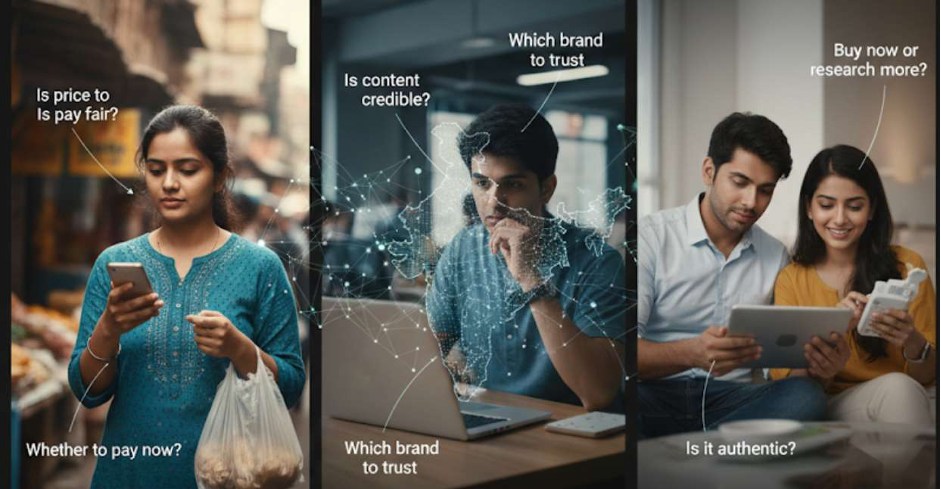
2. The Rise of the “Digital Micro-Decision” Economy
Every day, Indians make hundreds of micro-decisions:
- whether to trust a brand
- whether a price is fair
- whether a product is authentic
- whether content is credible
- whether to buy now or research more
Each of these decisions generates digital traces—searches, comparisons, scroll-time, clicks—that ripple across sectors. In 2025, India’s micro-decisions collectively influence:
- retail pricing
- product positioning
- advertising narratives
- credibility standards
- even the design of apps and websites
For example, analytics dashboards—like a publicly accessible data-insight dashboard—are used by curious users not for trading or speculation, but simply to understand how patterns form and how data behaves. This habit of observing before deciding reflects how digitally mature consumers are becoming.
Micro-decisions have silently become India’s biggest economic force.
3. Trust Has Become a Digital Currency
In earlier decades, trust was built through familiarity—your local shopkeeper, your known mechanic, your neighbourhood bank branch. In 2025, trust is digital-first.
Indians now evaluate trust in layers:
Layer 1: Information
Is the source transparent, consistent, and well-explained?
Layer 2: Verification
Do other sources confirm it?
Is it backed by data?
Layer 3: Experience
Does the digital journey feel secure, fast, and respectful?
Because of this shift, companies across sectors are rethinking:
- how they communicate
- how they design user journeys
- how they present facts
- how they handle customer communication
Trust has detached from physical familiarity and attached itself to clarity, simplicity, and accessibility.
4. The New Digital Skill: Pattern Interpretation
One of the most surprising behavioural shifts is India’s growing interest in understanding patterns:
- How consumer behaviour rises during festivals
- How prices move online
- How brands change strategy
- How trends emerge across apps
- How data changes week to week
People increasingly analyse information—not like analysts, but like observant citizens who want context behind what they see online.
From fitness to shopping, entertainment to education, people instinctively recognise:
- spikes
- slowdowns
- cycles
- momentum
- sentiment shifts
This behaviour—pattern interpretation—is shaping career choices, content consumption, personal finance, and decision-making. It is transforming India into a nation of independent interpreters, not passive receivers.
5. The Social Shift: Digital Communities Over Geographical Communities
India’s identity used to be shaped by the neighbourhoods people lived in. In 2025, identity is increasingly shaped by digital communities people join.
People connect around:
- interests
- professional goals
- hobbies
- learning objectives
- entertainment genres
- health and fitness
- financial awareness
Your closest community may no longer be within 500 metres of your home, but on a platform you log into daily.
This has reshaped:
- how support systems form
- how people collaborate
- how recommendations spread
- how cultural trends evolve
Digital communities have become the new towns and cities where people “live” intellectually.
6. The Frictionless Mindset
A defining characteristic of Indian consumers in 2025 is the intolerance toward friction. Whether it is long checkout processes, confusing information, hidden charges, slow websites, unclear explanations, or inconsistent interfaces—people abandon anything that wastes their cognitive energy.
This has resulted in companies optimising relentlessly for:
- speed
- clarity
- minimal steps
- transparent design
- intuitive interactions
The mindset is simple:
If it isn’t frictionless, it doesn’t deserve my time.
7. India’s Digital Evolution Is Becoming India’s Economic Edge
The cumulative effect of these behavioural changes is profound:
- Businesses are forced to innovate faster.
- Transparency is becoming non-negotiable.
- Consumers demand fairness, clarity, and accountability.
- Education ecosystems are expanding digitally.
- Data literacy is rising at an unprecedented rate.
India is not growing because of technology alone—it is growing because people are learning to use technology intelligently.
This is the real story of 2025: the rise of a digitally aware population that makes smarter decisions, demands better experiences, and pushes businesses to evolve.
Conclusion
India’s digital transformation is not just technological—it is behavioural. The apps we use, the dashboards we explore, the content we consume, and the decisions we take are collectively reshaping the country’s economic DNA.
From micro-decisions to digital trust, from pattern-reading to frictionless expectations, Indians are rewriting how consumers behave in a modern economy.
And the most remarkable part?
They’re doing it quietly—one tap, search, click, comparison, and curiosity-driven moment at a time.