


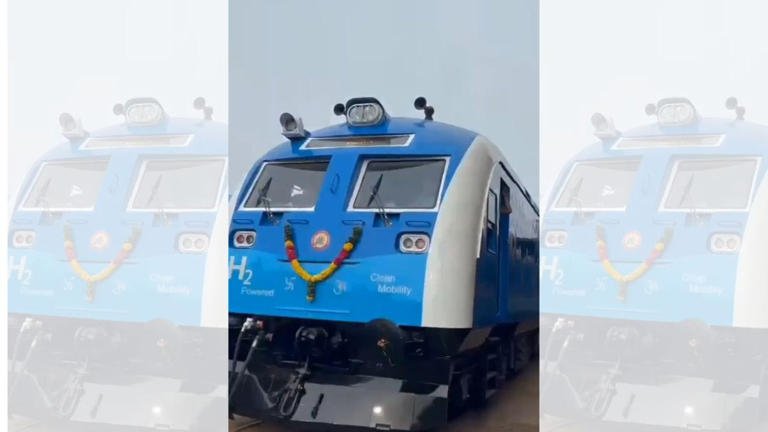
The Indian Railways is ready to enter a historic era of clean energy. Prime Minister Narendra Modi is likely to inaugurate the nation’s first hydrogen-powered train on Jind-Sonepat route later this month. This launch marks a major milestone for the “Hydrogen for Heritage” initiative. It positions India as only the fifth country in the world to operate such advanced green technology. By replacing diesel with hydrogen, the government is taking a giant step toward its goal of Net Zero Carbon Emission by 2030.
Read More: The Revival of the 1950 Act: Assam’s New Tool to Expel Foreigners
The Significance of the Jind-Sonepat Route
The 90-kilometer stretch between Jind and Sonepat in Haryana will serve as the pilot track for this revolution. This specific route was chosen due to its suitability for testing new traction technology on a broad-gauge line. Unlike traditional trains, the hydrogen-powered train on Jind-Sonepat route will emit only water vapor and heat. This eliminates harmful pollutants like carbon dioxide and nitrogen oxides. Consequently, this project serves as a national model for sustainable and noise-free public transport.
Key Features and Technical Specifications
The new train-set is a marvel of indigenous engineering. It was developed by the Research Design and Standards Organisation (RDSO) and manufactured at the Integral Coach Factory (ICF) in Chennai.
- Configuration: The train consists of 8 passenger coaches with two Driving Power Cars (DPC) at each end.
- Speed: It can reach a top speed of 140 km/h, though it will likely cruise at 110 km/h during its initial runs.
- Capacity: The train can accommodate approximately 2,638 passengers per trip.
- Fuel Efficiency: It uses roughly 2 kg of hydrogen to cover 1 kilometer. A full tank of 360 kg can power the train for 180 kilometers.
Infrastructure: India’s Largest Hydrogen Plant
To support the hydrogen-powered train on Jind-Sonepat route, the government has established a dedicated hydrogen production plant in Jind. This facility features a 1-megawatt Polymer Electrolyte Membrane (PEM) electrolyzer. It can produce nearly 430 kg of green hydrogen daily. Additionally, the site includes a 3,000 kg storage capacity and high-pressure dispensers for fast refueling. This infrastructure was built through a successful collaboration with experts from Spain, ensuring international safety standards.
Advancing the “Hydrogen for Heritage” Vision
The launch of this pilot project is just the beginning. Indian Railways plans to introduce 35 similar hydrogen trains across various heritage and hill routes. These include scenic sections like the Kalka-Shimla and Darjeeling Himalayan Railway. By focusing on the hydrogen-powered train on Jind-Sonepat route first, engineers can gather vital data on performance and operational costs. This information will help refine future rollouts. Ultimately, these trains offer a cheaper alternative to expensive electrification projects on low-traffic branch lines.
Enhancing Passenger Comfort and Safety
Commuters on this route can expect a premium travel experience. The coaches feature a metro-style design with automatic sliding doors. For safety, the train will not depart the platform until all doors are securely closed. Inside, the environment is significantly quieter because hydrogen fuel cells operate with 60% less noise than diesel engines. Furthermore, the train includes modern amenities like digital passenger information displays and high-capacity air conditioning powered entirely by clean energy.
A Landmark for Atmanirbhar Bharat
The upcoming inauguration by PM Modi represents the spirit of “Self-Reliant India.” Developing hydrogen traction technology indigenously shows the country’s growing prowess in high-tech manufacturing. As the hydrogen-powered train on Jind-Sonepat route begins its maiden journey, it carries the hopes of a greener future. This project proves that modern infrastructure and environmental conservation can go hand in hand. For the residents of Haryana and the rest of India, this month marks the start of a cleaner, faster, and more sustainable way to travel.
Read More: Tripura CM Lays Foundation for New Heritage Village