


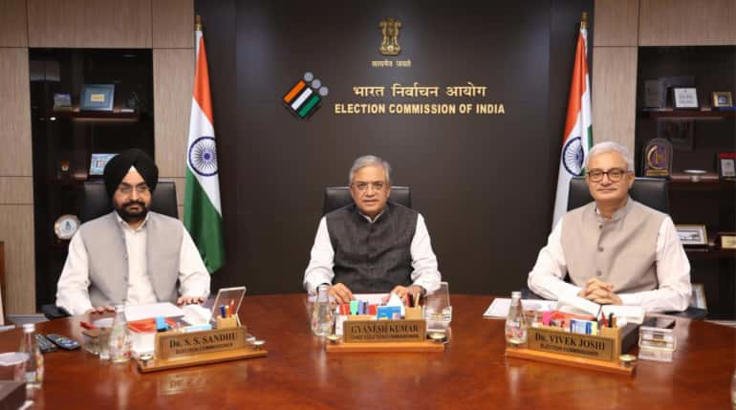
The INDIA bloc is preparing to approach the Supreme Court against the legal immunity granted to the Chief Election Commissioner (CEC) and Election Commissioners under a 2023 law. The proposed legal challenge comes amid growing protests against CEC Gyanesh Kumar and the Election Commission’s handling of electoral-roll revisions.
Congress, Trinamool Congress (TMC), Left parties, Rashtriya Janata Dal (RJD) and other opposition constituents are expected to jointly challenge the immunity provision in the Chief Election Commissioner and Other Election Commissioners (Appointment, Conditions of Service and Term of Office) Act, 2023.
The move forms part of the opposition’s wider campaign over the functioning of the Election Commission and the Special Intensive Revision (SIR) of electoral rolls.
What Does the 2023 Law Say About Immunity?
Section 16 of the 2023 Act provides legal protection to the CEC and Election Commissioners against civil or criminal proceedings for acts, things or words done or spoken while acting, or purporting to act, in the discharge of their official duties or functions.
The protection also extends to individuals who previously held these offices.
The provision does not provide unrestricted immunity for every action. Its application depends on whether the conduct falls within the discharge of official duties or functions.
Opposition parties have questioned the provision and argued that it limits accountability for the country’s top election officials.
The proposed petition will seek judicial scrutiny of this legal protection.
INDIA Bloc Leaders Discuss Legal and Political Action
The decision to pursue a Supreme Court challenge emerged during discussions among INDIA bloc leaders in New Delhi.
Senior advocate Kapil Sibal reportedly suggested that opposition parties jointly challenge the 2023 law.
The proposal received support from several opposition leaders, including West Bengal Chief Minister Mamata Banerjee.
Alongside the legal route, the bloc has announced a wider campaign involving public rallies, marches and district-level demonstrations.
The opposition has also planned a march by Members of Parliament to the Election Commission’s office.
The campaign seeks to raise concerns about electoral transparency, voter-list revisions and the independence of the poll body.
Protests Against Gyanesh Kumar Intensify
The proposed legal challenge comes as protests against Gyanesh Kumar spread across Delhi, Mumbai and other cities.
On October 2, the Cockroach Janta Party (CJP) organised a demonstration at Mumbai’s Shivaji Park, demanding Kumar’s resignation.
The party’s national convener, Abhijeet Dipke, announced that the organisation was prepared to continue its agitation for three months.
The protest focused on alleged irregularities in the SIR exercise and concerns about voter-list changes.
Several public figures and activists attended the Mumbai demonstration.
The Election Commission has maintained that decisions relating to the revision exercise were taken unanimously by the Commission.
AAP and Left Parties Lead Delhi Demonstrations
In Delhi, Aam Aadmi Party (AAP) leaders, Left organisations and student groups attempted to demonstrate near Jantar Mantar.
Delhi Police detained hundreds of protesters after authorities denied permission for the gathering.
AAP leaders Atishi and Saurabh Bharadwaj were among those detained. Other opposition leaders and student activists also joined the demonstrations.
Police imposed restrictions on public gatherings and deployed additional personnel around the protest site.
The demonstrators demanded Kumar’s resignation and raised concerns about the electoral-roll revision process.
The protests also affected public transport, with entry and exit facilities temporarily closed at several Delhi Metro stations.
Opposition Raises Concerns Over Special Intensive Revision
The SIR exercise has become a central issue in the dispute between opposition parties and the Election Commission.
Opposition leaders have alleged that the process could result in the exclusion of eligible voters from electoral rolls. They have demanded greater transparency and safeguards.
The Election Commission has defended its procedures and maintained that electoral-roll revisions follow established legal processes.
The controversy has also drawn attention to reported disagreements within the Commission over certain decisions.
Opposition parties have cited these developments while demanding accountability from the CEC.
However, allegations of wrongdoing remain contested and have not been established as judicial findings.
INDIA Bloc Plans Further Nationwide Agitation
The INDIA bloc has announced a series of political programmes to continue its campaign.
These include public rallies, district-level protests and a planned march to the Election Commission.
The opposition has also discussed wider electoral reforms, including changes to the 2023 law and concerns about electronic voting machines.
The proposed Supreme Court petition would add a legal dimension to the ongoing campaign.
As demonstrations continue, the dispute has brought renewed attention to the legal safeguards governing election officials, the independence of the Election Commission and the process of revising electoral rolls.