


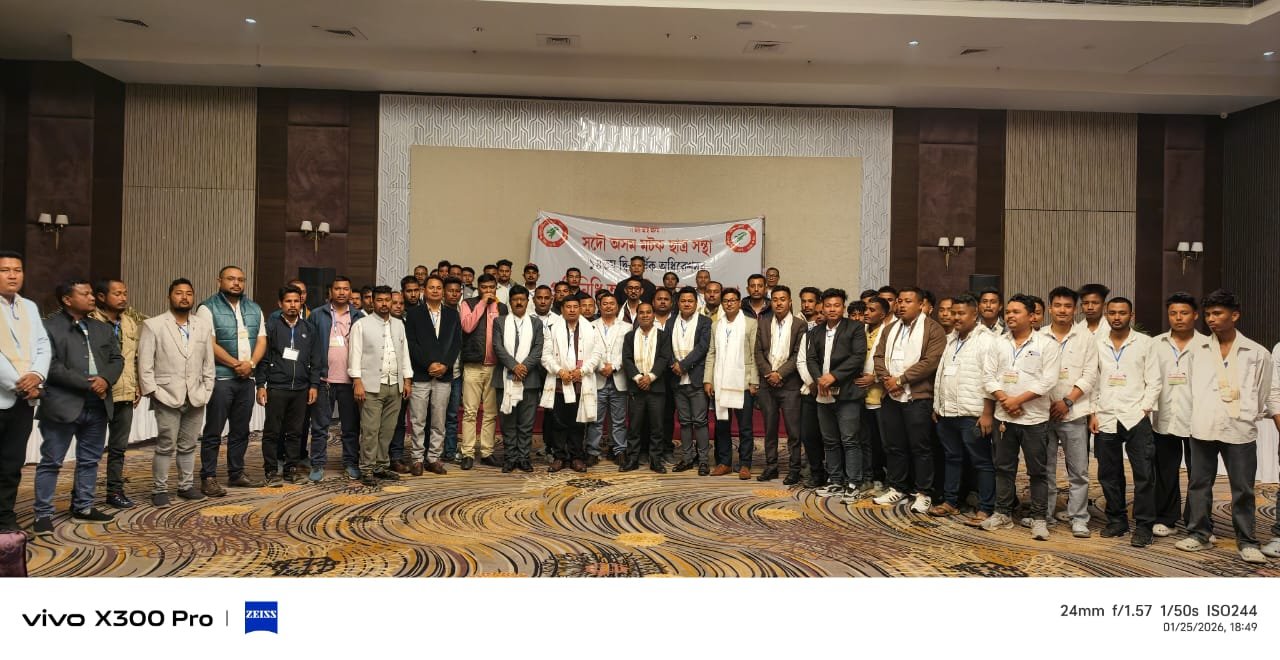
Guwahati: The All Assam Matak Students’ Union (AAMSU) marked a decisive turning point in its organisational journey by concluding its 14th biennial central conference with sweeping constitutional reforms, leadership re-election, and a clearly articulated vision for the socio-economic, educational, and cultural upliftment of the Matak community.
Highlighting the Union’s renewed priorities, Sanjoy Hazarika, President of the All Matak Students’ Union (AMSU), asserted that long-pending identity-based demands would now be pursued with greater resolve.
“The demand for Scheduled Tribe (ST) status for the Motok community and the revival, protection, and restoration of our historical monuments, heritage, and collective pride will remain our supreme focus in the coming days,” Hazarika told Northeast Now.
The day-long central delegate session, held in Tinsukia, saw the participation of over 500 delegates representing regional and branch units from Tinsukia, Dibrugarh, Sivasagar, and Namsai districts.
The conference was organised as part of the Union’s 29th Central Foundation Day celebrations and the office-bearers’ selection process held between January 23 and 25, 2026.
A major highlight of the conference was the adoption of key constitutional amendments aimed at strengthening organisational efficiency and expanding the number of office-bearers. In a significant identity-affirming decision, the delegate house unanimously resolved to formalise the name “All Assam Matak Students’ Union” at the state level and declared that the organisation earlier known as the All Assam Matak Students’ Union (AAMSU) will hereafter function as the All Matak Students’ Union (AMSU), signalling a unified and inclusive organisational identity.
The central delegate session was presided over by Central President Sanjay Hazarika, while the office-bearers’ selection meeting was conducted in a disciplined and transparent manner under the supervision of Founder General Secretary and present Chief Adviser Kalyan Bora.
Prior to the formation of the new committee, detailed activity and organisational reports of the outgoing body were placed before the house.
The financial report was presented by General Secretary Sulabh Jyoti Saikia, following which the existing committee was formally dissolved to pave the way for a newly constituted central body.
With unanimous consent from delegates of all participating districts, Sanjoy Hazarika was re-elected as President for the 2026–2029 term. Bitupon Duwara was appointed In-charge General Secretary, while Kalyan Bora was named Chief Adviser. Amit Rajkhowa and Padmalochan Baruah were inducted into the Advisory Council, along with other office-bearers, completing the formation of the new central committee.
Soon after assuming charge, the newly elected body adopted several far-reaching resolutions. Among the most significant was the decision to commission a systematic, expert-led study on the Motok community’s history, society, culture, politics, and economy, with plans to publish a comprehensive scholarly volume documenting these dimensions.
The Union also resolved to strengthen agriculture and cottage industries, placing special emphasis on women’s empowerment through self-help groups, skill-development programmes, and the proposed provision of traditional handlooms. For students, AMSU announced plans to introduce motivation, guidance, and counselling initiatives to support academic and personal development.
Reiterating its long-standing educational demands, the Union renewed its call for the establishment of a government university in Tinsukia and four government model colleges in Matak-inhabited areas, stating that these demands would be formally pursued with the Assam government.
The afternoon session witnessed the felicitation of senior journalists and eminent personalities from Tinsukia. Senior journalist Rupam Kakoti and noted Matak community figure Phatik Chandra Neog addressed the gathering, offering insights and constructive suggestions on long-term community development and social advancement.
Concluding the historic conference, the newly elected leadership reaffirmed its collective resolve to function with discipline, dedication, and unity, pledging sustained efforts to safeguard the Matak community’s identity while advancing inclusive growth, educational progress, and cultural resurgence in the years ahead.