


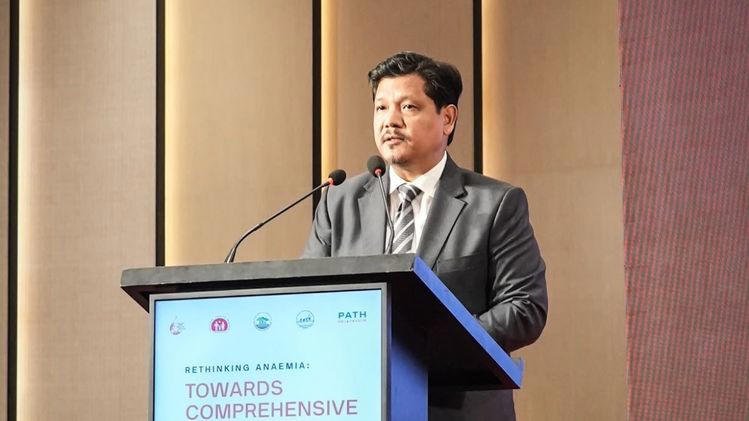
Meghalaya Chief Minister Conrad K. Sangma has called for regular reviews of critical health challenges, proposing that the state government take up one major health issue every six months to ensure focused action and measurable progress. The announcement came amid growing concerns over anaemia, particularly among women and children.
Sangma made the announcement on November 4 while addressing the inaugural session of the ‘Rethinking Anaemia: Towards Comprehensive Anaemia Care’ workshop in Shillong. The event brought together government representatives, medical experts and development partners to discuss ways to improve anaemia prevention, detection and treatment.
The Chief Minister said the government must move beyond routine implementation of welfare schemes and focus on identifying the root causes of public health problems. He stressed that coordinated and sustained efforts were necessary to bring meaningful improvements to people’s lives.
Government Plans Focused Health Reviews
Sangma said the Health Department should identify one major issue at a time and work consistently towards addressing it. He suggested that the government review important health concerns every six months or, at a minimum, once a year.
The approach aims to ensure that discussions and policy decisions lead to practical results. Instead of spreading resources across multiple issues without clear priorities, the government wants departments and partners to concentrate on specific challenges.
The Chief Minister referred to the Meghalaya Health Summit held last year, which brought together government departments, private hospitals, organisations and individuals to discuss healthcare development.
He said the initiative should continue through regular engagement and follow-up. He also urged participants not to treat the anaemia workshop as a one-day event but to translate its discussions into sustained action.
Anaemia Remains a Major Public Health Concern
Anaemia remains a significant health challenge in Meghalaya, especially among women, adolescent girls and children. The condition occurs when the body does not have enough healthy red blood cells or haemoglobin to carry sufficient oxygen to its tissues.
It can lead to weakness, fatigue and other health complications. Among pregnant women, severe anaemia can increase health risks for both mothers and babies. It can also contribute to low birth weight and affect children’s growth and development.
Sangma highlighted the connection between anaemia, maternal mortality, childhood stunting and child development. He said addressing the problem would require a comprehensive approach involving awareness, screening, treatment, nutritional support and regular follow-up.
The workshop focused on strengthening these interventions, particularly for adolescent girls and pregnant women. Experts and development partners were also encouraged to help extend healthcare knowledge and services to remote villages.
CM Calls for Action at the Grassroots Level
The Chief Minister emphasised that healthcare improvements must reach people at the community level. He urged medical experts and development organisations to take their knowledge beyond hospitals and institutional settings.
Sangma said even small initiatives could make a difference. These could include educating mothers in villages about child nutrition or conducting awareness sessions for schoolgirls on health-related issues.
He also highlighted the importance of identifying the actual reasons behind health problems before designing solutions.
Referring to Meghalaya’s maternal mortality reduction programme, launched in 2019, he explained that the government initially focused on institutional deliveries and awareness. However, officials later realised that geographical barriers prevented many women from reaching healthcare facilities.
Some villages were located two to three hours away from medical institutions. This showed that improving awareness alone would not solve the problem without better access to healthcare.
He stressed that policymakers must understand the underlying causes rather than focus only on visible outcomes.
Meghalaya Reports Improvements in Health Indicators
Sangma also highlighted improvements in several health indicators following sustained government interventions.
According to figures presented at the workshop, maternal deaths declined from 228 in 2021-22 to 106 in 2025-26. Institutional deliveries increased from 58.1 per cent under NFHS-5 to 65.6 per cent under NFHS-6.
The prevalence of child stunting also fell from 46.5 per cent to 36.8 per cent, while the state’s total fertility rate declined from 2.9 to 2.2.
The Chief Minister said these improvements reflected the importance of consistent efforts and cooperation between different organisations.
He also noted that Meghalaya allocates around nine per cent of its budget to healthcare. However, he stressed that financial investment alone cannot guarantee better outcomes. The government must ensure that resources reach the right areas and address the most urgent needs.
Coordinated Efforts Needed to Tackle Anaemia
Sangma called for stronger cooperation between government departments, healthcare professionals and development partners. He highlighted the role of organisations such as the International Fund for Agricultural Development (IFAD) in supporting development initiatives and reaching remote communities.
He said partnerships must focus on improving people’s lives rather than remaining limited to policy discussions or institutional meetings.
The proposed six-monthly review mechanism is expected to provide a more focused approach to Meghalaya’s public health priorities. Anaemia is among the major concerns requiring sustained attention, particularly because of its impact on women and children.
The Chief Minister stressed that meaningful change takes time and requires commitment beyond individual workshops or announcements. The success of the initiative will ultimately depend on whether regular reviews lead to stronger healthcare delivery and measurable improvements at the grassroots level.