


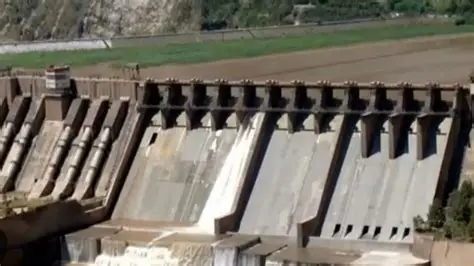
The Modi government has kicked off a mega dam project on the Chenab river after pausing the Indus Waters Treaty with Pakistan, marking a decisive shift in India’s water, energy, and strategic policy. The move, described by officials as long overdue, is expected to strengthen hydropower generation, improve water management, and assert India’s sovereign rights over its western rivers.
Senior government sources said the decision to begin the mega dam project on Chenab follows a comprehensive review of India’s obligations and constraints under the Indus Waters Treaty. With the treaty now paused, India has moved swiftly to utilise its full entitlements on the Chenab, a river that has remained underutilised for decades despite its immense hydropower potential.
The development signals a significant recalibration of India’s approach toward transboundary river management amid strained relations with Pakistan.
Read More: Tripura CM Saha Praises Budget Focus on All-Sector Growth
Mega dam project on Chenab enters execution phase
The mega dam project on Chenab has formally entered the execution phase, with preparatory construction activity and administrative clearances fast-tracked. Officials said the project will harness the river’s flow for large-scale hydropower generation while also improving flood control and water regulation.
The Chenab, one of the western rivers governed under the Indus Waters Treaty, offers high-altitude gradients suitable for power generation. However, India’s utilisation remained limited due to treaty restrictions and repeated objections from Pakistan.
With the treaty paused, authorities said India can now proceed without procedural delays that earlier stalled similar projects.
Indus Waters Treaty pause changes strategic equation
India’s decision to pause the Indus Waters Treaty with Pakistan has altered the strategic equation around river projects in Jammu and Kashmir. Officials said the treaty, signed in 1960, had long constrained India from fully exploiting rivers like the Chenab for storage-based projects.
According to sources, repeated disputes and objections raised by Pakistan over Indian hydropower projects prompted a reassessment of the treaty’s relevance under current geopolitical realities.
The mega dam project on Chenab is seen as the first major outcome of this policy shift.
Strategic importance of the Chenab project
The Chenab project carries strategic significance beyond power generation. Officials said the dam will strengthen India’s control over water flows in a sensitive border region and reduce downstream vulnerability during extreme weather events.
By regulating water discharge, the project can help manage floods during monsoons and ensure steady flows during lean seasons. This capability, officials said, enhances both civilian safety and strategic preparedness.
The mega dam project on Chenab also reinforces India’s long-term infrastructure presence in the region.
Boost to hydropower and energy security
Energy security remains a key driver behind the Chenab project. Officials said the dam will add substantial capacity to India’s renewable energy mix, reducing dependence on fossil fuels.
Hydropower from the Chenab will support grid stability and complement solar and wind energy. The project aligns with India’s broader push toward clean energy and climate commitments.
According to officials, the mega dam project on Chenab will generate thousands of jobs during construction and create long-term technical employment.
Economic and regional development impact
The project is expected to stimulate economic activity in Jammu and Kashmir by improving infrastructure, connectivity, and local employment. Officials said large projects often bring ancillary development such as roads, housing, and services.
Local businesses and contractors are likely to benefit from increased demand. In addition, improved power availability can attract industry and investment to the region.
The government said the mega dam project on Chenab forms part of a wider development strategy for border states.
Pakistan’s likely response and diplomatic fallout
Pakistan has consistently opposed Indian projects on the Chenab, citing treaty provisions. Analysts expect Islamabad to raise diplomatic objections and possibly approach international forums.
However, Indian officials said the pause in the Indus Waters Treaty gives New Delhi greater flexibility. They stressed that the project follows international engineering and environmental standards.
The mega dam project on Chenab is therefore likely to deepen diplomatic friction while reinforcing India’s negotiating position.
Environmental and safety considerations
Officials said environmental safeguards remain integral to the project. Detailed impact assessments, rehabilitation plans, and safety audits are part of the execution framework.
Authorities said modern dam design will minimise ecological disruption while maximising efficiency. Monitoring mechanisms will track seismic and environmental risks in the Himalayan region.
The government said development and sustainability must go hand in hand.
Political messaging from the Centre
The launch of the Chenab project also carries strong political messaging. The Modi government has repeatedly emphasised national interest, infrastructure development, and assertive diplomacy.
Supporters say the project demonstrates decisive governance and strategic clarity. Critics, however, caution about environmental risks and regional tensions.
Nevertheless, the mega dam project on Chenab has emerged as a symbol of policy resolve.
Broader implications for water policy
The project could set a precedent for future utilisation of western rivers. Experts said India may accelerate stalled projects on other rivers governed under the Indus framework.
Such moves could reshape South Asia’s water politics and redefine India’s approach to transboundary water agreements.
The mega dam project on Chenab thus holds implications far beyond a single river.
What lies ahead
Construction timelines and capacity details are expected to be announced in phases. Officials said inter-ministerial coordination will ensure smooth execution.
The government also plans regular reviews to address technical, environmental, and security challenges.
As work progresses, the project will remain under close domestic and international scrutiny.
Conclusion
The Modi government kicking off a mega dam project on the Chenab after pausing the Indus Waters Treaty marks a watershed moment in India’s water and infrastructure policy. The move reflects a strategic assertion of sovereign rights, a push for energy security, and a redefinition of regional water dynamics.
While the project promises economic and strategic gains, it also carries diplomatic and environmental responsibilities. As India moves forward, the mega dam project on Chenab will stand as a defining test of development, diplomacy, and long-term national planning.
Read More: Manipur Voice Highlights AI Sovereignty at UN AI Summit