

By Rohan Sharma, Executive Director — Reliable Power Systems, Faridabad
Two categories of electrical equipment have been fixtures on Indian factory floors for the better part of four decades: the servo voltage stabiliser, used to regulate supply voltage to sensitive loads, and the SCR or thyristor rectifier, used to generate the DC current that drives electroplating, anodising, chemical processing, and a range of other industrial applications. Both technologies are proven. Both are still being installed today. And both are being progressively displaced by IGBT-based solid-state alternatives — for reasons that are straightforward once examined.
This article does not argue that the older technologies are obsolete across the board. Context matters. What it does argue is that the decision between mechanical and solid-state power control deserves more deliberate attention than it typically receives at the procurement stage — because the performance gap has widened considerably as IGBT equipment costs have come down.
The Servo Stabiliser: Proven, But Limited
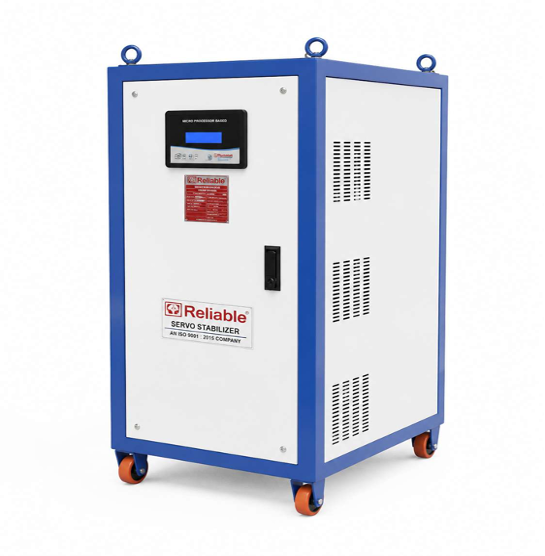
A servo voltage stabiliser corrects incoming supply voltage by rotating a motor-driven variac — a mechanically elegant solution that has served industry well. The limitation is inherent to the design. Correction is only as fast as the motor can physically move, which typically means response times in the range of several hundred milliseconds to a few cycles. For loads that can tolerate gradual correction, this is adequate. For loads that react to sub-cycle transients — precision CNC equipment, certain medical and laboratory instrumentation, high-speed packaging lines — it is not.
The mechanical nature of the system also means there is a maintenance schedule to keep. Rolling contacts wear. Motor brushes require replacement. In facilities running two or three shifts continuously, this adds up. Unplanned failures are uncommon, but not rare enough to be ignored entirely. The total cost of ownership, when maintenance and downtime are factored in, is higher than the purchase price suggests.
For loads that react to sub-cycle transients, a servo stabiliser’s response time — bounded by how fast a motor can move — is simply not fast enough.
None of this makes the servo stabiliser a poor choice categorically. For large, purely resistive loads with no sensitivity to transient variation, it remains a cost-effective option. The point is that it is not the only option, and it is not always the best one.
The Static Voltage Stabiliser: What Changes With IGBT
A static voltage stabiliser built on IGBT technology performs the same function — correcting supply voltage — but does so entirely through electronic switching, with no moving parts. The difference in response time is significant: a well-designed IGBT static stabiliser corrects voltage variation in under 20 milliseconds, fast enough to protect loads from virtually all practical transient disturbances before they register.
The absence of moving parts eliminates the maintenance requirements that accumulate in servo-based systems. There are no contacts to inspect, no motor windings to service, no mechanical wear to monitor. The system runs or it does not — and if it does not, diagnosis is electronic rather than mechanical, which is generally faster and less dependent on specialist intervention on-site.
Efficiency across the load range is a secondary but meaningful advantage. Mechanical correction losses are absent, and IGBT switching losses in a modern design are low enough that the stabiliser consumes measurably less power than its servo equivalent, particularly at partial load — which is where most industrial facilities spend most of their operating hours.
For facilities investing in sensitive new equipment, or upgrading existing infrastructure where servo systems are ageing out, the static stabiliser makes a compelling case on both performance and lifecycle cost.
SCR vs IGBT Rectifiers: The DC Output Story
On the DC side of the equation, the shift from SCR to IGBT-based rectifiers reflects a similar dynamic. SCR rectifiers convert AC to DC through thyristor switching — a robust, reliable technology that has powered Indian electroplating and chemical processing facilities for decades. The issue is the quality of the DC it produces.
Thyristor switching inherently introduces ripple into the DC output — periodic fluctuation in the current that the process load sees. In electroplating, ripple content in the DC supply directly affects the quality and uniformity of the deposited layer. Higher ripple means less consistent current density at the workpiece surface, which manifests as uneven deposit thickness, surface roughness, and in fine-tolerance applications, rejected parts. Managing this with passive filters helps, but does not eliminate the root cause and adds bulk and cost to the installation.
IGBT-based rectifiers switch at high frequency — typically 20 kHz and above — which produces a fundamentally cleaner DC output. Ripple content below 4% and input power factor above 0.93 across the operating range are achievable in a well-engineered design. For plating and anodising operations, these are not marginal improvements. Consistent, low-ripple DC means consistent process outcomes, less rework, and tighter quality control — which in precision manufacturing and aerospace anodising environments translates directly into yield and contract compliance.
The power factor advantage has its own implication. A facility drawing poor power factor from the supply incurs demand charges and may face penalties from the DISCOM under applicable tariff structures. Improving power factor through IGBT rectification reduces apparent power consumption and, depending on the tariff, reduces the electricity bill independently of any improvement in process efficiency.
In electroplating, ripple content in the DC supply affects deposit quality directly. IGBT rectifiers operating at 20 kHz produce a cleaner DC waveform than any passive filter arrangement can achieve downstream of an SCR unit.
Addressing Both Ends of the Power Chain
The facilities where both technologies deliver their full value are those running large, continuous DC process loads — electroplating shops, anodising lines, hard chrome plating, electrolytic chemical production. These facilities have two distinct power quality requirements: stable AC voltage on the incoming supply, and clean DC current at the process load. A weakness at either end affects process outcomes.
A facility that installs an IGBT rectifier but leaves the incoming supply uncorrected is solving half the problem. Grid voltage variation on the supply side feeds into the rectifier’s operating conditions and, depending on the design and load, can affect DC output quality even with a well-specified rectifier. Conversely, a facility with a servo stabiliser on the supply and a thyristor rectifier at the load has stable AC feeding a process that is still producing higher-ripple DC than it needs to.
Addressing both — a static voltage stabiliser on the incoming AC supply, an IGBT rectifier at the DC output — gives the process the electrical environment where it can perform consistently. This is not a configuration that requires special engineering. It is a practical combination that electroplating and anodising facilities in particular are well-positioned to benefit from.
ABOUT RELIABLE POWER SYSTEMS
Reliable Power Systems (RPS), based in Faridabad, designs and manufactures Power and Distribution Transformers (100 KVA–30 MVA), Special Purpose Transformers, HT and LT Automatic Voltage Regulators, HT Transformers with Built-in AVR, Static Voltage Stabilisers, IGBT Rectifiers, and Oil-Cooled Rectifiers for industrial and utility applications across India.
RPS also provides Annual Maintenance Contracts, Repair and Refurbishment, and Installation and Commissioning services — primarily on RPS-built equipment, and on third-party units of comparable construction. The service team is the engineering team. RPS operates across North India and undertakes projects pan-India.
Rohan Sharma, Executive Director | +91 93103 07186 | rpsrohan95@gmail.com
product-Static Stabilizer RPS MADE
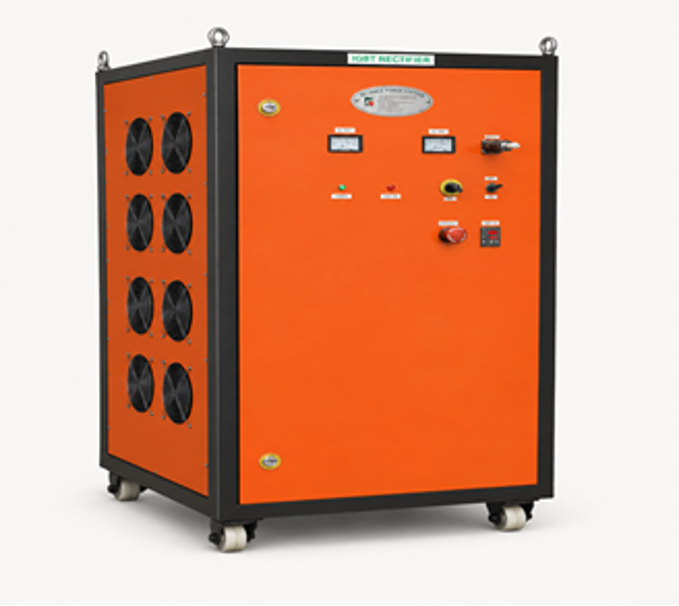
IGBT rectifier: product-igbt-rectifier-20V/8000A RPS MADE