


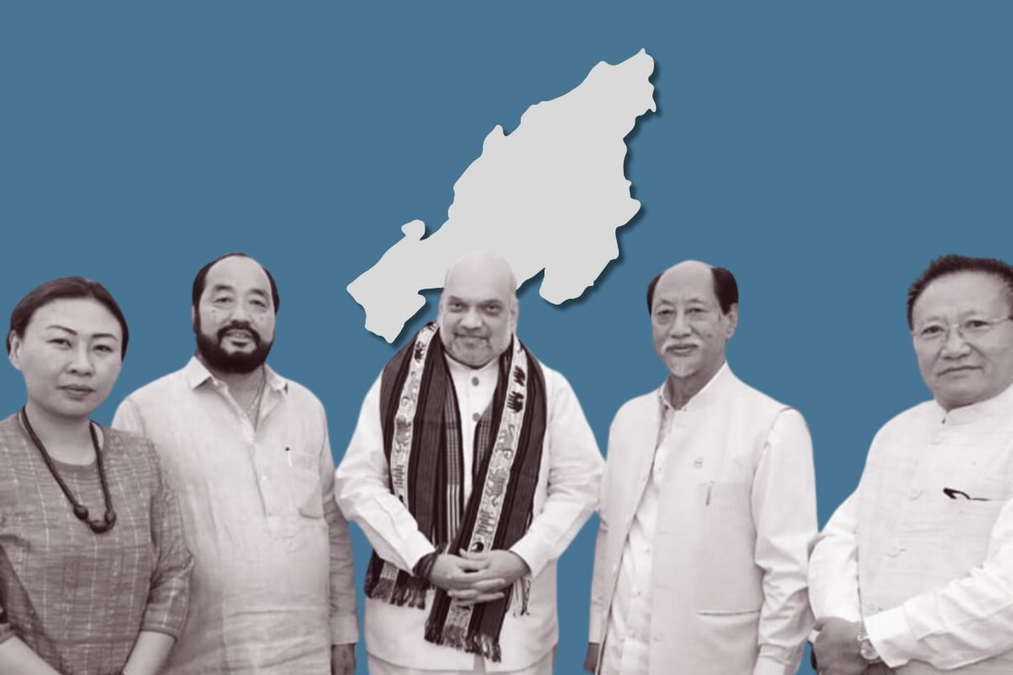
The Naga peace talks are entering another phase of political review as Nagaland’s Political Affairs Committee reassesses the state’s approach to the long-running dialogue with the Government of India. The review comes amid renewed efforts to elevate the process to a higher political level and establish a clearer roadmap toward an acceptable settlement.
The state government has repeatedly argued that the dialogue requires stronger political engagement from the Centre. Moreover, the Centre has recently moved toward a ministerial-level mechanism, although questions remain over its precise mandate and relationship with existing negotiating arrangements.
Consequently, the latest developments reflect both renewed political attention and continuing uncertainty surrounding the structure of the Naga peace process.
Real Student Review Who is Earning 2 Lakhs in a Month, Once Studied from Manish Mehta Academy
Naga Peace Talks Re-evaluation Gains Momentum
Nagaland’s Political Affairs Committee has played a central role in coordinating the state’s political position on the Naga issue. The committee includes senior political representatives and has been reviewing developments in the peace process while seeking a broader consensus within the state.
At a PAC meeting in August 2026, the committee reaffirmed its demand for a ministerial-level interlocutor. Government spokesperson K.G. Kenye said the meeting reviewed earlier resolutions and developments and agreed to maintain the position adopted during previous consultations.
The committee also resolved to engage stakeholders and work toward a roadmap for addressing the longstanding political issue. However, officials clarified that the August meeting itself was restricted to PAC members and did not include representatives of political parties.
The renewed review therefore represents an effort by the state government to consolidate its position before wider consultations. Furthermore, it follows earlier consultations involving tribal bodies, civil society organisations, churches, student organisations and political parties.
Centre Moves Toward Higher-Level Peace Dialogue
The question of who should lead the central government’s engagement has remained an important issue in the Naga peace process. Nagaland’s leadership has argued that a political or ministerial-level interlocutor would provide greater authority and help move negotiations toward a settlement.
Chief Minister Neiphiu Rio said in his August 15, 2026 Independence Day address that the Centre had constituted a committee under a Union Minister of State for Home Affairs to lead the Naga peace talks. He welcomed the development as a response to requests for the dialogue to be elevated to the ministerial level.
The announcement has nevertheless generated questions from sections of Naga civil society. The Concerned Naga Forum of Nagaland subsequently sought clarification about the new mechanism, including its mandate and its relationship with existing political agreements.
The forum specifically raised questions concerning the status of the 2015 Framework Agreement and the 2017 Agreed Position. These concerns remain part of the wider public discussion and should not be treated as evidence that either agreement has been replaced or cancelled.
Therefore, the emerging ministerial mechanism could become significant, but its practical role depends on further clarification from the Centre and the negotiating parties.
Existing Agreements Remain Central to Negotiations
The Naga peace process has developed through several rounds of negotiations and agreements involving the Government of India and different Naga political groups. The 2015 Framework Agreement with the NSCN (IM) remains one of the principal reference points in discussions surrounding the political settlement.
At the same time, the 2017 Agreed Position between the Government of India and the Working Committee of the Naga National Political Groups represents another important component of the wider dialogue process.
Nagaland’s Political Affairs Committee has repeatedly emphasised the need to bring different Naga political groups toward a common understanding. Its 2025 resolution called for all Naga political groups, with the support of tribal hohos, to work toward a common ground and shared political vision.
Moreover, the state government’s consultations have stressed unity among Naga society. The 2024 broad-based consultative meeting brought together tribal organisations, civil society groups, churches, NGOs, student bodies and political parties to discuss the political issue.
This wider participation remains important because the Naga political issue involves multiple organisations and competing positions. Consequently, any future settlement would require sustained political dialogue alongside efforts to build broader social acceptance.
The latest re-evaluation therefore concerns not only the Centre’s negotiating mechanism but also how different Naga stakeholders can contribute to a common political direction.
Naga Peace Talks Face Questions Over Next Roadmap
The current phase also comes as the Centre continues separate ceasefire and dialogue arrangements with different Naga political organisations. In September 2026, the Government of India and the NSCN-K (Niki) faction extended their ceasefire agreement for another year, from September 8, 2026, to September 7, 2027. The agreement reaffirmed the commitment to continue the process through peaceful dialogue and mutual understanding.
This development demonstrates that the broader Naga peace process involves multiple channels rather than a single negotiating track. Therefore, coordination between different agreements and political groups remains a significant challenge.
Nagaland’s government has consistently sought an early, honourable and acceptable settlement. Rio reiterated that position during his Independence Day address while welcoming the move toward ministerial-level engagement.
Meanwhile, questions from civil society about the mandate of the new central mechanism show that transparency around the next stage will matter. A clear understanding of who is negotiating, what existing agreements remain operative and how different groups will participate could help reduce uncertainty around the process.
Ultimately, the latest Naga peace talks re-evaluation is less about restarting negotiations from the beginning and more about determining how the existing dialogue can move forward with greater political direction and wider stakeholder confidence.
Conclusion
The Naga peace talks are undergoing renewed political review as Nagaland’s Political Affairs Committee seeks stronger engagement with the Centre and continues to advocate a ministerial-level mechanism. The state government has described the elevation of the dialogue as an important step toward an early and acceptable political settlement.
At the same time, questions remain about the mandate of the new Union Minister of State-led mechanism and its relationship with existing agreements. Civil society groups have called for greater clarity, while the state continues to emphasise unity among Naga political groups and broader stakeholders.
Therefore, the next stage of the Naga peace talks will depend on clearer institutional arrangements, continued dialogue among negotiating parties and broader efforts to build consensus around a durable political settlement.
FAQs
What is the Naga peace talks re-evaluation about?
The Naga peace talks re-evaluation concerns the structure and direction of the ongoing political dialogue, particularly the demand for stronger political-level engagement and a clearer roadmap toward settlement.
Why does Nagaland want a ministerial-level interlocutor?
Nagaland’s Political Affairs Committee believes a ministerial-level interlocutor would provide greater political authority and help advance the dialogue toward its logical conclusion.
What did Chief Minister Neiphiu Rio announce in August 2026?
Rio said the Government of India had constituted a committee headed by a Union Minister of State for Home Affairs to lead the Naga peace talks.
Are existing Naga political agreements being replaced?
There is no verified evidence in the sources reviewed that the existing agreements have been cancelled or replaced. Civil society groups have instead sought clarification about their status under the new dialogue mechanism.
Why is unity important in the Naga peace talks?
Nagaland’s Political Affairs Committee has repeatedly called for greater unity among Naga political groups and wider stakeholders because the peace process involves multiple organisations and interests.