


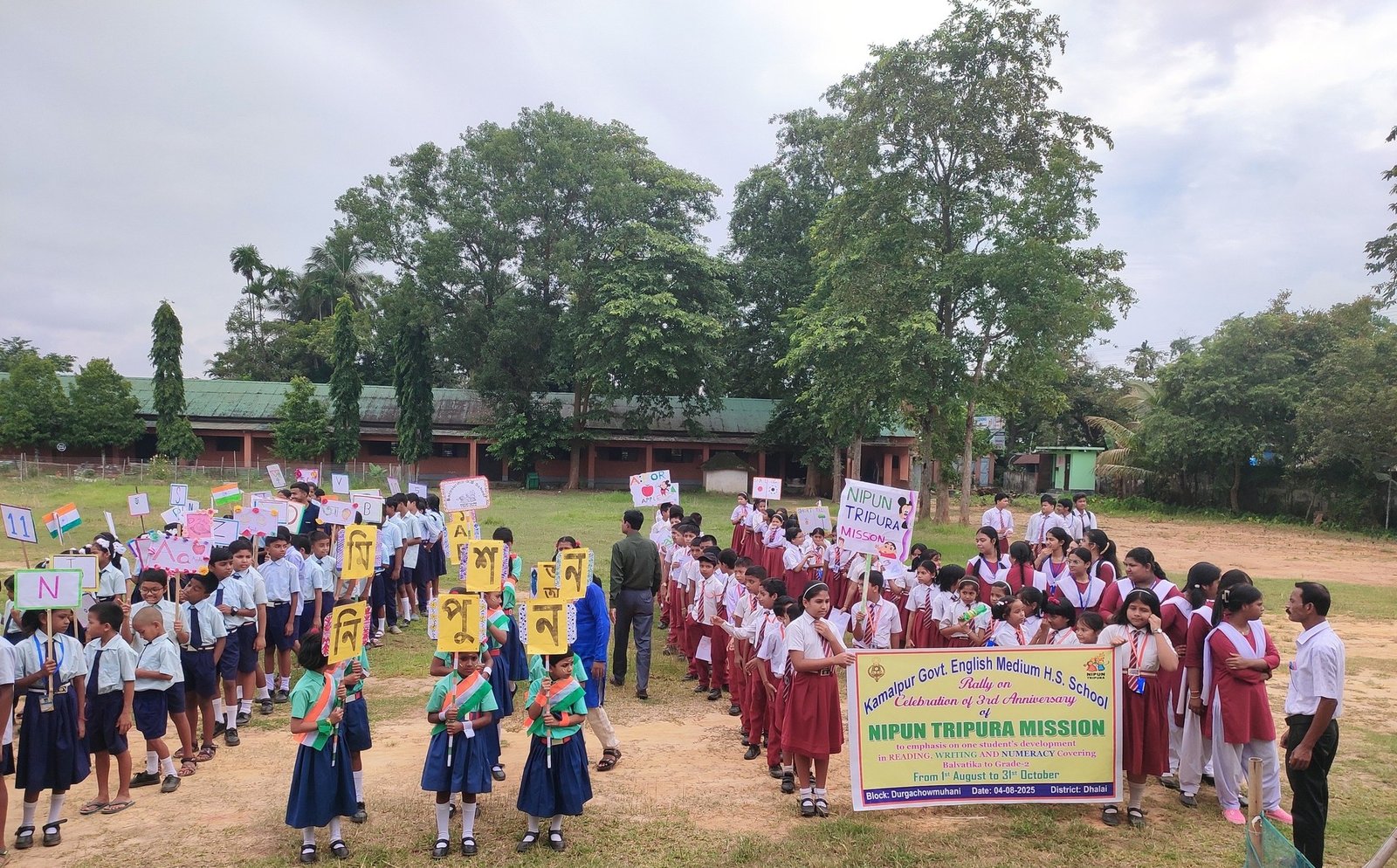
An NCERT visiting team has reviewed the implementation of NIPUN Tripura and observed classroom practices linked to foundational literacy and numeracy in the state. The assessment comes amid intensified school inspections across Tripura, where officials are examining teaching methods, student participation and the use of learning materials. NIPUN Tripura aims to strengthen foundational learning among children during the early years of schooling.
NIPUN Tripura Implementation Receives NCERT Attention
The NIPUN Tripura initiative has gained renewed attention following visits to schools and reviews of foundational learning practices. The programme represents Tripura’s state-level mission for Foundational Literacy and Numeracy (FLN), aligned with the objectives of the National Education Policy 2020 and the national NIPUN Bharat mission.
NIPUN Tripura focuses on helping children develop essential skills in reading, writing and basic mathematics during the foundational stage. According to the state’s official NIPUN framework, the mission aims to ensure that children acquire these core competencies by the end of Grade 2, while its broader learning targets extend through the foundational years.
The programme also promotes activity-based and play-based learning rather than relying exclusively on conventional classroom instruction. Furthermore, it encourages teachers to use children’s home or local languages, appropriate teaching-learning materials and regular assessments to understand individual learning progress.
The recent school-level reviews provide an opportunity to examine how these principles work in actual classrooms. Officials have been observing teaching practices, student engagement and the use of learning resources rather than relying only on administrative records.
However, the available reports do not provide a detailed public assessment from NCERT specifying that every school visited achieved a particular performance standard. Therefore, claims that the visiting team “heavily praised” all local schools should be understood carefully unless supported by a formal NCERT statement or written assessment.
NIPUN Tripura Schools Show Activity-Based Learning
School inspections in Tripura have increasingly focused on how teachers implement foundational learning programmes. During a recent inspection drive, education officials visited schools in Mandai block and reviewed classroom teaching, attendance, the learning environment and programmes including NIPUN Tripura, Vidya Setu and pre-primary activities.
Officials interacted with teachers and observed students during classroom activities. They also examined learning progress and participation, providing a ground-level view of how foundational learning strategies are being implemented.
Additionally, earlier surprise inspections placed particular emphasis on Teaching-Learning Materials, activity-based learning and NIPUN Corners. These resources are intended to make early-grade learning more interactive and give children opportunities to engage directly with learning materials.
NIPUN Tripura’s official framework similarly identifies play and activity-based pedagogy as an important part of the mission. It also calls for high-quality teaching-learning materials, teacher capacity building and regular tracking of children’s learning levels.
Therefore, classroom implementation remains central to the success of the programme. A policy framework can establish learning goals, but teachers and schools must translate those goals into daily classroom activities.
The inspection process also provides education authorities with information about areas requiring improvement. Consequently, visits by departmental teams and external academic institutions can contribute to identifying differences in implementation between schools and locations.
NIPUN Tripura Strengthens Foundational Literacy and Numeracy
The central purpose of NIPUN Tripura is to strengthen foundational literacy and numeracy during the earliest years of schooling. The state describes FLN as the ability of children to read with understanding and solve basic mathematical problems, skills that provide the foundation for later learning.
The programme follows the broader NIPUN Bharat framework introduced under the National Education Policy 2020. At the national level, NIPUN Bharat seeks universal foundational literacy and numeracy, with learning outcomes structured across the foundational stage. NCERT has an important role in developing and supporting curriculum and learning frameworks associated with these goals.
Tripura has adapted the national approach through its own state mission. The official NIPUN Tripura framework lists several objectives, including reading comprehension, understanding numbers and shapes, teacher training, learning assessments and community participation.
Moreover, the Directorate of Elementary Education has issued instructions for schools to display revised NIPUN Bharat learning targets and make key competencies and learning outcomes available in foundational-stage classrooms. The state has also directed schools to use local-language versions of relevant learning materials where appropriate.
Teacher preparation forms another important part of the initiative. The programme requires capacity building for teachers and education officials so that classroom instruction reflects the learning outcomes expected under the foundational-stage framework.
Similarly, NIPUN Tripura has incorporated monitoring mechanisms. Earlier government instructions required District Education Officers and inspectors to ensure that NIPUN learning targets were displayed, learning materials were available and NIPUN Corners were established in relevant classes.
These measures show that the initiative involves more than a single classroom teaching technique. It combines curriculum goals, teacher preparation, learning resources, assessment and administrative monitoring.
NIPUN Tripura Enters Wider School Monitoring Drive
The recent attention to NIPUN Tripura comes as the School Education Department has intensified inspections across government schools. The department has been examining classroom teaching, student attendance, learning outcomes and the implementation of various education programmes.
The inspections have also covered administrative offices and meetings with education officials. Therefore, the exercise is designed to examine both classroom-level implementation and the administrative systems supporting schools.
Earlier inspections reportedly covered more than 60 schools across different districts. Officials assessed classroom teaching, student learning outcomes, classroom management and the implementation of programmes including NIPUN Tripura, pre-primary education and activity-based learning.
Furthermore, recent surprise checks have examined whether teachers were using teacher-created teaching-learning materials and making effective use of NIPUN Corners. Such checks are intended to strengthen academic monitoring and accountability.
The inspection drive also creates a mechanism for identifying schools that may require additional academic support. Meanwhile, schools that demonstrate effective practices can provide examples for other institutions to adapt, subject to the requirements of their own classrooms and students.
NCERT’s wider work on foundational learning also places emphasis on early childhood education and FLN. In March 2026, NCERT organised a regional conference focused on Foundational Literacy and Numeracy and the well-being of children aged three to eight, bringing together education officials, researchers and practitioners from eastern and northeastern states.
Consequently, the continued monitoring of NIPUN Tripura fits into a broader national effort to improve foundational learning. The long-term measure of success, however, will depend on children’s actual learning outcomes and their ability to retain and apply foundational skills.
Conclusion
NIPUN Tripura continues to receive close attention as Tripura strengthens its focus on foundational literacy and numeracy. Recent school inspections have examined classroom teaching, student engagement, learning materials and the implementation of NIPUN-related activities.
The programme aligns Tripura’s foundational learning efforts with the broader NIPUN Bharat framework and the objectives of NEP 2020. While reports indicate positive attention toward implementation practices, a formal, school-by-school NCERT endorsement was not available in the sources reviewed. Therefore, the effectiveness of the programme should ultimately be assessed through verified learning outcomes, classroom observations and continued academic monitoring.
FAQs
What is NIPUN Tripura?
NIPUN Tripura is Tripura’s state mission for Foundational Literacy and Numeracy. It aims to help children develop essential reading, writing and basic numeracy skills during the foundational stage of education.
What does NIPUN Tripura focus on?
NIPUN Tripura focuses on reading with comprehension, writing, numeracy, activity-based learning, teacher capacity building, learning assessments and the use of appropriate teaching-learning materials.
Why are schools being inspected?
The School Education Department has intensified inspections to assess teaching-learning practices, student attendance, classroom environments, learning outcomes and implementation of programmes such as NIPUN Tripura and pre-primary activities.
What role do teaching-learning materials play in NIPUN Tripura?
Teaching-learning materials support activity-based and interactive classroom learning. Recent inspections have specifically examined whether teachers use teacher-made materials and NIPUN Corners to support foundational learning.
Has NCERT officially rated all inspected Tripura schools as successful?
The available sources confirm reviews of NIPUN Tripura and foundational learning practices, but they do not provide a formal NCERT statement declaring that every inspected school achieved a specific success rating. Therefore, broader claims of universal NCERT praise should be treated cautiously until an official assessment is published.