


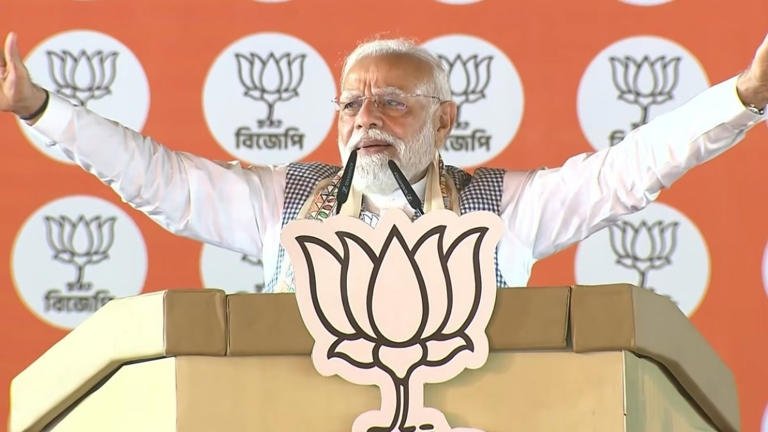
Modi West Bengal campaign is gaining momentum as Prime Minister Narendra Modi prepares to lead the BJP’s high-stakes electoral push in West Bengal. As elections approach, the party has intensified its outreach efforts. At the same time, leaders are focusing on voter engagement across districts. Therefore, Modi’s role has become central to the campaign strategy.
The BJP aims to strengthen its position in the state. Moreover, it wants to expand its voter base. Consequently, Modi’s rallies and roadshows will play a crucial role in shaping the political narrative.
Read More: Assam Votes: Himanta vs Gaurav Gogoi Contrast in Jorhat
Modi to Anchor BJP’s Campaign Strategy
Narendra Modi is leading the BJP’s campaign with a clear focus on visibility and voter connection. He is addressing multiple rallies across West Bengal. Additionally, he is interacting with different sections of society. As a result, the party expects to generate strong momentum.
His speeches focus on development, governance, and national progress. Furthermore, he highlights key achievements of the central government. Therefore, these themes form the backbone of the campaign.
Party leaders are carefully planning Modi’s schedule. They want to maximise outreach in both urban and rural areas. Consequently, each rally is strategically placed. This approach ensures wider coverage and stronger impact.
BJP’s Focus on Key Issues
The BJP is emphasising development as a core issue. It is highlighting infrastructure projects and economic growth. Moreover, the party is raising concerns about law and order. Therefore, these issues dominate campaign discussions.
Modi is expected to address these topics in his speeches. He will present the BJP as a party that delivers results. Additionally, he will outline future plans for the state. As a result, voters will hear a clear vision.
The party is also targeting specific voter groups. It is tailoring messages to address their concerns. For instance, youth-focused campaigns highlight employment opportunities. Similarly, rural outreach focuses on welfare schemes. Consequently, the strategy aims to cover all segments.
Opposition Prepares Counter Strategy
The All India Trinamool Congress (TMC), led by Mamata Banerjee, is preparing a strong counter strategy. The party is highlighting its governance record. At the same time, it is focusing on state-level achievements. Therefore, it aims to reinforce its support base.
TMC leaders are organising rallies and public meetings. They are directly engaging with voters. Moreover, they are responding to BJP’s criticism. As a result, the political contest is becoming sharper.
Other opposition parties are also active. They are presenting alternative narratives. Consequently, the electoral field remains competitive and dynamic.
Importance of West Bengal Elections
The West Bengal elections hold significant importance for all parties. For the BJP, the polls offer an opportunity to expand its presence. For the TMC, they represent a test of its dominance. Therefore, the stakes remain high.
These elections also have national implications. They reflect broader political trends. Moreover, they influence future strategies. As a result, leaders across the country are closely watching developments.
The outcome will shape governance in the state. Additionally, it will impact political alignments. Therefore, every campaign move carries weight.
Role of Campaign Rallies
Campaign rallies are playing a vital role in the election. They allow leaders to connect directly with voters. Modi’s rallies, in particular, are attracting large crowds. As a result, they create strong visibility.
These events energise party workers. Moreover, they reinforce support among voters. Therefore, rallies remain a key campaign tool.
The BJP is organising extensive roadshows and public meetings. Each event aims to strengthen its presence. Consequently, the campaign is reaching different regions effectively.
Voter Sentiment and Key Concerns
Voter sentiment in West Bengal is diverse. Some voters support the TMC’s governance. However, others are open to alternatives. Therefore, the election remains competitive.
Key issues include development, employment, and governance. Additionally, local concerns vary across constituencies. As a result, parties are adapting their strategies.
Modi’s campaign aims to address these concerns. His speeches focus on solutions and future plans. Consequently, they may influence voter perception.
At the same time, opposition leaders are presenting their own narratives. They are highlighting state-level achievements. Therefore, voters have multiple perspectives to consider.
What Lies Ahead
As the campaign progresses, political activity will intensify. Leaders will increase their outreach efforts. Moreover, debates and discussions will shape public opinion. Therefore, the coming days are crucial.
Modi’s role as the anchor of the BJP campaign highlights the importance of leadership. His presence is expected to influence voter engagement. Consequently, his rallies will remain in focus.
The Modi West Bengal campaign reflects the high stakes of the election. With strong competition and active participation, the polls promise to be closely contested. Ultimately, voters will decide the outcome and the future direction of the state.
Read More: Assam Voting 2026: What to Expect, Stakes and Result Updates