


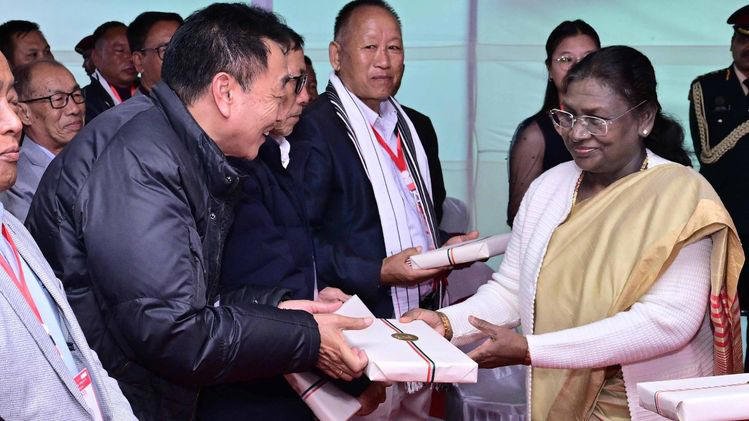
President Droupadi Murmu on December 12 met members of the Maram community in Senapati district, marking a significant engagement with Manipur’s only Particularly Vulnerable Tribal Group. The interaction took place amid a boycott of presidential programmes by displaced Kuki communities, lending political and social weight to the visit. During the meeting, community representatives highlighted the positive impact of government welfare schemes on their lives and livelihoods.
The President listened to their concerns, reviewed development outcomes, and commended the Maram people for preserving their cultural identity while making steady progress in education, agriculture, and health. The interaction underscored the Union government’s continued focus on inclusive development, especially for vulnerable groups in remote regions.
Read More: Mizoram Skill Competition 2025 Highlights Youth Talent
President Murmu’s interaction with the Maram community
During her visit to Senapati, President Murmu interacted closely with members of the Maram community, Manipur’s only recognised Particularly Vulnerable Tribal Group. Community elders and representatives shared their experiences and spoke about improvements in living standards over recent years.
They credited targeted welfare programmes for addressing long-standing gaps in healthcare, housing, and livelihood support. The President acknowledged their feedback and stressed that governance must remain responsive to the needs of the most vulnerable sections of society.
Her interaction focused on understanding ground realities rather than ceremonial engagement. Officials present described the meeting as an opportunity to assess the real-world impact of policies designed for marginalised groups.
Impact of PM-JANMAN and health schemes
Members of the Maram community highlighted the benefits of flagship schemes such as PM-JANMAN, which focuses on the development of Particularly Vulnerable Tribal Groups. According to them, the programme has improved access to basic infrastructure, housing support, and essential services.
They also spoke about the role of the National Health Mission in strengthening healthcare delivery. Improved medical access, regular health camps, and maternal care services have reduced vulnerabilities that once defined daily life in remote areas.
President Murmu took note of these outcomes and stated that such feedback validates the importance of focused and well-implemented welfare initiatives. She emphasized that government schemes must translate into measurable improvements at the grassroots level.
Recognition of cultural preservation and agriculture
The President praised the Maram people for preserving their cultural heritage despite the pressures of modernisation. She noted that maintaining language, traditions, and community practices strengthens social cohesion and identity.
She also acknowledged the community’s traditional agricultural techniques, which reflect sustainable practices suited to local geography. According to her, such knowledge systems deserve recognition and support, as they align with broader goals of environmental balance and food security.
By appreciating these efforts, President Murmu highlighted the value of indigenous knowledge in development planning. She encouraged the community to continue blending tradition with innovation.
Progress in education and social development
Education emerged as a key area of progress during the interaction. Community members shared that increased access to schools and government support has encouraged higher enrolment and retention rates among children.
The President welcomed these developments and stressed that education empowers communities to secure long-term growth and dignity. She urged families to continue prioritising education, especially for girls, as it plays a crucial role in breaking cycles of vulnerability.
She also noted that social development must move alongside economic support. Improvements in education, health, and awareness together create resilient communities.
Visit amid boycott by displaced Kuki communities
President Murmu’s visit came amid a boycott by displaced Kuki communities, who chose not to participate in presidential programmes due to ongoing tensions and displacement concerns. The absence highlighted the complex social and political situation in Manipur.
While the President’s interaction with the Maram community proceeded as scheduled, the broader context underscored the challenges facing reconciliation and inclusive outreach in the state. Observers noted that the visit reflected the government’s effort to continue engagement with vulnerable groups despite difficult circumstances.
The situation also drew attention to the need for sustained dialogue and trust-building across communities affected by unrest.
Union government’s focus on vulnerable groups
Through her interaction, President Murmu reiterated the Union government’s commitment to protecting and uplifting vulnerable communities. She stressed that development policies must prioritise those who face historical and structural disadvantages.
The visit reinforced the message that welfare schemes are not symbolic gestures but tools for empowerment. By engaging directly with beneficiaries, the President demonstrated an approach rooted in accountability and empathy.
Officials indicated that feedback from such interactions helps refine policies and improve delivery mechanisms.
A message of inclusion and continuity
President Murmu’s meeting with Manipur’s only vulnerable tribal group carried a broader message of inclusion and continuity in governance. Her engagement recognised progress while acknowledging the need for continued support and sensitivity.
Overall, the visit highlighted both achievement and challenge. While the Maram community showcased tangible gains through government schemes, the surrounding context reflected unresolved tensions elsewhere in the state. The interaction nevertheless reaffirmed the principle that inclusive development and direct engagement remain central to addressing vulnerability and fostering long-term stability in Manipur.
Read More: Assam CM Warns of Demographic Shift